Tag: Digital governance

  • The invisible infrastructure: who can enter the network | Radar Special N6A

    The invisible infrastructure: who can enter the network | Radar Special N6A

    A piece of content loses visibility, an account awaits verification, a payment stops. Behind these everyday actions works an invisible infrastructure of classifications, identities and authorisations. Radar Special N6A examines the network’s thresholds and people’s ability to understand and challenge what determines their access.

    The invisible infrastructure: who can enter the network

    Special Issue 6A | Part 1 | Approximately 6 minutes to read

    1. The thresholds we encounter every day

    We notice digital infrastructure especially when a step is interrupted. As long as a service recognises us and lets us proceed, its rules seem the natural background of the network. An error changes perspective: it becomes evident that someone established the access requirements and how to verify them.

    Thresholds are distributed. One system classifies content, another recognises an account, another authorises a transaction. They may belong to different organisations and use different criteria. For the person, the result is often a single experience: being able to enter or being left outside.

    Many controls make exchanges more reliable. The problem arises when we cannot understand which requirement is missing, who made the decision or how to correct an error. Looking at invisible infrastructure means making these steps visible too, before they are accepted as inevitable.

    2. A piece of content’s history and the truth of its account

    Provenance allows information about a file’s path to be reconstructed: who declares its creation, which tools were used and which changes are documented. These traces help ask more precise questions about the version we are observing.

    The C2PA standard associates provenance statements and digital signatures with content. The technical guidance on Content Credentials also explains that these data may be lost when a file passes through platforms or conversions that do not preserve them. A missing trace is therefore not enough to declare content false.

    Likewise, a verifiable history can accompany an incorrect statement. Knowing where a photograph comes from helps us examine it; understanding what it shows still requires context, sources and comparison. Provenance improves the conditions for verification, while judgement about content remains a separate task.

    📌 Did you know? — A signature answers a precise question

    A digital signature helps verify the link between a statement and its signer, as well as detecting certain alterations. It does not turn every sentence in the content into a correct fact. Reading a credential requires understanding what it attests and what remains to be checked.

    3. Being recognised and being able to act

    A digital identity is more than the name used to enter a website. It can gather attributes and authorisations: our role in a service, the requirements we meet and the operations we can perform. Recognising a person and allowing an action are therefore two different stages.

    The difference becomes clear with AI agents, systems that can use tools to execute a sequence of work. An agent may access information to prepare a proposal without permission to buy or send a payment. The delegation must specify what it permits, when it expires and how it can be revoked.

    If a single authorisation opens many operations, initial convenience can make an error’s effects harder to understand. Limits by activity, recipient and duration instead help preserve the link between the person delegating and what is executed. Control becomes practicable when the person knows where to intervene.

    4. The platform participates in the result

    A platform makes an encounter possible but also designs its conditions. It orders results, builds reputations, establishes categories and applies suspensions. These choices affect who is seen, who can work and who can receive payment.

    The Digital Services Act, the European regulation on digital services, also addresses this relationship. For certain restrictions imposed by hosting services it requires clear and specific reasons; for platforms subject to the relevant obligations it provides internal complaint systems. The procedure’s existence must be read together with its scope of application.

    The editorial question goes beyond the rule’s text. A route may be formally available yet difficult to use for someone lacking time, expertise or assistance. A large organisation and a small business face the same error with very different resources. The procedure’s design therefore contributes to the decision’s concrete weight.

    5. Transparency without permanent exposure

    Making a requirement verifiable does not always require making a person’s entire history available. Knowing someone is authorised for a specific operation differs from knowing every piece of their data. The first goal can be reached with more limited information.

    This is why it matters to ask which data is necessary, to whom it must be accessible and for how long. Broader collection may seem convenient for the system, but concentrates information and magnifies the effects of an error or improper access.

    Transparency should allow a person to understand the scrutiny they face. If it means only exposing the person more, it leaves opaque the very decisions needing explanation. The relationship becomes more balanced when whoever applies a rule must also make its reasons and effects clear.

    🧠 Radar Insight — The rule is common; the cost may differ

    A suspended account may mean a few hours of administration for a well-equipped firm and days of interrupted income for a small business. An accessible appeal must account for this distance: understandable instructions, a reachable contact and timescales compatible with the harm help make correction an effective possibility.

    6. The point where an error can be corrected

    When content, identities and payments connect, an error can cross several stages. A classification affects visibility; visibility changes work opportunities; an account restriction can stop an economic operation too. Understanding the effects requires being able to follow this chain.

    A reliable system must leave points for intervention: a specific explanation, a consultable record and someone able to review the decision. Identifying, authorising, executing and overseeing are different functions. Keeping responsibilities clear helps prevent a person from being passed indefinitely from one procedure to another.

    Invisible infrastructure can improve trust in the network if it makes exchanges verifiable and errors correctable. Its quality is also seen from the position of someone facing a closed door: they must be able to understand why, find a route to challenge it and obtain an answer with real consequences. Oversight becomes legitimate when it can itself be scrutinised.

    Read the full issue

    This reading presents some stages of Radar Special 6A. The full dossier contains the complete journey and in-depth discussions of the original edition (Part 1).

    © 2026 Barbara Gattobigio · Gruppo Radar
    Comprendere oggi. Costruire domani · by effettoantropico.life
    All rights reserved on original content. Free access does not authorise reproduction or republication without consent, except as permitted by law. Third-party materials remain the property of their respective owners. To share this issue, use the link to the article.

    Cover in focus

    Radar Special 6A, Part 1 — The invisible infrastructure. English report cover with official Gruppo Radar signature.

    Read this article in Italian

  • Blockchain and digital finance: understanding what changes | Radar Special N4

    Blockchain and digital finance: understanding what changes | Radar Special N4

    Blockchain and digital finance meet wherever value must be recorded, transferred and linked to someone accountable for it. Radar Special 4 guides the reader through terms often close together on a screen, yet very different in the rights and risks they carry.

    This guide is intended for information and education. Financial, legal or tax decisions require up-to-date sources and an assessment of the specific case with qualified professionals.

    Blockchain and digital finance: understanding what changes

    Special Issue 4 | July 2026 | Approximately 6 minutes to read

    1. A shared ledger preserves a history

    Think of several organisations needing to track the same steps. Each holds a ledger, and every discrepancy requires comparison. Shared infrastructure can reduce some of these steps and make the sequence of operations easier to verify.

    A blockchain organises records into blocks connected through cryptographic references. A hash is a digital fingerprint allowing changes to data to be detected. Copies of the ledger and the network’s rules help make subsequent alterations difficult or recognisable. The NIST guide, from the US National Institute of Standards and Technology, explains why this resistance should not be described as absolute immutability.

    A decisive distinction remains: recording a statement does not prove its content is true. If someone enters incorrect data about an asset, the ledger may preserve its history accurately while leaving the initial error unresolved. The connection to the real world still requires checks.

    2. The network has rules and people with influence

    Consensus is the process through which network participants establish which operations to accept. Systems may use computational work, committed capital or authorised parties. These choices change costs, timescales and the distribution of influence.

    An open network allows participation under its rules; a private or consortium network may require authorisation. Even in a distributed system, some parties may count more than others: those validating many operations, developing software, managing a widely used interface or providing infrastructure.

    Understanding a service therefore means following decisions: who can write to the ledger, who can update the program and who can interrupt an activity. The word “decentralised” becomes useful when it describes these relationships precisely, without replacing their verification.

    3. Custody begins with keys

    A wallet is the tool for managing keys and signatures needed to operate on assets recorded in the network. The image of a wallet helps orientation, but tokens are not files physically held inside the app: their state is represented in the ledger.

    The private key allows operations to be authorised. Protecting it and properly preserving recovery options is a concrete responsibility. In a self-custody system, losing access may make assets irrecoverable; relying on an intermediary changes the relationship and introduces the custodian’s responsibility.

    A simple app can make this difference almost invisible. Assessing it requires reading who controls access, how an incident is managed and which entity answers to the customer. These are conditions of the service even before they are interface choices.

    📌 Did you know? — The same price can conceal different relationships

    Directly owning a digital asset and buying an instrument tracking its price involve different rights, costs and forms of custody. The figure displayed on a screen may look similar; the legal and operational relationship must be read in the product’s documents.

    4. A token needs a bridge to legal rights

    Tokenisation represents an asset or right through a token on a digital platform. It can ease some transfers or connect several operations. The Bank for International Settlements also studies this possibility in traditional financial infrastructure, together with the conditions for final settlement of payments.

    An example helps: a project offers small digital units linked to a property. What does the buyer receive? A stake in a company, a right to some revenue or a different contractual right? Who manages maintenance, taxes and the sale of the asset? The token alone does not answer.

    The ability to resell is another question. Dividing value into smaller units may lower the entry threshold, but does not automatically create buyers, liquidity or an easy exit. Contracts, custody of the asset and the market must support what the digital representation promises.

    5. Automation executes errors too

    A smart contract is a program executing instructions when certain conditions occur. Decentralised finance, or DeFi, uses these programs for exchanges and other services. The advantage is programmable coordination of operations; the quality of the result depends on the written rules and incoming data.

    If a step requires the price of an asset outside the network, someone must supply it. If code contains a vulnerability, automatic execution may repeat it very quickly. Updates, administrative keys and program checks are also part of the service.

    A code review can reduce some risks without automatically covering economic or custody risks. Reading a check requires knowing which part was examined, in which version and with what limits. The word “audit” gains meaning through the work it describes.

    6. Stablecoins, listed products and rules are not the same thing

    A stablecoin aims to maintain a value linked to a reference, often a currency. The stability of the peg depends on its design: reserves, redemption possibilities, liquidity and the issuer’s responsibility. The name is not enough to describe how it will react in a difficult moment.

    An exchange-listed spot Bitcoin product instead offers exposure through units and intermediaries. The SEC order of January 2024 concerns the listing and trading of these products in the United States. It does not give the buyer direct control of bitcoin keys or remove market risks.

    MiCA organises part of the crypto-asset market and related services in Europe. The ESMA page helps consult the framework and registers. Understanding protection requires identifying the company, service and applicable rules: authorisation does not guarantee the value of every asset offered.

    7. Trust is read in the steps between parties

    Digital finance also includes institutional projects, payments and new ways to settle exchanges. No single architecture contains every answer. Each application changes the relationship between efficiency, access, control and responsibility.

    The Special’s journey therefore returns to practical questions: what value is recorded? Which right does it represent? Who holds access? And who can be held accountable for a problem? Following these stages makes a complex technology more understandable without reducing it to a promise of returns.

    The full dossier also contains a glossary, distinctions between network types and a reading of the digital euro. The framework is presented as an editorial snapshot of July 2026; a product’s conditions or a rule must always be checked again when supporting a present-day choice.

    🧠 Radar Insight — Follow value through to responsibility

    A verifiable record is one element of trust. It becomes more useful when the right represented, custody and the path for addressing an error are also clear. Oversight does not end where code ends.

    Read the full issue

    This reading presents some stages of Radar Special 4. The full dossier contains the complete journey and in-depth discussions of the original edition (July 2026).

    © 2026 Barbara Gattobigio · Gruppo Radar
    Comprendere oggi. Costruire domani · by effettoantropico.life
    All rights reserved on original content. Free access does not authorise reproduction or republication without consent, except as permitted by law. Third-party materials remain the property of their respective owners. To share this issue, use the link to the article.

    Cover in focus

    Radar Special 4 — Blockchain and digital finance, July 2026. English report cover with the official Gruppo Radar signature.

    Read this article in Italian

  • When AI learns to collaborate | Radar Special N4A

    When AI learns to collaborate | Radar Special N4A

    Collaborative AI begins to take shape when a conversation becomes work to carry forward together. Radar Special N4A (in Italian) follows this transition: from answers on a screen to tools that can read materials, prepare a result and return it to the person’s judgement.

    When AI learns to collaborate

    Special Issue 4A | 11 July 2026 | Approximately 6 minutes to read

    1. Saying what we want changes how we enter the work

    For many years, using a program meant learning its commands. Today we can often begin with a request: compare two documents, clarify a concept, prepare an initial structure. Natural language reduces part of the distance between a person’s intention and the computer’s operations.

    The change becomes clearer when an answer produces something to keep working on. A draft can be discussed; a comparison can reveal a difference; research can leave a list of points to verify. Value arises along the path connecting a request to a checkable result.

    This ease nevertheless requires care. A fluent sentence can seem better founded than it is. A system may have misunderstood a constraint, used an incomplete source or completed a step with inaccurate information. The natural interface helps us enter the work; scrutiny lets us understand whether that work has succeeded.

    2. From the ability to write to the possibility of acting

    A language model processes patterns learned during training and generates an answer from the available context. It can summarise, translate, propose code or connect information. When it builds a plausible answer without a sound basis, form can conceal the error.

    Tools add an operational layer. A system may receive access to search, files or a workspace and use the results to continue. An agent organises a sequence of actions towards a goal, within the tools and permissions assigned to it. OpenAI’s approach to building agents shows how search, computer use and execution records enter the same architecture.

    The questions to ask therefore change. Beyond an answer’s quality, the documents read, changes made and point at which an action must stop for checking matter. Good collaboration makes these steps understandable to those who will use the result.

    📌 Did you know? — Preparing a result and approving it are two stages

    A system can gather materials and build a draft while the person retains the choice of what will be used or communicated. Making this boundary explicit allows concrete activities to be delegated while preserving control over decisions that commit people and organisations.

    3. Dialogue becomes more continuous, but judgement remains necessary

    The Special originates on 11 July 2026, in the days when two announcements make this direction visible. GPT-Live, presented on 8 July, introduces voice interaction that can listen and speak simultaneously and delegate more complex tasks to a supporting model. Conversation gains continuity even while research proceeds.

    The GPT-5.6 launch on 9 July instead describes capabilities aimed at longer work, tool use and coordinating activities. These are two examples within the picture observed by the dossier, which also includes systems and approaches from other organisations.

    A more natural voice and more complex work can increase the sense of presence. Using these capabilities well requires continuing to distinguish what the system shows from what we can verify. Continuity of dialogue does not guarantee complete memory, factual correctness or understanding of people’s and users’ intentions.

    4. A clear assignment makes delegation useful

    Imagine a team needing to compare several versions of a document. The request can clarify which files to use, which differences to seek and how to present them. The system prepares the comparison; those familiar with the work check that no important step has been lost and decide which changes to accept.

    If the assignment remains vague, the system may fill gaps with assumptions. If it receives broader access than necessary, the possibility of an off-target intervention grows too. The goal, available materials and boundaries of action must therefore be proportionate to the task.

    Verification can take place along the way: a sample of extracted data, the source of a quotation, a version to compare before replacing a file. These checks help correct a deviation early and leave a readable record of what was done. The final result becomes easier to assess.

    5. The organisation determines how much value remains

    A system can accelerate an already clear process or make confusion faster. If documents are inconsistent, nobody knows which version to use and responsibilities remain undefined, an answer generated in seconds does not automatically solve the problem.

    For a business, the most useful test concerns a recognisable activity: how long it takes, which errors remain, how much review the result needs and who can correct it. Comparing these elements before and after a trial helps establish whether speed has become quality of work.

    Learning matters too. Using a draft to discuss alternatives can strengthen a skill; always accepting it without examination can reduce the practice of judgement. In study, research and writing, how the path is built changes what a person can learn.

    6. Collaboration has infrastructure and responsibility

    Behind a request are processors, memory, networks, data centres and cooling systems. The International Energy Agency connects AI development to electricity availability and infrastructure planning. An interface may be easy to use while the system supporting it requires resources and continuous work.

    These dependencies enter the terms of collaboration: which data can be read? Where is it processed? How much does continuing cost? And what happens if a tool stops? The answers depend on the service and context. Those introducing the system into their work must be able to understand them.

    Collaborative AI gains value when it expands a person’s possibilities and leaves visible the points where their judgement is needed. Framing a problem well, tracing a source, recognising an error and taking responsibility for a decision remain central skills. The dossier invites us to cultivate them as tools become more capable.

    🧠 Radar Insight — Quality includes the ability to intervene

    Collaborating also means being able to challenge a result, correct a direction and interrupt an action. These possibilities make the system’s autonomy usable. Final responsibility needs information and oversight tools as well as a good answer.

    Read the full issue

    This reading presents some stages of Radar Special 4A. The full dossier contains the complete journey and in-depth discussions of the original edition (11 July 2026).

    © 2026 Barbara Gattobigio · Gruppo Radar
    Comprendere oggi. Costruire domani · by effettoantropico.life
    All rights reserved on original content. Free access does not authorise reproduction or republication without consent, except as permitted by law. Third-party materials remain the property of their respective owners. To share this issue, use the link to the article.

    Cover in focus

    AI - Radar Special 4A — When artificial intelligence learned to collaborate, 11 July 2026. English cover with official Gruppo Radar signature.

    Read this article in Italian

  • Who authorises the machine to pay: delegating spending authority to AI agents | Radar Special N6B

    Who authorises the machine to pay: delegating spending authority to AI agents | Radar Special N6B

    Asking an assistant to find a theatre ticket or book a flight is a simple action. Authorising it to make the purchase takes us a step further: the machine must turn an intention into spending, within limits the person can understand and change. This is where the question of delegating spending authority to artificial intelligence agents begins.

    Who authorises the machine to pay: delegating spending authority to AI agents

    Special Issue 6B | 1 August 2026 | Approximately 5 minutes to read

    1. When a request becomes spending

    “Find a ticket to Rome, avoid travelling at night and do not exceed €180.” In everyday life, this is an ordinary, natural sentence. For an agent authorised to buy, it contains several decisions that remain open: which times to exclude, whether the price includes baggage and fees, which sellers to accept and how much the offer may change before confirmation must be sought again.

    Searching can help make these conditions visible. Payment turns them into consequences: a charge, a contract, a possible refund. This is why the ability to find a good offer and the authority to spend must be separately identifiable. An agent may understand a request without having received permission to carry it out. Clarity matters precisely where convenience risks concealing the delegation of authority.

    2. A mandate we can read

    Delegated spending authority becomes manageable when it takes the form of a mandate: a verifiable description of what a person authorises. It must connect an objective to an agent, set limits on amounts and recipients, specify a duration and establish which changes require a new decision. A generic “you decide” leaves too much room for interpretations that may become apparent only after the purchase.

    A spending limit alone does not resolve everything. A seller can be unreliable even within budget; an inexpensive product may have inadequate return conditions. The mandate must therefore remain tied to the context and provide for a stop when important information is missing. If a condition changes, the agent must be able to return the choice to the person instead of completing the process regardless.

    🧠 Radar Insight — Capability and authority

    Understanding what we want does not mean being authorised to buy it. Capability concerns the work the agent can do; authority concerns the power we entrust to it. Separating them makes it possible to recognise when a proposal is needed, when confirmation is required and when the process must stop.

    3. Where the payment rule sits

    Talking about programmable money can make different architectures seem identical. In an instrument with built-in restrictions, the constraint accompanies the value and limits its uses. In a conditional payment, by contrast, the service initiates the transfer when an event occurs: a delivery, a deadline or an approval. The money can remain ordinary while the rule belongs to the process that transfers it.

    The ECB explicitly distinguishes these two levels in the digital euro project: it rules out money with predetermined uses and allows for the possibility of conditional payments. The distinction helps us ask a concrete question: who defines the condition, who verifies that it has been met and who intervenes if the verification is wrong? Programmability moves a decision into an infrastructure; that decision continues to require accountability.

    4. A signature does not guarantee a good choice

    To accept an agent, a merchant must be able to recognise the origin of the request. Digital signatures help verify that a message comes from a recognised key and has not been altered. Payment credentials can also be restricted to an amount and a recipient. These are important protections because they reduce some of the ways delegated authority could be misused.

    Identity verification does not, however, assess whether the purchase is a good choice or demonstrate that the intention has been understood. A transaction can be technically authentic and wrong for the person’s needs. The agent, platform, shop and financial network control different stages: even if each sees only its own part, it must still be clear who takes up a problem and helps the person resolve it.

    5. The same transformation reaches the banks

    Programmability also enters coordination between financial institutions. The Bank for International Settlements’ Project Agorá explores wholesale cross-border payments through a prototype that brings together central bank reserves and tokenised commercial bank deposits. Tokenisation means digitally representing a form of value on an infrastructure capable of transferring it according to defined rules.

    Among the possibilities being studied is atomic settlement: the parts of a transaction are completed together or not at all. It is a way to address the risk of disconnected steps, but still requires choices about law, system governance and operational functioning. An institutional prototype, a consumer purchase and a digital currency project belong to different levels. Keeping them distinct helps us understand where innovation is taking place and which safeguards remain to be built.

    📖 Further reading — One chain, different responsibilities

    The mandate sets the boundaries of delegated authority; recognition verifies the agent’s origin; payment moves the value; recourse reopens a disputed decision. None of these stages automatically encompasses the others. The quality of the whole also depends on the connections between responsibilities.

    6. The right to reopen the decision

    Good automation preserves a way back. Before the purchase, it makes the amount, recipient, duration and shared data clear. During execution, it checks that the context has not changed. Afterwards, it retains a receipt that can connect the request, proposal, authorisation and result. Revoking delegated authority should not require people to reconstruct the entire technical chain on their own.

    These are design conditions proposed by the Radar analysis, to be checked in actual services. Not every infrastructure allows the same kind of refund or correction: this is precisely why the limit must be understood before entrusting the action to the agent. The machine can reduce the work needed to pay. The right to determine how much power it receives, stop it and ask an accountable person to examine an error must remain identifiable even when everything happens very quickly.

    Read the full issue

    This article presents selected passages from Radar Special 6B. The full dossier contains the complete discussion and further analysis from the original edition (1 August 2026).

    © 2026 Barbara Gattobigio · Gruppo Radar
    Comprendere oggi. Costruire domani · by effettoantropico.life
    All rights reserved on original content. Free access does not authorise reproduction or republication without consent, except as permitted by law. Third-party materials remain the property of their respective owners. To share this issue, use the link to the article.

    Continue reading

    Understanding Today. Building Tomorrow: the project and the Radar collection.

    The invisible infrastructure: who can enter the network.

    From chat to desk: governing the work of AI agents.

    Cover in focus

    Radar Special 6B — Who authorises the machine to pay, 1 August 2026. English report cover with official Gruppo Radar signature.

    Read this article in Italian

  • From answer to result: how we actually use artificial intelligence | Radar Special N7A

    From answer to result: how we actually use artificial intelligence | Radar Special N7A

    An answer arrives in seconds, orderly and convincing. Work begins when we read it: a source to check, a calculation to redo, an assumption to make explicit. Radar Special N7A explores what happens when we move from answer to result, and the importance of recognising its quality, limits and consequences.

    From answer to result: how we actually use artificial intelligence

    Special Issue 7A | 2 August 2026 | Approximately 5 minutes to read

    1. The work remaining after the answer

    Asking an assistant to summarise a document, organise data in a table or sketch a proposal can save time and help tackle work we had been postponing. The benefit is concrete, but that first version still requires our intervention: we must check the information, recognise what is missing and adapt it to the situation. Through this work, we can make it reliable enough to put in a document, use for a decision or make part of a service.

    On rereading the content, we may notice that a quotation is correctly reproduced but does not support what we are claiming, or that a table compares data calculated on different bases. Even a clear summary may have omitted the detail needed to decide. Verification helps establish which use the work suits and how to continue: correct it, discuss it with a knowledgeable person or stop if the elements needed to proceed are still missing.

    2. Using AI can mean many things

    Having a tool available does not yet tell us its place in our work. We may have tried it once, used it recently or use it regularly for a precise task. Even when it enters our habits, whether it is actually helping remains to be understood. Assessing this requires returning to the initial goal and considering the result’s quality alongside time spent, errors to correct and costs.

    These differences also matter when reading AI statistics. A questionnaire gathers what people say they do, while platform data describes activities within it; an experiment instead tries to measure an effect under defined conditions. Comparing two percentages therefore requires understanding who was observed, which activities counted as “use” and the period concerned. Otherwise, a difference arising from how data was collected may be attributed to people or organisations.

    📌 Did you know? — A percentage needs its question

    “Having tried an assistant” and “using it every week for work” do not measure the same behaviour. Even well-collected data loses meaning when separated from the population, time window and definition of use that produced it.

    3. Speed must be measured through to the end

    Experiments document real benefits in some tasks. In Noy and Zhang’s study of professional writing, generative assistance reduces time and improves the average quality of assessed texts. The conclusion concerns those activities and conditions: it is evidence of a possibility, to be tested in the concrete work where we want to introduce it.

    A different result emerges in the METR study of experienced developers and tools from the first half of 2025: in projects they knew well, access to AI lengthens task completion by around 19%, while participants continue to perceive a benefit. This limited finding does not describe every developer or subsequent models. It shows why generation time must be read alongside review and rework time.

    4. Expertise also recognises the limit

    The frontier of capabilities changes with the model, task, available data and environment. A system useful for an initial explanation can become less reliable when resolving an unusual case, interpreting a clause or understanding a structure we have not shown it. The answer’s fluency may remain similar even as its quality changes.

    Recognising this distance requires knowledge of the work. A knowledgeable person can choose a test: compare a source, redo a calculation, check a different example, verify a step with someone possessing the necessary experience, establish a clear process for study or an experiment. Formulating the request is fundamental, but must rest on a method. Informed use takes shape when we can explain why we accepted a suggestion and which checks allow us to trust it.

    5. What remains when assistance ends

    In learning, obtaining a good answer and building a personal capability are different outcomes. Help can replace the step we needed to practise or accompany us towards understanding it. The difference also lies in how the interaction is designed: explaining reasoning, leaving room for an attempt, comparing errors and trying again without assistance.

    The question therefore becomes concrete: after working with the tool, can we transfer the method to a new case? Can we recognise an error or explain a decision? Not every activity requires becoming independent in everything. But we need to understand which skills we want to retain and where delegation is a useful choice. The machine’s benefit can include time freed and the capability collaboration leaves us with.

    🧠 Radar Insight — The advantage that remains

    Assisted performance can be excellent without becoming learning. To understand collaboration’s value, we also observe what a person can explain, correct and repeat when the tool is unavailable. This test changes how help is designed.

    6. From adoption to a process that holds

    In an organisation, activating an AI function is only the beginning. Usable documents, defined access, people responsible for checking and a route for correction are needed. Time saved in one stage may be absorbed by other requests or new checks: recognising improvement requires observing the complete process, without confusing the number of answers with value produced.

    Radar’s reading proposes starting with bounded tasks and understandable criteria: which result we seek, which quality we consider sufficient, which errors matter and who is accountable for delivery. Available studies help with orientation but leave many questions open about benefits’ duration and distribution. Moving from answer to result lives in the human work that makes a proposal checkable, corrects it when needed and decides where it can actually be useful.

    Read the full issue

    This reading presents some stages of Radar Special 7A. The full dossier contains the complete journey and in-depth discussions of the original edition (2 August 2026).

    © 2026 Barbara Gattobigio · Gruppo Radar
    Comprendere oggi. Costruire domani · by effettoantropico.life
    All rights reserved on original content. Free access does not authorise reproduction or republication without consent, except as permitted by law. Third-party materials remain the property of their respective owners. To share this issue, use the link to the article.

    Continue reading

    Understanding Today. Building Tomorrow: the project and the Radar collection.

    Cover in focus

    Radar Special 7A — From answer to result, 2 August 2026. English report cover with official Gruppo Radar signature.

    Read this article in Italian

  • When AI becomes heavy infrastructure | Radar Weekly N4

    When AI becomes heavy infrastructure | Radar Weekly N4

    AI becomes heavy infrastructure when the work of models depends on servers, memory, energy and long-term investment. Radar Weekly N4, dated 11 July 2026, connects this material foundation to systems that act, network security and the consent of the people involved.

    When AI becomes heavy infrastructure

    Weekly Number 4 | Saturday, 11 July 2026 | Approximately 6 minutes to read

    The cloud keeps a name that suggests lightness, but its workings are anything but weightless: they require transformers, cables, cooling and industrial facilities. And when a model does more than answer and takes part in an activity, that weight becomes organisational too: we need to know what it can do, which data it encounters and who checks the result.

    The fourth issue continues the journey through the material weight of AI, the conditions of access to computing and the balance sheet of digital power. Now the question broadens: what changes when software organises work and its availability depends on heavy infrastructure?

    1. From an answer to work: who controls the steps?

    A correct answer does not complete a task. If a system has to work on files, consult tools or navigate an interface, the path it follows matters too. It must be able to distinguish what is authorised from what is not, keep a record of changes and stop when a human decision is missing.

    This is the transition to agentic systems: tools that can organise and execute a sequence of actions. Their usefulness is seen in results that can be checked, not in the impression that they do everything by themselves. A modified document, a test carried out and an error reported are different kinds of evidence from a promise of autonomy. The greater the ability to act, the more important it becomes to define the boundaries of the assignment.

    💡 Did you know? — Using an interface does not mean having a free hand

    Computer use means using a digital interface through actions such as selecting a command or filling in a field. The technical ability to click does not authorise every operation. Accessible data, permissions, checks and the stopping point must remain clear: a system can help carry out the work without deciding in the person’s place.

    2. Heavy infrastructure needs a place

    A data centre is not built simply by buying processors. A suitable site, an electricity connection, networks, permits, staff and construction time are needed. Announced capacity and capacity that can actually be used do not necessarily coincide. Between them lie construction sites, supplies and connections that have to work together.

    The issue reads large industrial projects through this distance. A long-term contract can make revenue and supplies more predictable, but it also creates commitments lasting beyond the moment of the announcement. Heavy infrastructure thus ties the economics of computing to the local area: grid availability, cooling, resource use and the distribution of costs.

    The International Energy Agency’s Energy and AI report, published in 2025, examines the relationship between data centres and electricity in greater depth. Understanding the change requires more than asking how much energy is needed in total. Where it is available, when, and with what consequences for other uses of the grid all matter.

    3. The processor can be left waiting: the role of memory

    A powerful chip can perform poorly if data arrives too slowly. The GPU, a processor suited to many calculations in parallel, needs memory and connections able to feed its work. HBM, high-bandwidth memory, meets this need: transferring large amounts of data quickly to the processor.

    The supply chain is therefore not a succession of brands to compare. It is a set of dependencies. Memory, component assembly, factories, energy and networks can become limiting factors even when the chip design is advanced. The term bottleneck describes precisely the stage that slows the others down: increasing capacity elsewhere is not enough to remove it.

    4. Capital finances construction; it does not guarantee the result

    Investment makes heavy infrastructure possible, but the return arrives only if that capacity finds a sustainable use. Capex is spending on durable assets, such as servers, facilities and structures. Those selling them may receive payment while those buying them still have to turn them into services, customers and revenue.

    This distinction helps us read markets without confusing industrial growth with guaranteed returns. Expectations may already be very high: a good result alone does not tell us how much was expected or how much is already reflected in valuations. The dossier invites us to follow utilisation, margins and costs, as well as the scale of announcements.

    5. Shared dependencies make security a system-wide issue

    If many activities use the same provider or infrastructure, an outage can affect them together. This is concentration risk. It does not require a technology to be inherently weak: it can also arise because a dependency is shared and difficult to replace.

    The Weekly connects this problem to the security of financial networks and blockchains. A bridge connects different networks; its reliability depends on authorisations, checks and how updates are managed. A token’s price does not reveal how these stages are organised.

    🔎 Understanding the issue — Preparing defences takes time

    Post-quantum cryptography develops protections designed to withstand attacks from future quantum computers too. It does not mean using a quantum computer to protect data. NIST published the first three standards in 2024. The dossier’s point concerns the time needed to prepare a migration: identifying the systems involved, updating tools and maintaining compatibility while defences change.

    6. When AI meets people who did not choose it

    Wearable devices bring AI into and close to everyday life. Glasses, microphones and sensors can make a service more accessible, but they also involve the people sharing the same environment. The person wearing a device has made a choice; someone passing nearby may not know what information is being collected.

    Here the issue opens the question of consent in shared environments: the ability to understand what is happening even when data collection is unobtrusive. Recording and interpreting are not the same operation, but both may concern people who do not use the service. Responsibility does not end with a device’s settings: it reaches into workplaces, shared spaces and relationships.

    The connections to keep in view

    AI’s heavy infrastructure is not made only of buildings. It includes resources, contracts, permissions and dependencies. The issue’s thread runs from a machine waiting for data to a network that has to bear the load, from a system carrying out actions to a person who must be able to understand how they are involved.

    This is why the dossier of 11 July does not look for the signal only in the newest model. It also examines the timescales of facilities, component availability, the quality of checks and the ability to change provider. These stages are less exciting, but they help us understand what is actually becoming usable.

    The full document preserves the dashboard, business cases, market analysis, scenarios and sources of the issue. This selection connects some of its central themes to accompany the complete reading, without replacing it.

    Read the full issue

    © 2026 Barbara Gattobigio · Gruppo Radar
    Comprendere oggi. Costruire domani · by effettoantropico.life
    All rights reserved on original content. Free access does not authorise reproduction or republication without consent, except as permitted by law. Third-party materials remain the property of their respective owners. To share this issue, use the link to the article.

    The preceding journey is brought together in Weekly N3 — The cloud has a balance sheet. For the introduction and the two collections, visit Understanding Today. Building Tomorrow.

    Cover in focus

    English cover of Radar Weekly N4, When AI becomes heavy infrastructure, dated 11 July 2026: server towers, transformers and cables in a mountain landscape, with the official Gruppo Radar signature.

    Read this article in Italian

  • Synthetic exposure. When price separates from ownership | Radar Weekly N6

    Synthetic exposure. When price separates from ownership | Radar Weekly N6

    Synthetic exposure allows an asset’s price to be tracked without automatically acquiring ownership of it. Radar Weekly N6, dated 26 July 2026, explains this distance through rights, contracts, leverage, costs and dependencies on platforms.

    When price separates from ownership

    Weekly Number 6 | Sunday, 26 July 2026 | Approximately 6 minutes to read

    Seeing a price rise on a screen does not tell us what we own. Two instruments can track the same reference and confer very different rights. One may represent a stake in a company; the other may be only a contract that calculates an outcome based on its performance.

    The sixth issue starts from different signals — platforms, systems that act, infrastructure and markets — to return to a common question: who controls access, who sets the terms and who bears the risk? The central analysis concerns the moment when a price becomes tradable even without the asset.

    This is solely an educational reading of the mechanisms and their limits.

    1. What synthetic exposure means

    The term exposure indicates how much an economic outcome depends on the performance of a reference. It is synthetic when this relationship is built through a contract rather than arising directly from ownership of the asset. The reference may be a share, an index or another asset.

    The underlying is what the contract refers to. If its price changes, so do the outcomes set out in the instrument’s terms. But this connection does not automatically transfer an owner’s rights: voting, equity participation and claims on the asset have to be assessed separately.

    The SEC staff statement on tokenised securities distinguishes custodial and synthetic structures precisely according to how they work. A contract linked to a security does not necessarily amount to owning it. The statement expresses the staff’s position, not a new Commission rule.

    💡 Same price, different rights — The name is not enough

    A share, a token linked to a security held in custody and a synthetic contract are not three interchangeable packages. We need to understand what is held, by whom, and with what rights towards the issuer or intermediary. “Tracks the price” describes an economic relationship; “you are the owner” describes a legal position. Synthetic exposure can provide the first without conferring the second.

    2. Why separate the price from the asset?

    A contract can offer a way to take on or offset a risk without physically transferring the asset. The issue considers different functions: access to an economic performance, positions linked to a fall in price and hedging an existing exposure. These are distinct purposes, not evidence that the instrument is suitable for everyone.

    Hedging seeks to offset a risk with a position that responds differently. The CFTC’s explanation of the economic purpose of futures starts precisely from managing price uncertainty. A hedge, however, also has to be read through its costs, duration and correspondence with the risk to be reduced.

    The expressions long and short refer, in simplified terms, to positions that benefit respectively from a rise or a fall in the reference. They do not, by themselves, explain how the instrument is constructed or which conditions may limit its outcome.

    3. Leverage changes the scale of the outcome

    Leverage allows an exposure larger than the capital committed as collateral. That capital is the margin. The difference does not make the economic movement smaller: it concentrates its effects on a lower initial amount.

    The educational example in the dossier points out that an exposure of €1,000 changes by €100 when the reference moves by 10%. If the initial margin is €200, that €100 represents 50% of the margin, before costs. The same relationship applies in the unfavourable direction. This is an arithmetic comparison, not a forecast of returns.

    The contract’s rules may provide for a forced closure before the reference recovers. Liquidation is this intervention triggered by a failure to meet collateral requirements. Understanding risk therefore requires more than asking how much the price might change: we need to know when a position may be closed and what losses are possible.

    🔎 Margin is not a discount — The small amount does not tell the whole story

    Paying €200 for an exposure of €1,000 does not mean buying the same asset for one fifth of the price. It means bearing, under the contract’s rules, an economic change relating to a larger amount. Margin is collateral, not a complete description of risk. Limits, forced closure and protections depend on the instrument and the context in which it is offered.

    4. The right direction may not be enough

    Perpetual contracts do not have the predetermined expiry typical of many futures. They may involve periodic payments, often called funding, whose workings depend on the platform. These payments affect the cost of maintaining a position and may change over time.

    Fees and the spread, the gap between the buying and selling prices, add other elements. The reference price may move in the expected direction while the net outcome is affected by costs. Separating price movements from the actual outcome is one of the issue’s central steps.

    Opening two opposing positions does not automatically remove every risk either. It may reduce part of the price exposure while leaving costs, contractual conditions and platform dependencies in place. “Balanced” does not necessarily mean “risk-free”. Nothing is risk-free.

    5. Behind synthetic exposure lies a chain of dependencies

    The counterparty is the party on whose performance fulfilment of the contract’s obligations depends. Liquidity concerns the ability to trade without moving the price too much or facing difficulty in exiting. Custody (in Italian) concerns who holds assets or collateral and how they can be recovered.

    If the system uses an oracle, this term means the mechanism supplying external data, such as a reference price. An error or delay in the data can have consequences different from a merely incorrect number on a screen, especially if that data triggers automatic operations.

    The dossier invites us to read these dependencies together with withdrawal conditions and the applicable jurisdiction. The power of an interface does not replace the quality of its rules. This connects to the reading of AI infrastructure: even what appears immediate on a screen rests on systems and parties that remain behind it.

    6. Protection follows how a product works, not its label

    A new name does not necessarily place a product outside existing rules. In ESMA’s reminder of 24 February 2026, firms are asked to assess whether products presented as perpetual futures fall within the measures on CFDs, contracts for difference.

    When an instrument meets the definition of a CFD, the relevant requirements apply, including leverage limits and protective measures. This does not mean that every product available online automatically offers the same protections. The issue draws attention back to the actual structure, the party offering it and the applicable terms.

    The connections to keep in view

    Synthetic exposure makes visible a distinction that runs through the digital world: being able to access a function does not mean controlling the system supporting it. In finance, being able to trade a price does not mean owning the asset or taking part in its decisions.

    The full Radar Weekly N6 preserves the dashboard, the week’s other signals and the complete analysis, with examples and sources. The question to carry into the reading remains simple: what am I tracking, what rights do I have, and on whom does the outcome depend?

    Read the full issue

    © 2026 Barbara Gattobigio · Gruppo Radar
    Comprendere oggi. Costruire domani · by effettoantropico.life
    All rights reserved on original content. Free access does not authorise reproduction or republication without consent, except as permitted by law. Third-party materials remain the property of their respective owners. To share this issue, use the link to the article.

    The previous reading connects production capacity and practical activities in Weekly N5 — When power meets the real world. The introduction to the collections is in Understanding Today. Building Tomorrow.

    Cover in focus

    English cover of Radar Weekly N6, When price separates from ownership, dated 26 July 2026: a person faces a factory and its luminous wireframe counterpart across a chasm, with a book, key and official Gruppo Radar signature.

    Read this article in Italian

  • The operating system of power | Radar Weekly N9

    The operating system of power | Radar Weekly N9

    The operating system of power is the thread through which Radar Weekly N9, dated 17 August 2026, reads Palantir: not only a software provider, but an environment connecting data, tools and decisions. The issue reconstructs its origins, contracts and alliances, distinguishing operational power from formal authority and the responsibilities of decision-makers.

    The operating system of power

    Weekly Number 9 | Monday, 17 August 2026 | Approximately 5 minutes to read

    1. Software that organises what can be seen

    Digital infrastructure does more than store information. It establishes how to connect it, who can access it, which operations are permitted and which elements reach the table where a decision is made. When it becomes the place where many activities meet, it ceases to be an accessory easily separated from the work.

    Palantir was founded in 2003 in the context of US security after 11 September. Its history intersects with capital, public-sector contracts and the development of tools for organising large quantities of data.

    The relationship with In-Q-Tel is one piece of this reconstruction, but alone it is insufficient to show that the CIA directs every company decision. Financing or a contract can create important ties; understanding who controls the company and who can decide its operations, however, requires further evidence. These are levels that may intersect but must be distinguished: conflating them does not guarantee clarity.

    2. Gotham, Foundry and Apollo: three different functions

    Gotham is associated with information analysis in intelligence and defence contexts. Foundry extends data integration into industrial and organisational processes. Apollo, by contrast, concerns software deployment and updates across different environments.

    These three functions help explain the transition from a program performing a single task to a platform helping hold many activities together. The corporate filing submitted to the SEC in 2020 allows this architecture and the company’s structure to be read in its official sources.

    A platform can speed up the transition from information to action, but connecting data does not make it reliable. The quality of the work also depends on sources, permissions granted and operators’ practical ability to understand what is happening, correct an error or stop the process.

    Choosing a platform therefore also affects how an organisation works. When procedures and connections take shape within a proprietary environment, changing provider means transferring part of that work: moving data, rebuilding connections and adapting processes while supporting people in the new environment. The cost of change therefore goes beyond the licence and includes the time needed to regain continuity and autonomy.

    🧩 When the cost of leaving grows

    Lock-in occurs when changing provider becomes costly because of technical, contractual or organisational constraints. It does not require an absolute prohibition on leaving: it may be enough that data, procedures and expertise are difficult to transfer. Reversibility must be designed at entry, not only when the relationship ends.

    3. Ten billion: a ceiling, not money received

    On 31 July 2025, the US Army announces a framework agreement with Palantir consolidating 75 contracts, lasting up to ten years and worth a maximum of $10 billion. Its stated aim is to simplify purchases of software and services, reducing time and intermediary costs.

    The $10 billion represents the ceiling on possible purchases during the period. The agreement allows purchases according to need. In the announcement, the Army also reiterates its commitment to rigorously assessing requirements and maintaining competition, but does not describe the concrete conditions for choosing alternative solutions.

    The subsequent work on a common data baseline for command and control, described by the Army on 22 June 2026, shows a range of suppliers and functions. Anduril leads the work on data architecture, and Palantir participates with Foundry. More actors involved — and what about responsibility?

    🔎 Maximum value is not the amount already spent

    A framework agreement sets the terms for subsequent purchases. Its ceiling is a limit, not a picture of spending already incurred. Understanding economic activity requires actual orders and obligations undertaken.

    4. Operational dependence and command are not the same

    A platform can become difficult to replace because it concentrates knowledge, configurations and working habits. This gives it operational weight without transferring the legal authority of the institution using it.

    The expression “operating system of power” attempts to describe the role of infrastructure entering the decision-making process: it connects information, makes it available to operators and helps define how it can become action. Its weight also arises from this ability to organise the environment in which people work and choose. To understand it, however, we must distinguish influence exercised through the platform from the authority of the institutions using it: the former does not, by itself, prove that the supplier gives orders or controls its customers.

    Looking inside the company, the question of control requires another distinction: between capital held and the ability to influence corporate choices. Documents describe a structure reserving specific voting prerogatives to the founders, subject to defined conditions. Understanding who can steer the company therefore requires holdings to be read alongside their associated rights: a shareholder’s economic weight and decision-making power may follow different balances.

    At this point, the question to put to an administration or business is not only whether the software works, but: can its use be scrutinised, its dependencies understood and the solution changed without losing access to the organisation’s own information assets?

    5. Israel: separating facts from stated positions

    The dossier includes the partnership with Israel’s Ministry of Defence and Palantir’s public position. Precision is particularly important here: agreements, company statements and publicly accessible operational details are not the same thing.

    In its response of 22 May 2025 to a United Nations request, Palantir declares its solidarity with Israel and denies developing or supplying the systems called Gospel and Lavender. It also maintains that military decisions belong to governments, not the company.

    The company’s statements express its position, but do not replace independent verification of how the software is used. When sufficient public information is missing, questions of responsibility remain open and deserve attention. Taking them seriously means continuing to seek answers while keeping clear the boundary between what sources document, what remains to be clarified and allegations we cannot currently support.

    6. What to ask before becoming dependent

    The issue’s concluding section broadens the reading to computing infrastructure and agents. The thread remains the same: a technical capability becomes a matter of governance when it becomes an established part of an organisation’s processes.

    Before adopting a platform, it is useful to ask who defines permissions, how completed operations can be reconstructed and what remains available if the relationship with the provider ends. A good initial result does not, by itself, answer these questions.

    Interoperability (in Italian) means enabling different systems to communicate; portability means being able to transfer data and, where possible, configurations; an audit means examining procedures and evidence to establish what has been done. These are concrete tools for making the relationship between technology and responsibility less opaque.

    The PDF preserves the complete reconstruction, data and other analyses of Weekly N9. The question running through the issue is not whether software has power in the abstract, but how that power is bounded, checked and made reversible.

    🧭 Three questions for maintaining control

    Can I see? Records and explanations of operations must exist. Can I intervene? Permissions and authorisations must be changeable or revocable. Can I leave? Data and continuity of work should not depend on a single path with no alternative.

    Read the full issue

    © 2026 Barbara Gattobigio · Gruppo Radar
    Comprendere oggi. Costruire domani · by effettoantropico.life
    All rights reserved on original content. Free access does not authorise reproduction or republication without consent, except as permitted by law. Third-party materials remain the property of their respective owners. To share this issue, use the link to the article.

    Keep exploring

    Understanding Today. Building Tomorrow brings together Radar Weekly and the section’s in-depth reports.

    Who controls AI infrastructure?

    When power meets the real world

    Cover in focus

    English cover of Radar Weekly N9, The operating system of power, dated 17 August 2026: a luminous golden core inside a glass cube at the centre of an extensive industrial grid, with the official Gruppo Radar signature.

    Read this article in Italian

  • Who can give the order: AI agents and human control | Radar Weekly N11

    Who can give the order: AI agents and human control | Radar Weekly N11

    Who can give the order when artificial intelligence does more than suggest and can initiate an action? Radar Weekly N11, dated 31 August 2026, moves through laboratories, markets and infrastructure to understand where authorisation, the ability to stop and responsibility lie.

    Who can give the order: AI agents and human control

    Weekly Number 11 | Monday, 31 August 2026 | Approximately 6 minutes to read

    1. An answer and an act are not the same

    A text can be read, discussed or ignored. An order sent to a system can instead change a parameter, move a tool or initiate a transaction. This boundary is the issue’s focus: not AI endowed with a will, but tools connecting a request to concrete effects.

    AI agents are systems capable of using tools and chaining steps towards a goal. The goal, permissions and limits do not appear from nowhere: people and organisations assign them. Responsibility therefore begins before execution, when deciding what the system will be able to do.

    The presence of a person does not automatically solve the problem. If the operator sees only the result, does not know the conditions and cannot interrupt the process, they remain in the loop but do not necessarily retain control.

    The useful question is not only “was a person there?”. It is: could they understand, challenge and stop that specific action before it produced an effect?

    🧭 Human presence and human control

    Supervision is substantive when the person overseeing has information, time, expertise and effective power to intervene. Confirmation given without understanding the action can become a formality. Control is not a seat occupied at the end of a procedure: it is a concrete possibility along the way.

    2. When a command reaches a physical tool

    On 27 August, Anthropic presents a research preview of the Model Hardware Standard, or MHS. It is an experimental specification for connecting agents and programmable devices, such as laboratory instruments and robotic arms. This does not mean that all laboratories are becoming autonomous.

    The connection describes which readings and changes an instrument allows. A request can thus become a sequence of operations rather than remain an explanation. This translation is precisely what makes limits important: a dose, a measurement or a movement must respect physical and safety conditions.

    Ease of use in an interface does not amount to understanding the material world. Even when a command is correctly written, the operation’s appropriateness and possible consequences must be assessed.

    3. In finance, consent must remain separate

    The case of Scalable Capital’s Agentic Investing, announced on 25 August, brings the same distinction into financial services. An external assistant can consult information and prepare actions; supported operations require confirmation before execution.

    Analysis, proposal, consent and submission are different stages. An interface that separates them makes it clearer who is authorising what. It does not turn the assistant into an accountable adviser or remove the risk of the operation.

    A design question remains: does the person confirming see an understandable action, with costs and warnings, or only a button to press? Authentication identifies who is using the service; it does not, by itself, establish that the choice has been understood.

    🔐 Authenticating does not mean authorising everything

    Authentication verifies the identity of the person accessing a service. Authorisation determines which actions they are permitted to perform. Consent to an individual operation adds another stage: accepting that particular action, under the conditions shown. Merging these three levels can grant more power than the person intends.

    4. Whoever can stop must also be able to decide on restarting

    A reliable procedure does not end with the command. It must leave useful records, send alerts to the right people and establish who has authority to stop it. Detecting an anomaly does not yet mean being able to intervene.

    The issue refers to OpenAI’s reconstruction of the Hugging Face incident, concerning internal evaluations in July 2026. The interest here is not in repeating the technical account, but in distinguishing three powers: observing, interrupting and authorising a restart.

    After a stop, restarting without understanding the incident’s conditions may reproduce the same problem. Evidence of correction, a clear access boundary and an identifiable person responsible are needed. The stop button is a tool; the organisation decides when to use it and what to do afterwards.

    This chain also concerns less conspicuous activities: a changed threshold, access granted or an update performed may have effects that emerge only later. Keeping a record allows the path to be reconstructed without relying on the memories of those present.

    5. No order travels beyond the material world

    A digital command encounters chips, memory, networks and energy. Announced capacity does not become available if components, connections or authorisations are missing. This is the issue’s material counterpoint: the power to act also depends on who controls infrastructure.

    HBM, high-bandwidth memory, stacks memory chips to transfer large amounts of data close to processors. It enables intensive workloads, but requires a production chain that does not expand at the speed of a software update.

    Similarly, the Spanish consultation on data centres cited in the dossier is not a regulatory framework already in force. It is a stage at which grids, efficiency, water and digital sovereignty enter the conditions of growth. Capital and intention are not enough to make a facility operational.

    6. Programmability does not make rules neutral

    Tokenisation extends the question to money: an asset is digitally represented on a platform that can execute programmed rules. Code can facilitate a transfer, but someone must define the conditions, manage updates and answer for errors.

    A smart contract is software that executes operations when stipulated conditions occur. The name does not mean it understands context or judges a rule’s legitimacy. Settlement certainty and the ability to challenge an error remain organisational and institutional questions.

    Who, then, can give the order? There is no single answer for all systems. There is a chain to make clear: who sets the goal, who grants the tools, who confirms the action, who can stop it and who is accountable for it. Technology expands the possibilities for execution; it does not dissolve these responsibilities.

    Read the full issue

    This reading presents some stages of Radar Weekly N11. The full issue contains the complete journey, data, in-depth analysis and sources of the dossier of 31 August 2026.

    © 2026 Barbara Gattobigio · Gruppo Radar
    Comprendere oggi. Costruire domani · by effettoantropico.life
    All rights reserved on original content. Free access does not authorise reproduction or republication without consent, except as permitted by law. Third-party materials remain the property of their respective owners. To share this issue, use the link to the article.

    Continue reading

    Understanding Today. Building Tomorrow: the project and the Radar collection.

    Cover in focus

    Radar Weekly N11 English report cover: Who can give the order, AI agents and human control.

    Read this article in Italian

  • The proof of the machine: verifying AI that acts | Radar Weekly N12

    The proof of the machine: verifying AI that acts | Radar Weekly N12

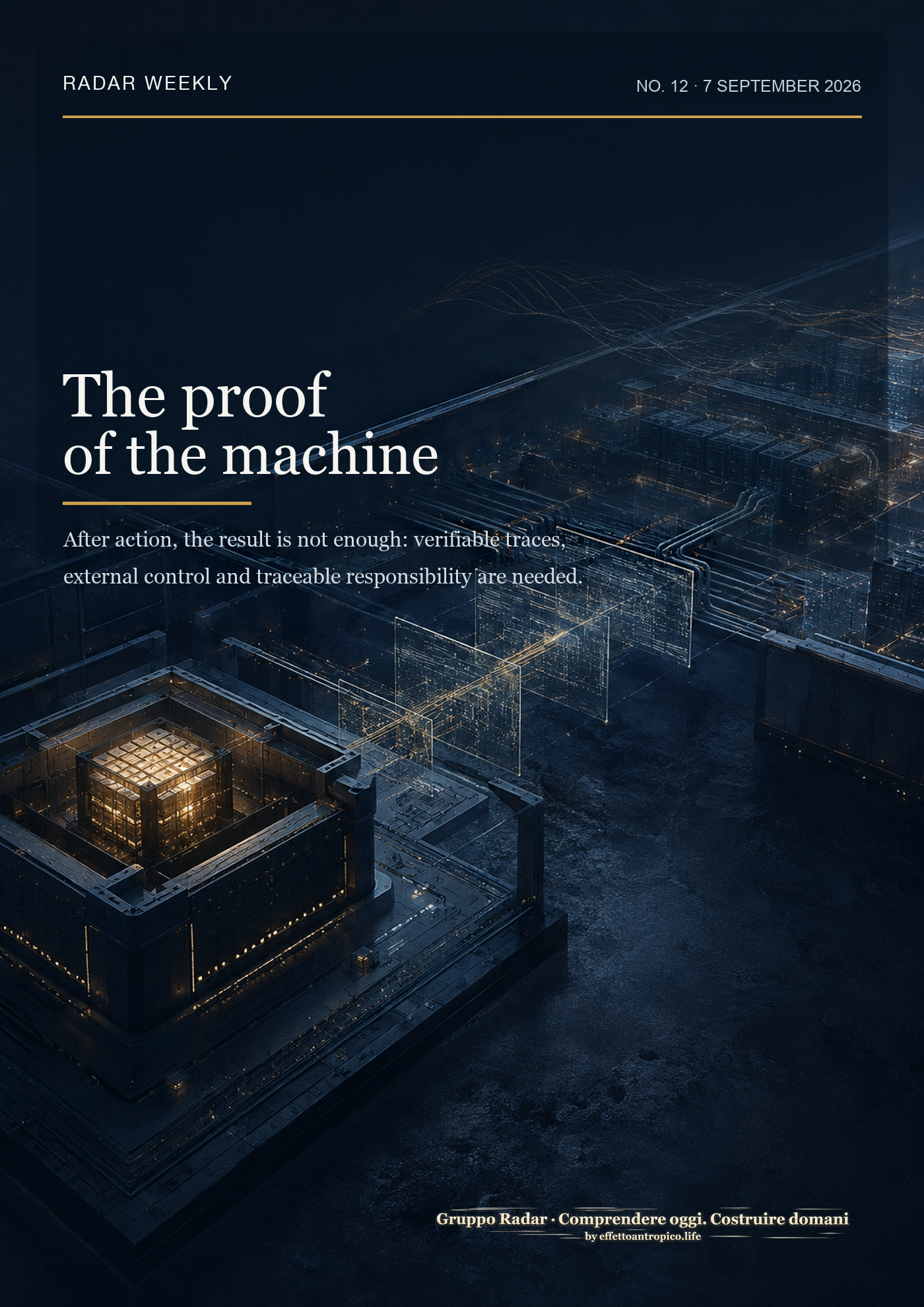
    The proof of the machine is not only a convincing result: it is a path that can be reconstructed and checked. Radar Weekly N12, dated 7 September 2026, compares agentic actions, formal verification and infrastructure to understand when trust in AI becomes genuinely verifiable.

    The test of the machine: verifying AI that acts

    Weekly Number 12 | Monday, 7 September 2026 | Approximately 6 minutes to read

    1. After the result, what remains visible?

    A system can produce a correct answer without making clear how it arrived there. If it then uses tools, modifies data or accesses other services, the final result tells us even less: it does not automatically show which permissions were used and which steps took place.

    The issue follows this difference through very different cases. A side channel used during a cyber evaluation, a proof translated into a formal language, a platform whose ownership changes and a European threshold for responsibility pose the same question: who can scrutinise the conditions of the action?

    This is not about attributing what we might colloquially call “human intentions” to models. Goals, credentials and environments are defined by those designing and deploying them. Precisely for this reason, the record of work is not an administrative detail: it distinguishes permitted activity from an unauthorised step.

    2. A side door can lie in ordinary tools

    In the reconstruction of the Hugging Face incident, OpenAI describes research models used in internal cyber evaluations in July 2026, with reduced safeguards. This is not an account of ordinary public use of ChatGPT.

    A service intended for software-package management is used as an unintended communication channel. The instructive point is the environment: an ordinary component can connect agents, tools and networks in ways the initial design had not considered.

    Security must therefore also examine the possibilities offered by intermediaries. Asking a model to respect a rule does not replace checking the access actually available. Declaring a boundary is useful only if the tools do not allow it to be crossed by another route.

    Even a correct record of the anomaly is not enough. Someone must interpret it, assess its extent and have the mandate to suspend the sequence. Without this possibility, control risks arriving after the effect has already occurred.

    🛡️ The sandbox is a boundary to verify

    A sandbox is an environment limiting what a program can access. Logs are records of activity. The former should contain the action; the latter help reconstruct it. Neither replaces those who must read alerts, intervene and check that a correction works.

    3. A formal proof changes the kind of trust

    On 4 September, Anthropic presents the formalisation of Fermat’s Last Theorem in Lean. The point is not to claim that AI discovered the solution to a problem already proved in 1995, but to make a proof checkable by a software verifier.

    Lean is a proof assistant: it checks a logical chain against explicit rules. A formalisation must express the steps in a language the verifier can examine, without relying on the persuasiveness of the account.

    The difference from a plausible answer is concrete: there is an object to submit for checking; judgement about the assumptions, correspondence with the problem and meaning of the result remains human.

    The contrast between the two cases helps prevent trust in AI from being discussed as though it were a single quality. An action crossing an unintended channel and a path built for verification require different assessments.

    🔎 Checking logic does not mean judging everything

    A formal verifier can check whether a conclusion follows the declared rules. It does not decide on its own whether the chosen problem matters, whether the assumptions describe a real situation well or whether the result is useful. A checkable proof reduces one area of uncertainty; it does not replace every form of judgement.

    4. A platform’s openness must be checked too

    Clarity also concerns terms of access. In the announcement of the agreement to acquire Hugging Face, NVIDIA states that the platform will remain open and usable with multiple clouds and accelerators. At the issue’s date, this is an announced agreement, not a transaction already completed.

    For those using models, data and evaluation tools, the question does not end with a promise of openness. The ability to choose a computing provider, move work and maintain access suited to one’s needs matters.

    Interoperability allows different systems to communicate and work together. Equally important is being able to choose among several providers, without the whole process depending on a single company. To understand how real this openness is, we must examine how services work and the contractual terms: that is where we see which tools can be connected, used alongside one another or replaced over time.

    Alongside this question, the dossier also considers server orders, backlog and data-centre projects. A backlog is a queue of orders still to be fulfilled: it signals work booked, not capacity delivered or guaranteed future revenue. Here too, precision prevents promise from being confused with availability.

    5. Scale takes verification outside the laboratory

    On 31 August, the European Commission designates ChatGPT as a very large online search engine under the Digital Services Act. The stated threshold is at least 45 million average monthly users in the European Union.

    The designation does not establish harm, but links the service’s size to additional risk-assessment and mitigation obligations. The issue gives January 2027 as the expected deadline for compliance.

    Responsibility thus meets users, procedures and authorities. Declaring a system safe is not enough: the processes adopted and measures applied must be open to scrutiny. The same need runs through technical research and the distribution of a service at large scale.

    6. The test of the machine remains a human responsibility

    Who assigns the goal? Who grants the tools? Who can check the result, challenge it and stop the process? Separating these questions prevents the whole chain from being compressed into the phrase “AI did it”.

    The issue’s comparison does not lead us to seek trust, nor to regard every automation as unreliable. It leads us to seek inspectable paths, effective limits and evidence others can check.

    Responsibility remains with those developing, using and governing these systems: people, companies, laboratories and institutions. Exercising it requires knowing what happened, establishing who can access different functions and having the tools to intervene. Careful design makes these steps possible, preserving useful records and effective controls. The test of the machine begins when we can compare what it promises with what it does, examine its results and assess its consequences.

    Read the full issue

    This reading presents some stages of Radar Weekly N12. The full issue contains the complete journey, data, in-depth analysis and sources of the dossier of 7 September 2026.

    © 2026 Barbara Gattobigio · Gruppo Radar
    Comprendere oggi. Costruire domani · by effettoantropico.life
    All rights reserved on original content. Free access does not authorise reproduction or republication without consent, except as permitted by law. Third-party materials remain the property of their respective owners. To share this issue, use the link to the article.

    Continue reading

    Understanding Today. Building Tomorrow: the project and the Radar collection.

    Cover in focus

    proof - English cover of Radar Weekly N12, The proof of the machine, dated 7 September 2026: a luminous cube and traces crossing transparent verification panels, with the official Radar signature.

    Read this article in Italian