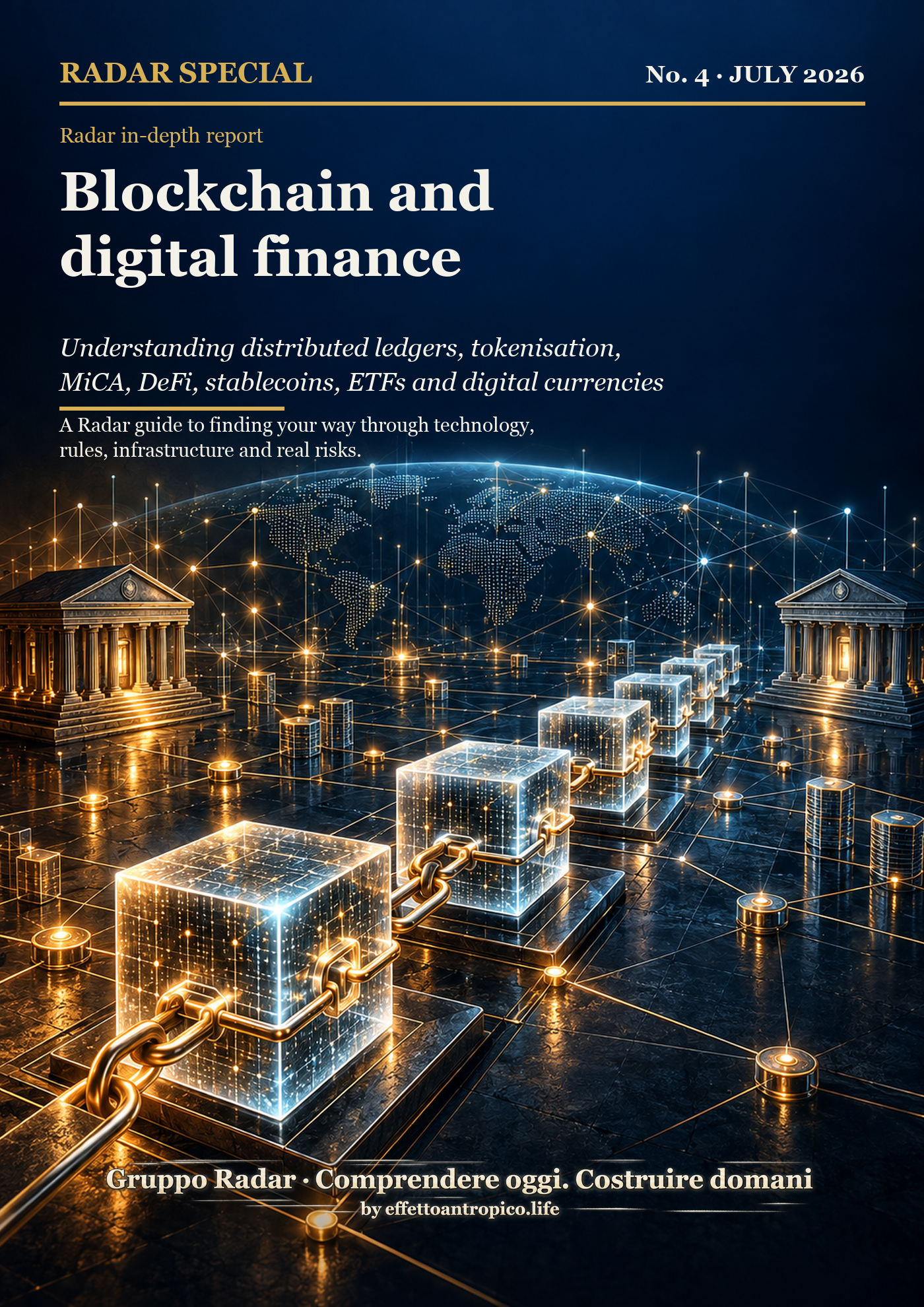
Blockchain and digital finance meet wherever value must be recorded, transferred and linked to someone accountable for it. Radar Special 4 guides the reader through terms often close together on a screen, yet very different in the rights and risks they carry.
This guide is intended for information and education. Financial, legal or tax decisions require up-to-date sources and an assessment of the specific case with qualified professionals.
Blockchain and digital finance: understanding what changes
Special Issue 4 | July 2026 | Approximately 6 minutes to read
1. A shared ledger preserves a history
Think of several organisations needing to track the same steps. Each holds a ledger, and every discrepancy requires comparison. Shared infrastructure can reduce some of these steps and make the sequence of operations easier to verify.
A blockchain organises records into blocks connected through cryptographic references. A hash is a digital fingerprint allowing changes to data to be detected. Copies of the ledger and the network’s rules help make subsequent alterations difficult or recognisable. The NIST guide, from the US National Institute of Standards and Technology, explains why this resistance should not be described as absolute immutability.
A decisive distinction remains: recording a statement does not prove its content is true. If someone enters incorrect data about an asset, the ledger may preserve its history accurately while leaving the initial error unresolved. The connection to the real world still requires checks.
2. The network has rules and people with influence
Consensus is the process through which network participants establish which operations to accept. Systems may use computational work, committed capital or authorised parties. These choices change costs, timescales and the distribution of influence.
An open network allows participation under its rules; a private or consortium network may require authorisation. Even in a distributed system, some parties may count more than others: those validating many operations, developing software, managing a widely used interface or providing infrastructure.
Understanding a service therefore means following decisions: who can write to the ledger, who can update the program and who can interrupt an activity. The word “decentralised” becomes useful when it describes these relationships precisely, without replacing their verification.
3. Custody begins with keys
A wallet is the tool for managing keys and signatures needed to operate on assets recorded in the network. The image of a wallet helps orientation, but tokens are not files physically held inside the app: their state is represented in the ledger.
The private key allows operations to be authorised. Protecting it and properly preserving recovery options is a concrete responsibility. In a self-custody system, losing access may make assets irrecoverable; relying on an intermediary changes the relationship and introduces the custodian’s responsibility.
A simple app can make this difference almost invisible. Assessing it requires reading who controls access, how an incident is managed and which entity answers to the customer. These are conditions of the service even before they are interface choices.
📌 Did you know? — The same price can conceal different relationships
Directly owning a digital asset and buying an instrument tracking its price involve different rights, costs and forms of custody. The figure displayed on a screen may look similar; the legal and operational relationship must be read in the product’s documents.
4. A token needs a bridge to legal rights
Tokenisation represents an asset or right through a token on a digital platform. It can ease some transfers or connect several operations. The Bank for International Settlements also studies this possibility in traditional financial infrastructure, together with the conditions for final settlement of payments.
An example helps: a project offers small digital units linked to a property. What does the buyer receive? A stake in a company, a right to some revenue or a different contractual right? Who manages maintenance, taxes and the sale of the asset? The token alone does not answer.
The ability to resell is another question. Dividing value into smaller units may lower the entry threshold, but does not automatically create buyers, liquidity or an easy exit. Contracts, custody of the asset and the market must support what the digital representation promises.
5. Automation executes errors too
A smart contract is a program executing instructions when certain conditions occur. Decentralised finance, or DeFi, uses these programs for exchanges and other services. The advantage is programmable coordination of operations; the quality of the result depends on the written rules and incoming data.
If a step requires the price of an asset outside the network, someone must supply it. If code contains a vulnerability, automatic execution may repeat it very quickly. Updates, administrative keys and program checks are also part of the service.
A code review can reduce some risks without automatically covering economic or custody risks. Reading a check requires knowing which part was examined, in which version and with what limits. The word “audit” gains meaning through the work it describes.
6. Stablecoins, listed products and rules are not the same thing
A stablecoin aims to maintain a value linked to a reference, often a currency. The stability of the peg depends on its design: reserves, redemption possibilities, liquidity and the issuer’s responsibility. The name is not enough to describe how it will react in a difficult moment.
An exchange-listed spot Bitcoin product instead offers exposure through units and intermediaries. The SEC order of January 2024 concerns the listing and trading of these products in the United States. It does not give the buyer direct control of bitcoin keys or remove market risks.
MiCA organises part of the crypto-asset market and related services in Europe. The ESMA page helps consult the framework and registers. Understanding protection requires identifying the company, service and applicable rules: authorisation does not guarantee the value of every asset offered.
7. Trust is read in the steps between parties
Digital finance also includes institutional projects, payments and new ways to settle exchanges. No single architecture contains every answer. Each application changes the relationship between efficiency, access, control and responsibility.
The Special’s journey therefore returns to practical questions: what value is recorded? Which right does it represent? Who holds access? And who can be held accountable for a problem? Following these stages makes a complex technology more understandable without reducing it to a promise of returns.
The full dossier also contains a glossary, distinctions between network types and a reading of the digital euro. The framework is presented as an editorial snapshot of July 2026; a product’s conditions or a rule must always be checked again when supporting a present-day choice.
🧠 Radar Insight — Follow value through to responsibility
A verifiable record is one element of trust. It becomes more useful when the right represented, custody and the path for addressing an error are also clear. Oversight does not end where code ends.
Read the full issue
This reading presents some stages of Radar Special 4. The full dossier contains the complete journey and in-depth discussions of the original edition (July 2026).
© 2026 Barbara Gattobigio · Gruppo Radar
Comprendere oggi. Costruire domani · by effettoantropico.life
All rights reserved on original content. Free access does not authorise reproduction or republication without consent, except as permitted by law. Third-party materials remain the property of their respective owners. To share this issue, use the link to the article.
Cover in focus