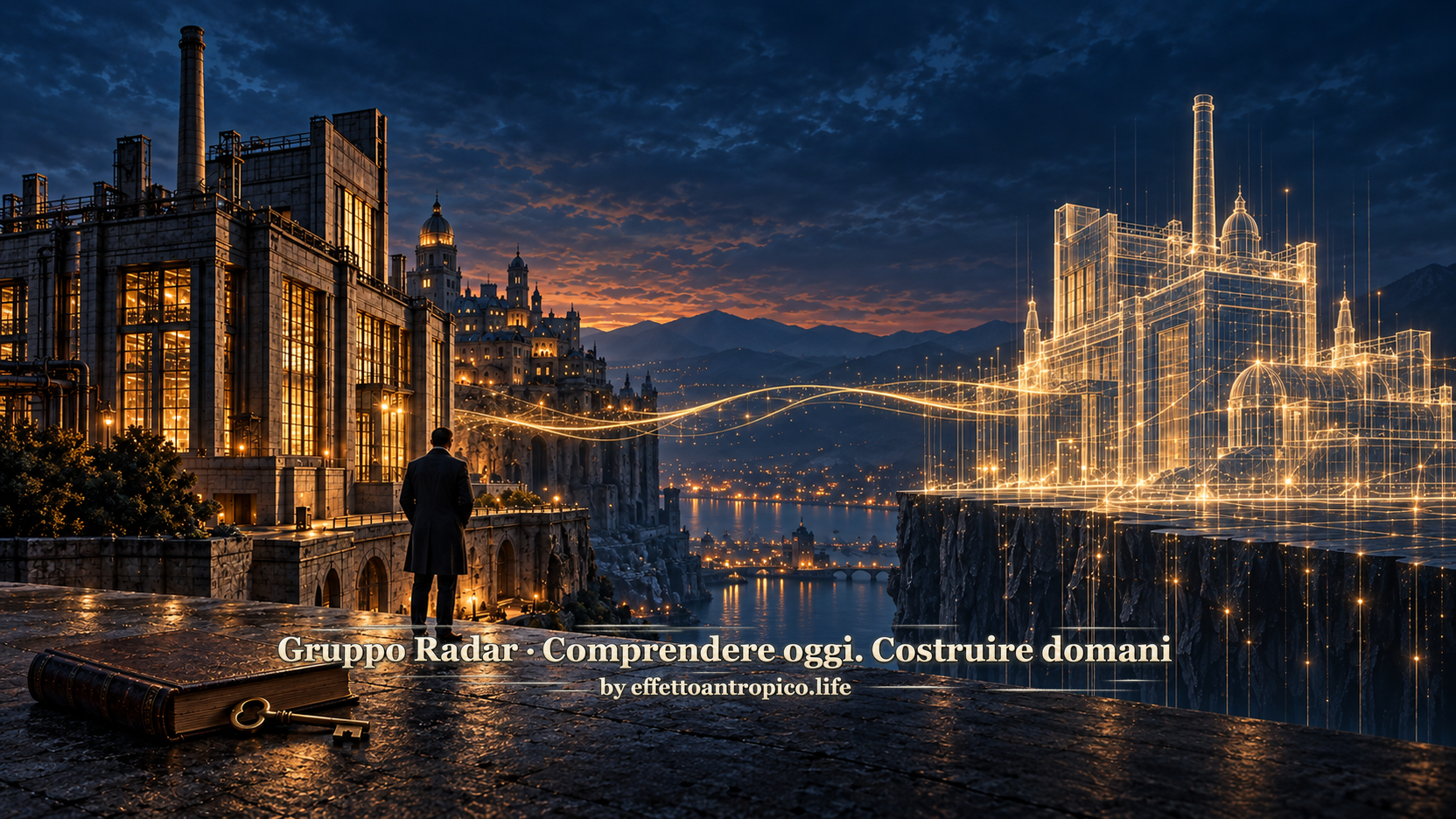
Synthetic exposure allows an asset’s price to be tracked without automatically acquiring ownership of it. Radar Weekly N6, dated 26 July 2026, explains this distance through rights, contracts, leverage, costs and dependencies on platforms.
When price separates from ownership
Weekly Number 6 | Sunday, 26 July 2026 | Approximately 6 minutes to read
Seeing a price rise on a screen does not tell us what we own. Two instruments can track the same reference and confer very different rights. One may represent a stake in a company; the other may be only a contract that calculates an outcome based on its performance.
The sixth issue starts from different signals — platforms, systems that act, infrastructure and markets — to return to a common question: who controls access, who sets the terms and who bears the risk? The central analysis concerns the moment when a price becomes tradable even without the asset.
This is solely an educational reading of the mechanisms and their limits.
1. What synthetic exposure means
The term exposure indicates how much an economic outcome depends on the performance of a reference. It is synthetic when this relationship is built through a contract rather than arising directly from ownership of the asset. The reference may be a share, an index or another asset.
The underlying is what the contract refers to. If its price changes, so do the outcomes set out in the instrument’s terms. But this connection does not automatically transfer an owner’s rights: voting, equity participation and claims on the asset have to be assessed separately.
The SEC staff statement on tokenised securities distinguishes custodial and synthetic structures precisely according to how they work. A contract linked to a security does not necessarily amount to owning it. The statement expresses the staff’s position, not a new Commission rule.
💡 Same price, different rights — The name is not enough
A share, a token linked to a security held in custody and a synthetic contract are not three interchangeable packages. We need to understand what is held, by whom, and with what rights towards the issuer or intermediary. “Tracks the price” describes an economic relationship; “you are the owner” describes a legal position. Synthetic exposure can provide the first without conferring the second.
2. Why separate the price from the asset?
A contract can offer a way to take on or offset a risk without physically transferring the asset. The issue considers different functions: access to an economic performance, positions linked to a fall in price and hedging an existing exposure. These are distinct purposes, not evidence that the instrument is suitable for everyone.
Hedging seeks to offset a risk with a position that responds differently. The CFTC’s explanation of the economic purpose of futures starts precisely from managing price uncertainty. A hedge, however, also has to be read through its costs, duration and correspondence with the risk to be reduced.
The expressions long and short refer, in simplified terms, to positions that benefit respectively from a rise or a fall in the reference. They do not, by themselves, explain how the instrument is constructed or which conditions may limit its outcome.
3. Leverage changes the scale of the outcome
Leverage allows an exposure larger than the capital committed as collateral. That capital is the margin. The difference does not make the economic movement smaller: it concentrates its effects on a lower initial amount.
The educational example in the dossier points out that an exposure of €1,000 changes by €100 when the reference moves by 10%. If the initial margin is €200, that €100 represents 50% of the margin, before costs. The same relationship applies in the unfavourable direction. This is an arithmetic comparison, not a forecast of returns.
The contract’s rules may provide for a forced closure before the reference recovers. Liquidation is this intervention triggered by a failure to meet collateral requirements. Understanding risk therefore requires more than asking how much the price might change: we need to know when a position may be closed and what losses are possible.
🔎 Margin is not a discount — The small amount does not tell the whole story
Paying €200 for an exposure of €1,000 does not mean buying the same asset for one fifth of the price. It means bearing, under the contract’s rules, an economic change relating to a larger amount. Margin is collateral, not a complete description of risk. Limits, forced closure and protections depend on the instrument and the context in which it is offered.
4. The right direction may not be enough
Perpetual contracts do not have the predetermined expiry typical of many futures. They may involve periodic payments, often called funding, whose workings depend on the platform. These payments affect the cost of maintaining a position and may change over time.
Fees and the spread, the gap between the buying and selling prices, add other elements. The reference price may move in the expected direction while the net outcome is affected by costs. Separating price movements from the actual outcome is one of the issue’s central steps.
Opening two opposing positions does not automatically remove every risk either. It may reduce part of the price exposure while leaving costs, contractual conditions and platform dependencies in place. “Balanced” does not necessarily mean “risk-free”. Nothing is risk-free.
5. Behind synthetic exposure lies a chain of dependencies
The counterparty is the party on whose performance fulfilment of the contract’s obligations depends. Liquidity concerns the ability to trade without moving the price too much or facing difficulty in exiting. Custody (in Italian) concerns who holds assets or collateral and how they can be recovered.
If the system uses an oracle, this term means the mechanism supplying external data, such as a reference price. An error or delay in the data can have consequences different from a merely incorrect number on a screen, especially if that data triggers automatic operations.
The dossier invites us to read these dependencies together with withdrawal conditions and the applicable jurisdiction. The power of an interface does not replace the quality of its rules. This connects to the reading of AI infrastructure: even what appears immediate on a screen rests on systems and parties that remain behind it.
6. Protection follows how a product works, not its label
A new name does not necessarily place a product outside existing rules. In ESMA’s reminder of 24 February 2026, firms are asked to assess whether products presented as perpetual futures fall within the measures on CFDs, contracts for difference.
When an instrument meets the definition of a CFD, the relevant requirements apply, including leverage limits and protective measures. This does not mean that every product available online automatically offers the same protections. The issue draws attention back to the actual structure, the party offering it and the applicable terms.
The connections to keep in view
Synthetic exposure makes visible a distinction that runs through the digital world: being able to access a function does not mean controlling the system supporting it. In finance, being able to trade a price does not mean owning the asset or taking part in its decisions.
The full Radar Weekly N6 preserves the dashboard, the week’s other signals and the complete analysis, with examples and sources. The question to carry into the reading remains simple: what am I tracking, what rights do I have, and on whom does the outcome depend?
Read the full issue
© 2026 Barbara Gattobigio · Gruppo Radar
Comprendere oggi. Costruire domani · by effettoantropico.life
All rights reserved on original content. Free access does not authorise reproduction or republication without consent, except as permitted by law. Third-party materials remain the property of their respective owners. To share this issue, use the link to the article.
The previous reading connects production capacity and practical activities in Weekly N5 — When power meets the real world. The introduction to the collections is in Understanding Today. Building Tomorrow.
Cover in focus