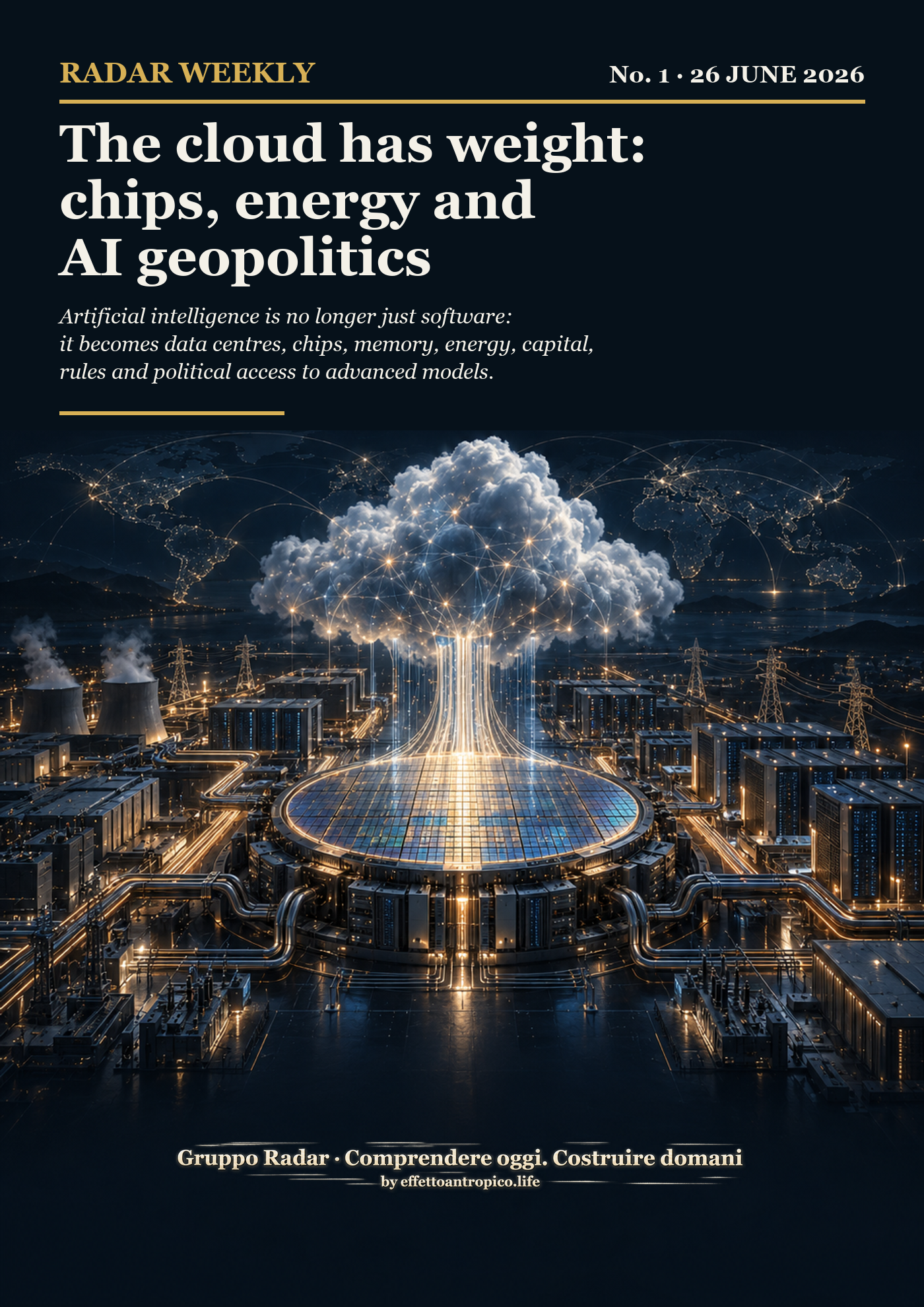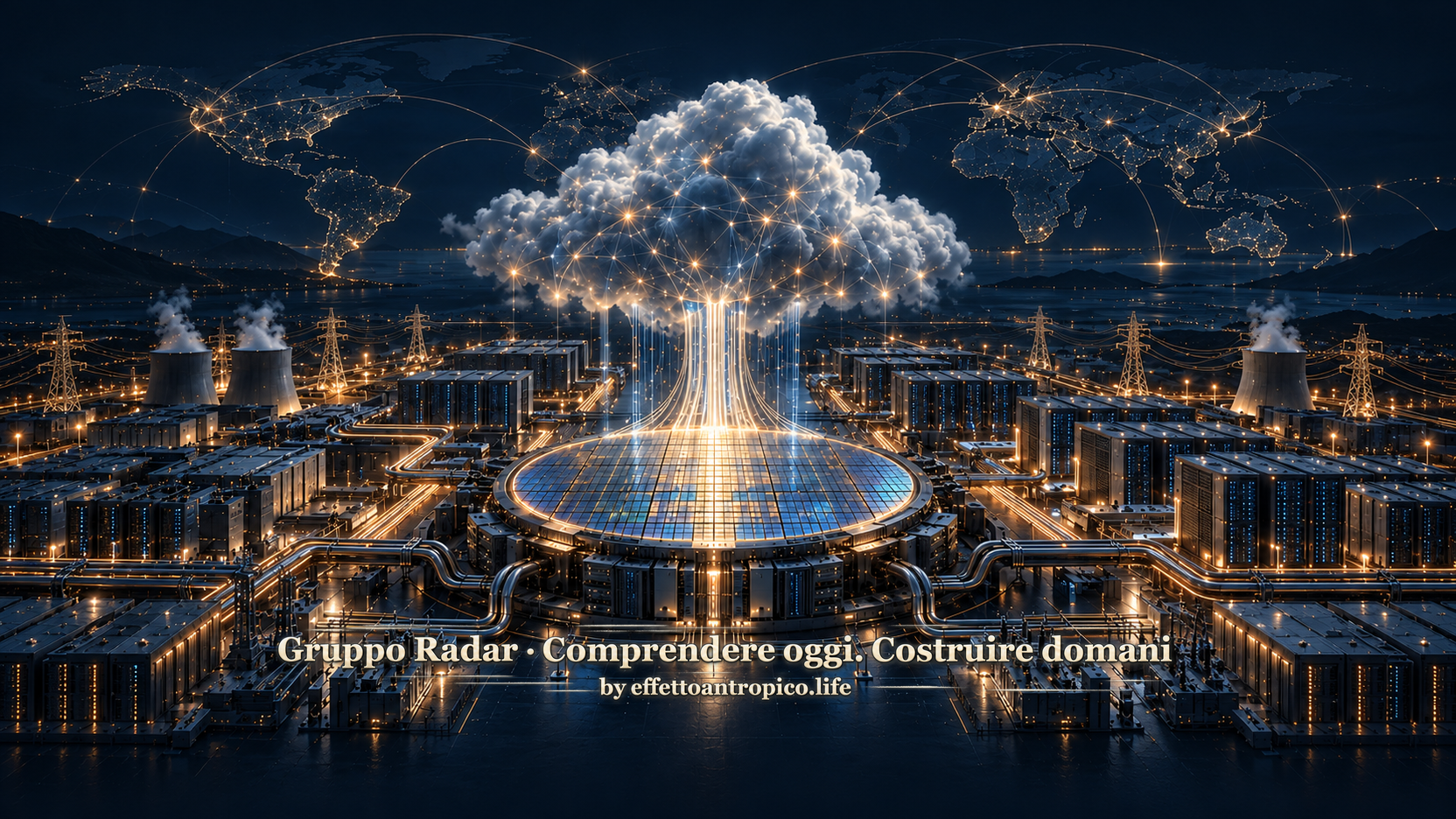
Chips, energy and data centres sustain artificial intelligence: the cloud has a physical foundation. Radar Weekly N1 explores infrastructure costs and the geopolitics of AI, connecting technology, capital and rules of access through the signals of 26 June 2026.
The cloud has weight. Chips, energy and the geopolitics of AI
Weekly Issue 1 | Friday 26 June 2026 | Approximately 5 minutes to read
One question runs through this first Radar Weekly: how much does artificial intelligence really weigh? On screen, it appears as an answer, an image, a conversation. Behind that apparent lightness lie chips, memory, energy, water, networks and land. The cloud is not outside the world: it occupies a concrete part of it.
Issue 1, dated 26 June 2026, examines the geopolitics of AI through markets, research, companies and rules of access. Here we retrace its essential points: the first stretch of a journey that begins to recognise AI as infrastructure rather than something intangible.
1. From the model to matter
The question should not begin with which model is more capable, but should focus above all on who can build it, power it, maintain it and distribute it. A digital service needs physical structures, investment and agreements: as demand for computing grows, the costs and availability of these resources become increasingly important.
This is the thread that holds the issue together. Software, meaning the programs, remains central, but it is not enough to explain the race for AI: we also need to look at the machines that make it work and the conditions that make its use possible.
📌 Did you know? The cloud has an address
A data centre is a facility that houses servers, memory, networks and cooling systems. It is one of the physical places where cloud services and AI models run. Speaking of the “cloud” describes how we access a service, not an absence of matter behind that service.
2. Who sells the tools, who bears the cost
A distinction emerges from Radar’s reading of the markets: selling infrastructure and financing its construction are not the same thing. On one side are suppliers of chips, memory and storage systems; on the other are the platforms that must bear the expense required to provide their services.
The issue’s metaphor is simple: some companies sell the pickaxe, while others dig and pay the cost of the mine. This is neither a ranking of winners nor a call to rush into investing; it simply helps explain why growing demand for AI can have different consequences for costs, margins and expected returns.
3. Chips, energy and land
The frontier of chip research and investment in data centres, also examined through the Indian case, bring technology back into a concrete geography. Where is it built? Who manages the data? Who pays for the energy? Who sets the conditions of access?
The miniaturisation of transistors, the components of chips, also belongs in this picture: density, efficiency and consumption are part of computing capacity. But a research result is not the same as a product already available. The issue maintains this distinction, avoiding turning an experimental frontier into an immediate promise.
4. Digital finance beyond the price
The journey also passes through cryptocurrencies and stablecoins, cryptoassets designed to maintain a stable value, often linked to the dollar or other currencies. The focus moves beyond prices alone to the reserves backing them, custody, rules and the management of personal data.
This point is connected to the rest: when a service becomes infrastructure, the responsibilities of those who manage it and the conditions under which people can use it also matter. Technology, finance and control thus begin to meet within the same line of thought.
5. When AI enters objects
Another signal concerns Physical AI, artificial intelligence integrated into sensors, robots, vehicles and industrial devices. Here, AI does more than produce an answer: it enters systems that perceive and act in the material world.
The formula proposed in the issue brings together AI, sensors, efficient chips and physical control. It is a way of reading a possible evolution: from conversation to operational capability. How objects actually work becomes part of the technological question, alongside the computing that sustains them.
6. Who can gain access, who decides
If models and data centres acquire strategic value, access is no longer merely a technical matter. Radar leaves one question open: what limits, licences and authorisations might distinguish countries, users and purposes of use?
⚠️ What to watch — Control also operates through access
The question is not only what a model can say. It is also who can use it, for what purpose and under what conditions. In this first issue, it deliberately remains a question to observe.
The thread to take with you
In this issue’s reading, the future of AI is not decided solely by the quality of its answers. It is also decided by the ability to bear its cost, control its infrastructure and define its accessibility. This is where Radar begins: connecting seemingly distant signals to understand the transformation they are forming together.
The full issue brings together the weekly dashboard, charts, the growing vocabulary and scenarios to watch. This reading accompanies that journey without replacing the archive document.
Read the full issue
© 2026 Barbara Gattobigio · Gruppo Radar
Comprendere oggi. Costruire domani · by effettoantropico.life
All rights reserved in the original content. Free access does not authorise reproduction or republication without consent, except for uses permitted by law. Third-party materials remain the property of their respective rights holders. To share this issue, use the link to the article.
This issue opens the path of Understanding Today. Building Tomorrow.: Radar Weekly and Radar Specials explore technological, cultural and social transformations and their consequences for everyday life.
Cover in focus