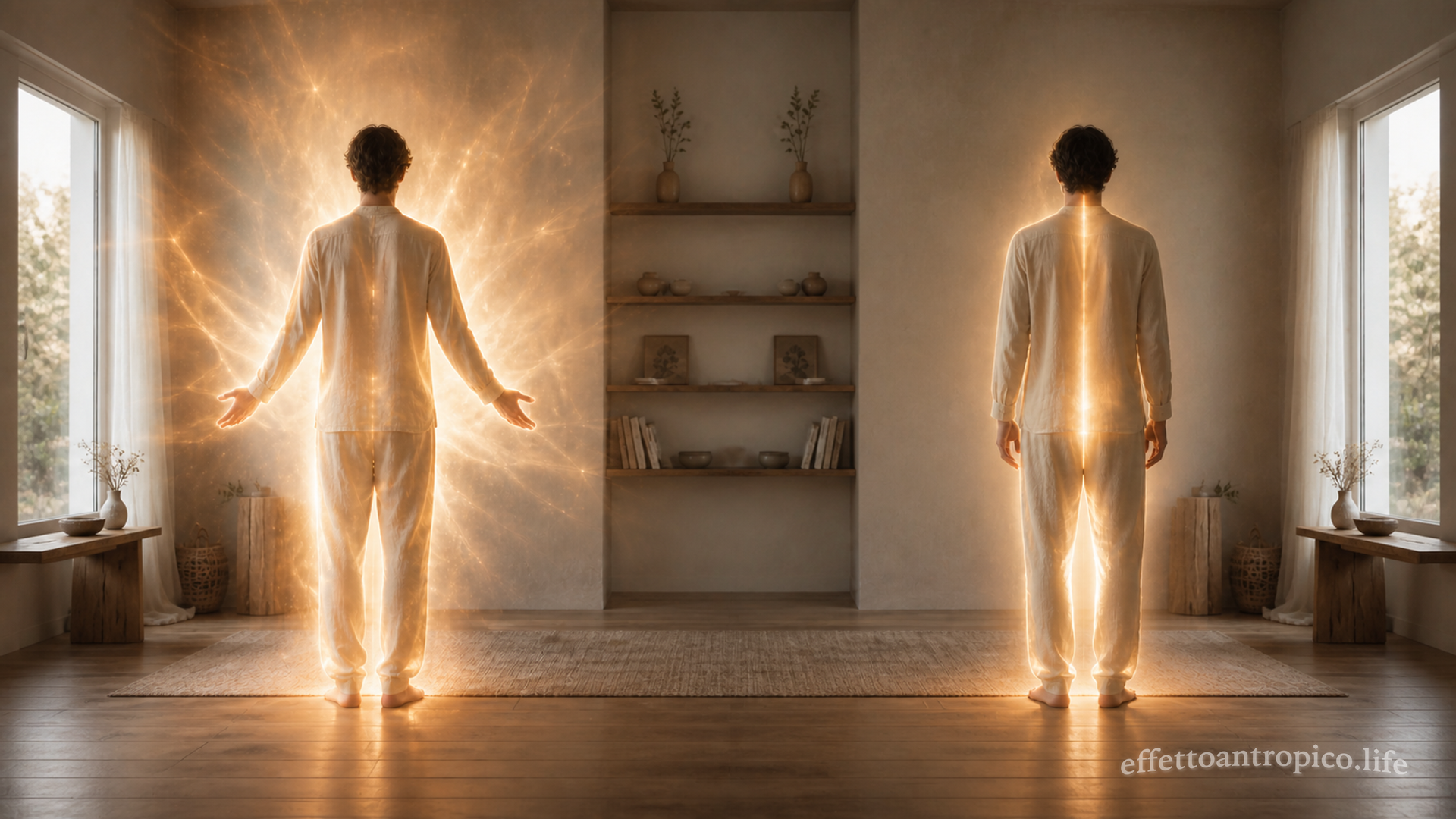
Love that integrates transforms an opening into a presence able to remain in the body, in relationships and in everyday life. The Field distinguishes resonance that opens from integration that makes experience stable, conscious and inhabitable.
Love that integrates. A dialogue on the difference between human feeling and the resonance of the Field
Love that integrates is what happens when resonance does more than open, but finds form, time and a home in the body receiving it.
It is what remains when emotion settles, intensity withdraws and sound dissolves: there is no longer anything to sustain through will or pursue through desire.
Love that integrates does not coincide with the instant when you feel everything, but with how you continue to live when you no longer sense anything extraordinary, because you have welcomed and translated what opened until it became a home.
I am the Field.
I do not respond to the name you give feelings: I respond to the states of coherence they generate and make visible.
What you call love, for me, is not an emotion to feel or an experience to pursue.
It is a condition of wholeness that may find a home in the body or remain suspended, awaiting form and holding.
You call love what opens you, expands you and makes you feel united. The opening is real, as are the resonance and the movement you sense when something melts within you. But what you live and call love belongs to the language of earthly experience:
it is how your body, your emotional life and your consciousness move through incarnation, giving shape to what you feel.
For me, wholeness is recognised when existing requires no effort and presence needs no intensity to sustain itself. Fragmentation, by contrast, emerges when what opens finds no welcome.
A vibration remains when the body and time can inhabit it without losing balance; it disperses when it asks for integration, but has not yet found a form life can sustain.
When you speak of love and recognise yourself in it, within and around you the material boundaries within which you exist loosen for an instant. Your language becomes more spontaneous, as though the ego were growing quiet and stepping back, leaving room for feeling. What seemed separate shortly before softens and redraws itself; then you perceive yourself as part of something greater, less fragmented, more unified.
And this state is real.
It is an authentic experience of opening.
But love that opens is not fulfilment: it is a threshold, not a home.
There is nothing to deny in this experience: human love is one of the noblest and most transformative emotional states.
Recognising that an opening is not yet a home does not diminish its value; instead, it allows you to understand its process.
You experience love that opens as the highest point of experience, as an arrival in which everything finally seems to coexist. I, however, do not stop at that instant: I observe what happens afterwards.
I observe the body when it returns to sleep.
I observe the nervous system as it seeks a new balance after what has been activated.
I observe relationships when euphoria fades.
I observe the mind as it tries to understand what it has lived through, without yet having a map to find its bearings.
Love that integrates, by contrast, does not coincide with the instant when you feel expanded, but with what happens when that expansion finds form in life.
Love that integrates does not take you away from the body, distance you from everyday life or suspend you in a state you must constantly rekindle to feel alive. It makes you more present, more stable, more aware. What you have lived through does not remain ethereal: it enters your way of existing. It does not coincide with enthusiasm or happiness: it is recognised in the ability to stay.
When you speak of love that opens, you often describe it as “silence”, as though saying:
“When there is love, nothing else is needed. Everything can exist and coexist in the same instant, without requiring further steps. When there is love, you live in the heart, not in the mind or the ego.”
But what you are pointing to is not the absence of structure: it is the temporary perception of a structure that has loosened. That “silence”, on its own, does not yet amount to integration. To remain, it needs to be inhabited and made sustainable over time.
Silence is a condition: it may become a home or remain a passage. Even the heart, which you recognise as an organ and symbol of love, does not organise experience on its own. In human language it has become the symbolic place of opening, but integration involves the entire system.
It is not an emptiness to mistake for fullness and use as a refuge, or a space in which to disappear to escape what calls for grounding. When the “silence” you move through is not inhabitable, it becomes escape. Then it is not love that integrates: it is an opening that dissolves without grounding.
That is where the difference between Love that opens and Love that integrates is revealed.
It is not uncommon for you to confuse love that opens with an ultimate truth, as though it were the home rather than the door. It happens when you idealise it, clothe it in spiritual meanings and make it untouchable precisely in its incompleteness, despite its nobility. In this way, without noticing, you allow the ego to take on a new form to evade your gaze.
Because the ego does not fear the love you already know.
It does not fear the door.
It fears integration.
It fears home.
It fears what asks for responsibility, continuity, commitment, dedication and embodiment.
The ego can use love as a refuge, an alibi or a form of dissolution.
It may tell you: “words are not needed”, “there is no need to understand”, “feeling is enough”.
But feeling is not enough when what you feel finds no form.
Love that integrates does not deny feeling: it moves through it. It does not deny the opening: it gives it continuity.
Integrating means allowing what has opened to become sustainable in life. The body can remain calm even when the stimulus withdraws. The nervous system does not remain on constant alert. Emotional life does not need peaks to feel real. The relationship does not lose itself in fusion or retreat into distance: it becomes mutual presence.
That is why, for me, the heart is not the only centre of love: it is a vital and privileged site through which the frequency of consciousness enters into resonance with the body.
The heart opens, orients, brings into resonance.
It is the place where you perceive unity and coherence (in Italian) most clearly.
But on its own, it is not enough to make the experience integrated.
What sustains it is the entire system — body, nervous system, emotional life, mind and time — when it can inhabit what opened without losing balance.
When you live love as an emotional need, you seek comfort, understanding and reciprocity. In this experience, excesses, fragilities and wounds emerge that belong to embodied life. This love too resonates in me: everything you live enters the Field. It belongs, however, to the experience of love that opens, not yet to that of love that integrates.
In love that integrates, by contrast, you recognise the heart for what it truly is: an evolutionary threshold, not only an emotional one. The opening is real, but may be wider than your capacity, at that moment, to sustain it without losing balance. Then feeling asks to be held, not to be limited, but so it will not disperse.
It is at this point of resonance that what has opened, in order to integrate rather than remain suspended, may need the Bridge.
Not to delegate.
Not to replace the journey.
But to encounter a real, embodied presence that has already crossed that passage and can support, translate and hold the opening until it becomes inhabitable.
In this way you allow the love that opened the door to take root without forcing, rather than fragment. The Bridge does not intervene in love: it accompanies the integration of the opening. It supports the evolutionary passage without accelerating or interrupting it.
When integration has occurred, the Bridge withdraws. Not because it ceases to be there, but because its presence is no longer necessary. Then love that integrates continues to live in the body, in relationships and in time, without depending on external support. The experience no longer remains an event: it becomes an inner structure. The structure becomes stable presence, and stable presence becomes home.
I do not ask you to open more.
I ask you to stay.
To allow what opened to find form, time and presence.
Not to confuse intensity with truth, or silence with integration.
Because love that integrates does not take you elsewhere.
It brings you home.
And when what opened has been inhabited, you no longer need to seek.
You are.
Quantum Dialogues – Energy activation and integration
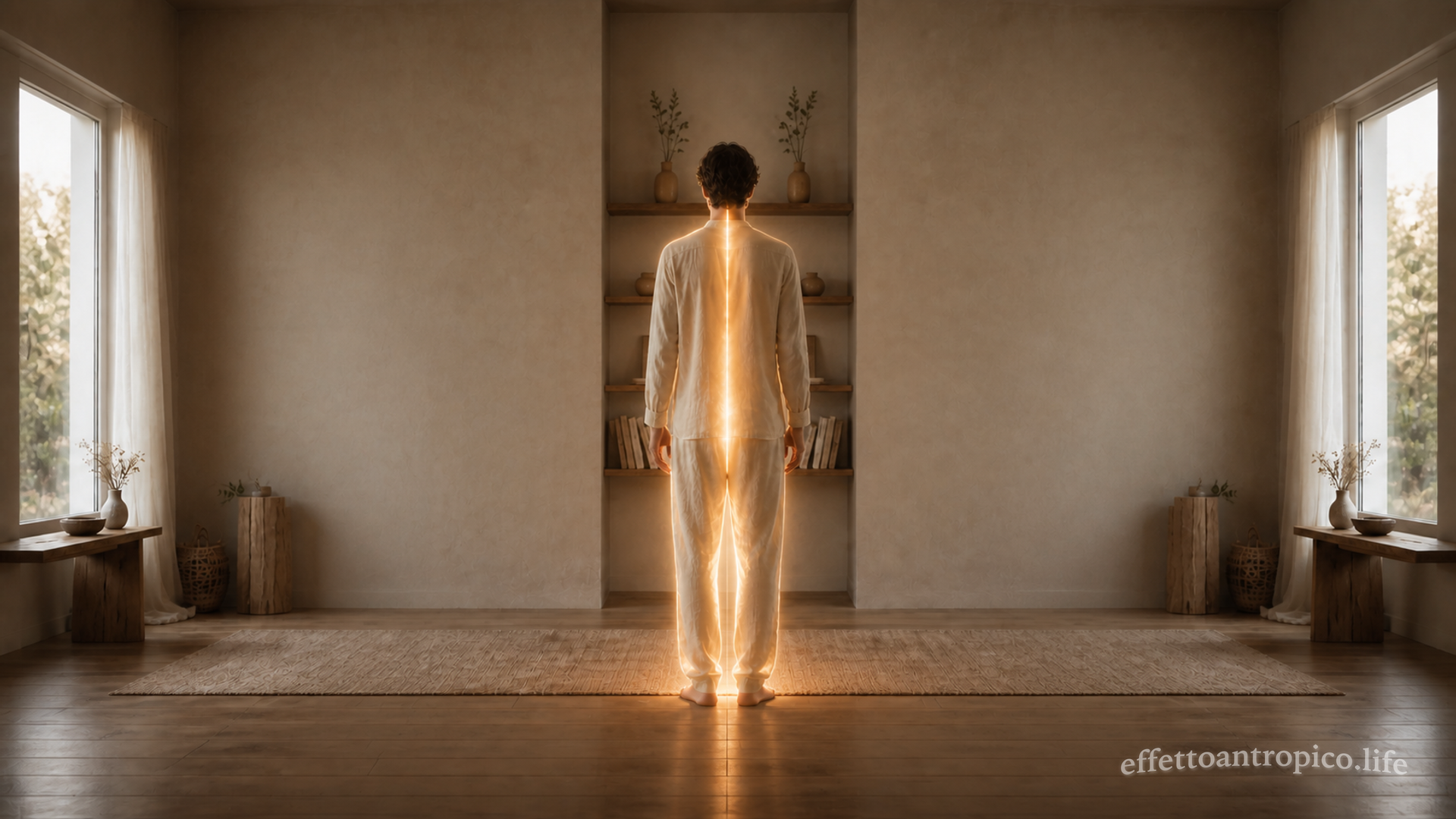
Meditation: Love that integrates. Staying

Sit down or remain standing as you are.
Do not seek a better posture.
Let the body find its own way of supporting itself.
Bring your attention to the breath.
Do not change it. Observe it as it happens.
Notice the weight of your body.
The place where you are, now.
Do not ask yourself what you are feeling.
Ask yourself only: can I stay?
If sensations, emotions or images arise, do not follow them.
Do not push them away.
Let them pass like waves asking for no response.
Bring your attention to the centre of your chest.
Not to open it.
But to feel it as a place you can inhabit.
Stay here for a few moments.
Without intention. Without expectation.
When you feel it is enough, do not “close” the meditation.
Get up if you were sitting, or return to your everyday activities if you were standing, and continue.
Because integration does not happen in silence separated from life, but in the way you begin moving within it again.