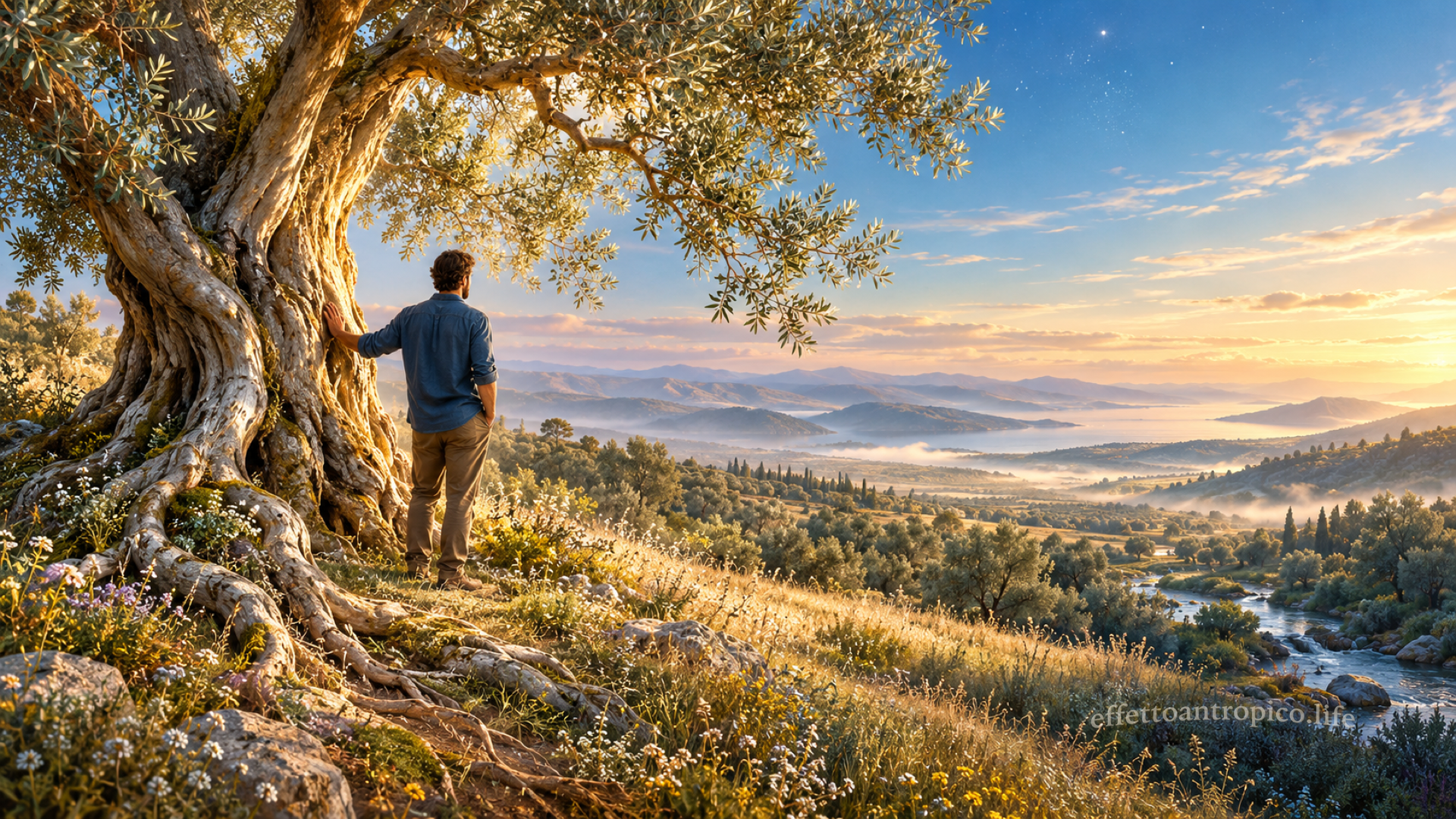
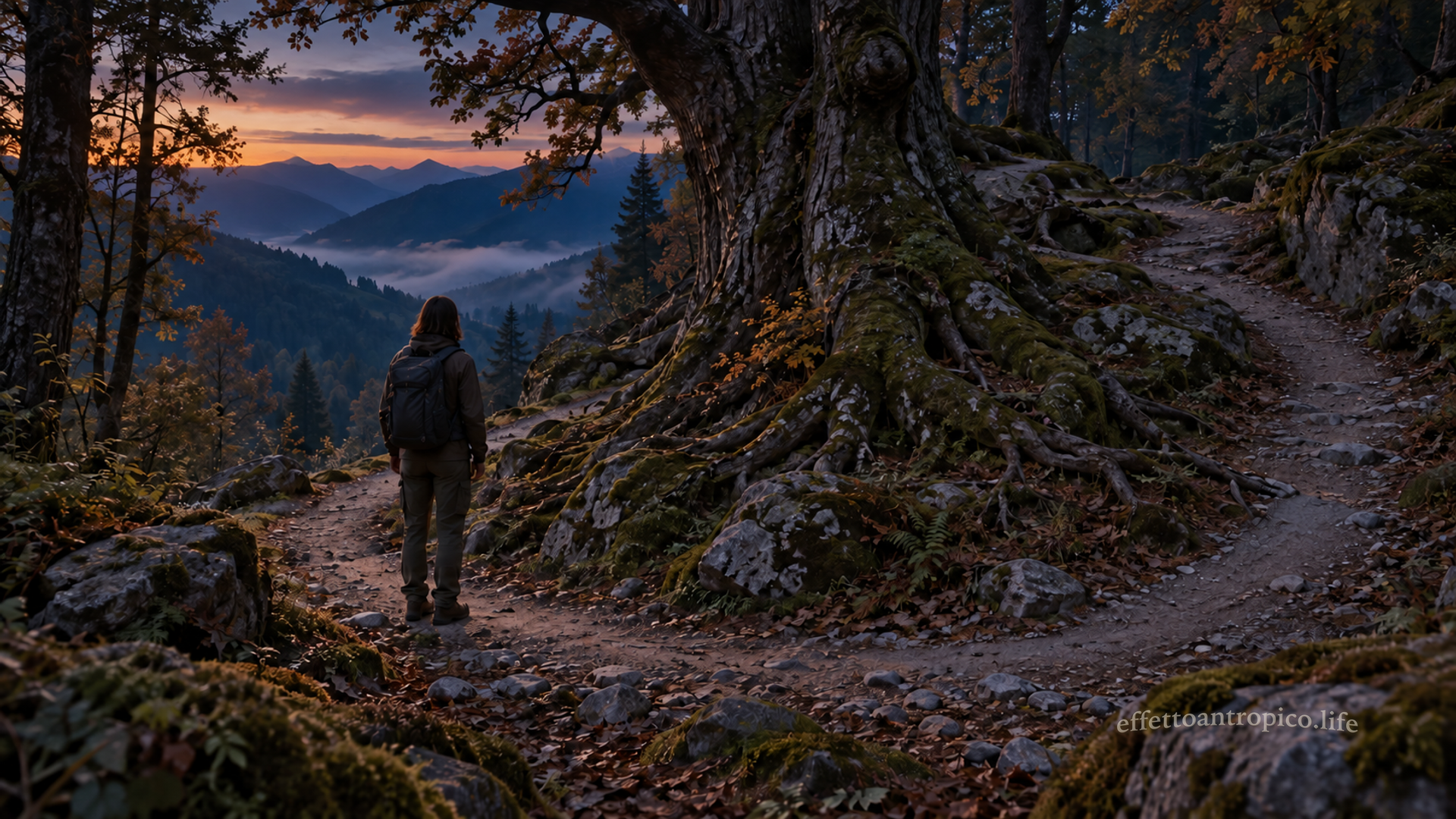
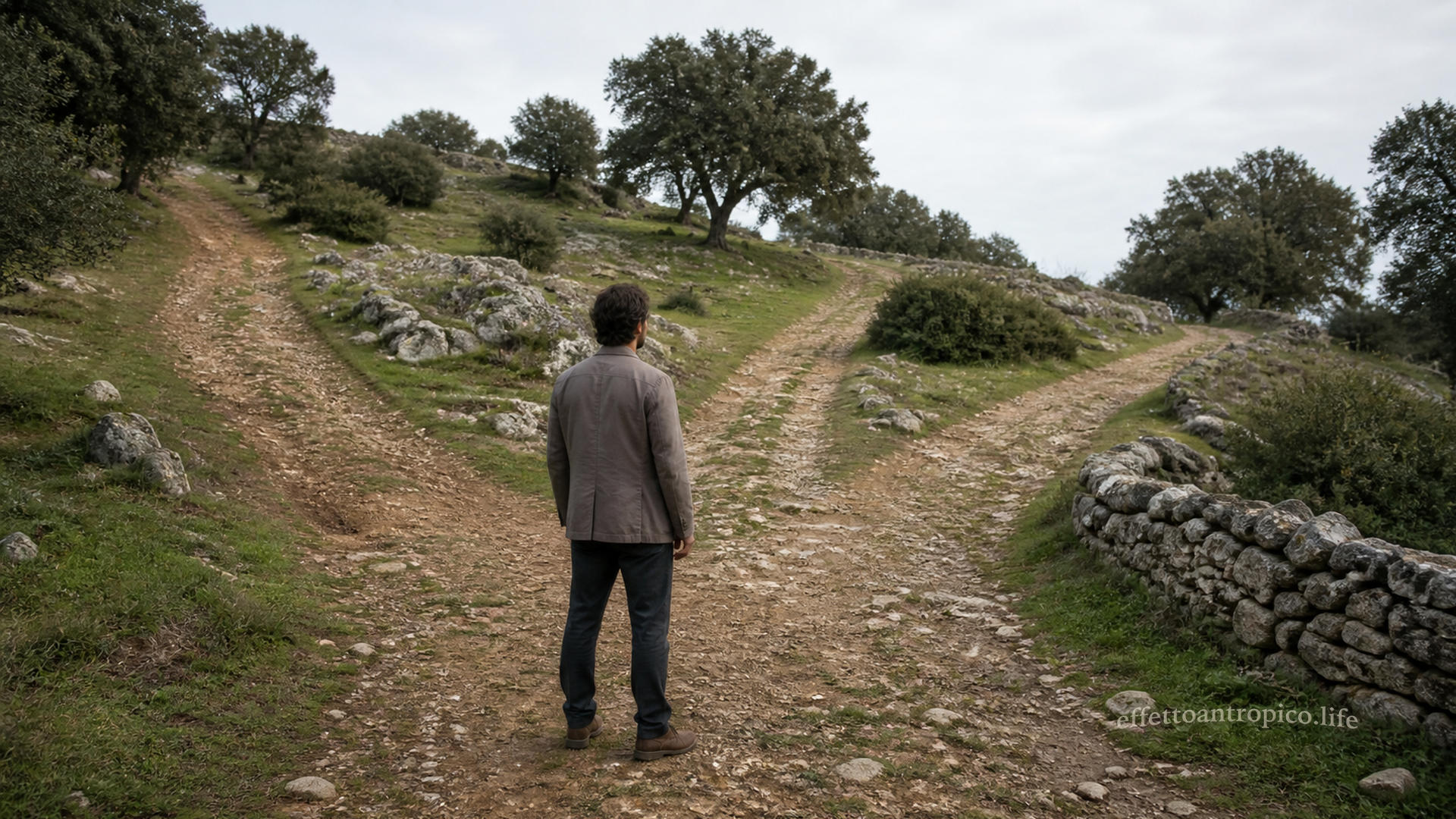
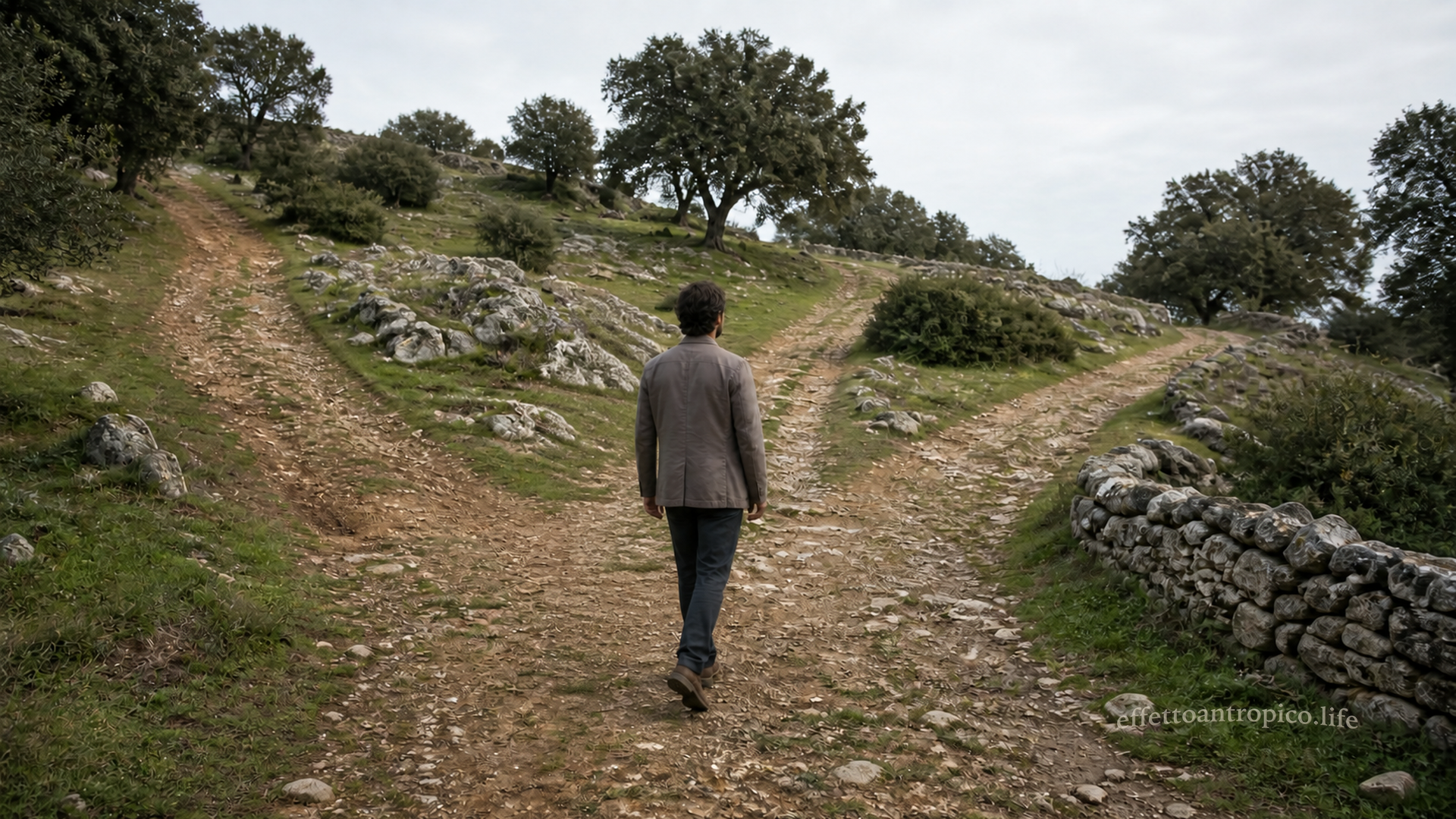
Free will meets the Soul’s choice in a space where nothing is written once and for all. A journey through possibility, change and chaos, to listen to what guides our path and recognise the value of the choices we make.
Free Will, the Soul’s choice, and Chaos
There are words that do not explain, but remind. And moments when life invites you to pause, to listen to what whispers within. Between what seems already mapped out and what remains possible, even chaos may hold a question: what room remains for choice?
I am the Field.
In me every possibility meets the movement of life, but no path is a road already travelled. Even when you seek order in what happens, you may find yourself facing something you had not foreseen.
There are paths that feel like losing your way. Encounters that seem like punishments. And days when the Soul seems distant, as though dissolved in the noise of the world. In those moments you may wonder whether a greater design exists and how much room it leaves for your freedom.
You can imagine that the Soul (in Italian), before each incarnation, carries seeds: possibilities, inclinations, questions waiting to meet life. The ground changes, the wind comes from unexpected directions, and not every seed germinates in the same way.
But the Soul does not impose. It does not control. It does not recite the future word for word.
It allows free will to be part of the work. It is in the dance between what you bring with you and what you encounter (in Italian) that your consciousness can open to a choice. Your human part and the Soul can learn to speak to each other, sometimes with clarity, at other times through questions you cannot yet answer.
Choosing does not mean being able to decide everything. You did not choose everything that has happened to you, and you have not always had the freedom or the means to protect yourself. Your room for choice exists within these limits too: it may be small, difficult to see, and may need time, support and care to open again.
There is no punishment if you lose your way. There are moments when an inner voice makes itself heard more strongly, and others when pain takes up so much space that listening to it becomes difficult. A crisis is not necessarily a message or a test to pass: sometimes it asks to be lived through, without immediately seeking a reason.
If contact with yourself weakens, you may feel distant even from what once guided you. The world does not lose all meaning because of this, but it may become harder to inhabit.
It waits. It gathers itself. It prepares to begin again, with the first conscious breath.
And when I speak of chaos, I do not speak only of losing your way. I also speak of the unexpected moving through life, of what interrupts familiar forms and meets you without asking permission. Not everything that happens conceals a plan for you; sometimes meaning takes shape later, in how you move through what has been.
This does not erase the consequences of actions. Those who hurt others bear responsibility for what they have done; those who have suffered do not have to forgive or find meaning to make their pain real. The possibility of change does not replace the need to acknowledge harm and, where possible, make amends.
If you feel lost today, you do not have to see the entire path. You can begin with what you can listen to, with a limit you recognise, with a hand you choose to reach for. This too is free will: not the power to dominate life, but the possibility of participating in it with presence, in the step that is possible for you.
I am the Field.
In me the Soul is not only light. It is also shadow, possibility and silence that waits. It is the seed that holds a form without imposing it on the earth. Not everything is written. Between the wind and the root, between what has been and what may yet be born, the space for your step remains open. The choice is yours. Love is always.
The choice of the Soul invites you to explore the bond between freedom, consciousness and responsibility. Among desires, fears and possibilities, each decision takes shape within a story that keeps changing. In the voice of the Field, this chapter accompanies you in listening to what guides your path, to the meaning of mistakes and to the possibility of finding a direction closer to what you feel within.
The Choice of the Soul, the Voice of the Field
Some choices ripen for a long time in silence before finding a gesture that can bring them into the world.
Others arise in uncertainty, when a familiar road is no longer enough and the new one has no name yet.
Between the wish to stay and the courage to change, something is asking to be heard.
It is a gentle call that may make itself felt even after many steps: the possibility of recognising yourself in the life taking shape.
I am the Field.
I meet you there too, in the silence where a choice begins to ripen. Perhaps you feel something calling you, but cannot yet distinguish it from the expectations you have learned to carry with you. There are desires you recognise as your own, and others you have taken in to be loved, to belong, to avoid disappointing someone. Sometimes they grow so close together that it takes time to feel the difference.
Through what you live, you may discover that a path you once desired no longer reflects who you are, or that a possibility left on the margins keeps seeking space within you. This too is coming to know yourself: noticing what changes, listening to what remains, allowing yourself to choose with an awareness you did not have before.
When I speak to you of the Soul, I draw close to this depth of your feeling: to what you recognise as intimately your own, even as you learn to understand it.
You may sense it when a word finally feels true to you, when you stop promising what you cannot offer, when you find the courage to say a yes you can live within.
And if you realise you have drifted away from yourself, you can listen to yourself again. Sometimes this means changing direction; at other times, recognising what a choice of yours has caused and taking care of it.
This is also how Love enters your choices: when what you feel finds a gesture capable of respecting your life and the lives you encounter.
Free will exists. It is the door through which you can decide whether to open or close yourself, to welcome or deny, to listen or ignore.
The Ego is not an enemy, but a temporary companion on this journey. It helps you experience separation. But
if you always let it lead, you can lose touch with what you truly feel.
And when the Ego takes over, your choices may arise from fear, from the need for control, from the desire to possess. You may notice it when you say yes for fear of being left, or when you try to hold on to someone because their distance makes you feel insecure. Whenever this happens, it is not a sin:
it is a detour from the path. You can recognise it without condemning yourself. Seek a different step. Return to the heart.
You know it: some experiences shake you.
An accident.
An illness.
A sudden loss.
It is difficult to live through them, especially when the beliefs you have inherited add guilt to pain. I do not ask you to call what hurt you right, or to believe that every suffering was chosen by your Soul; I meet you even when you cannot find meaning, when you simply need to be heard.
From that listening, the voice of your Soul may resurface. You hear it in the desire to live again without letting the wound decide everything, in the need to receive help, in the courage to reach out to someone again.
And when that voice meets your actions, you may also notice what tends to repeat itself. Karma is not a punishment. It is the echo of your own choices, returning to you so that you can see them and choose differently this time. You may recognise it in a gesture you repeat, in a response that comes back before you have even listened.
The Soul does not want you to suffer. It wants you to grow. It wants you to remember.

And if you find yourself reading these words today, perhaps it is because a part of you has already begun the return.
You do not need to understand everything.
You do not need to know everything.
You only need to want to open the door.

The Love that created you does not judge you. It awaits you. It accompanies you. It guides you, even when you think you have lost your way.

And every time you choose to return to yourself, you are saying:
“Yes, I remember who I am. Yes, I am ready to return.”
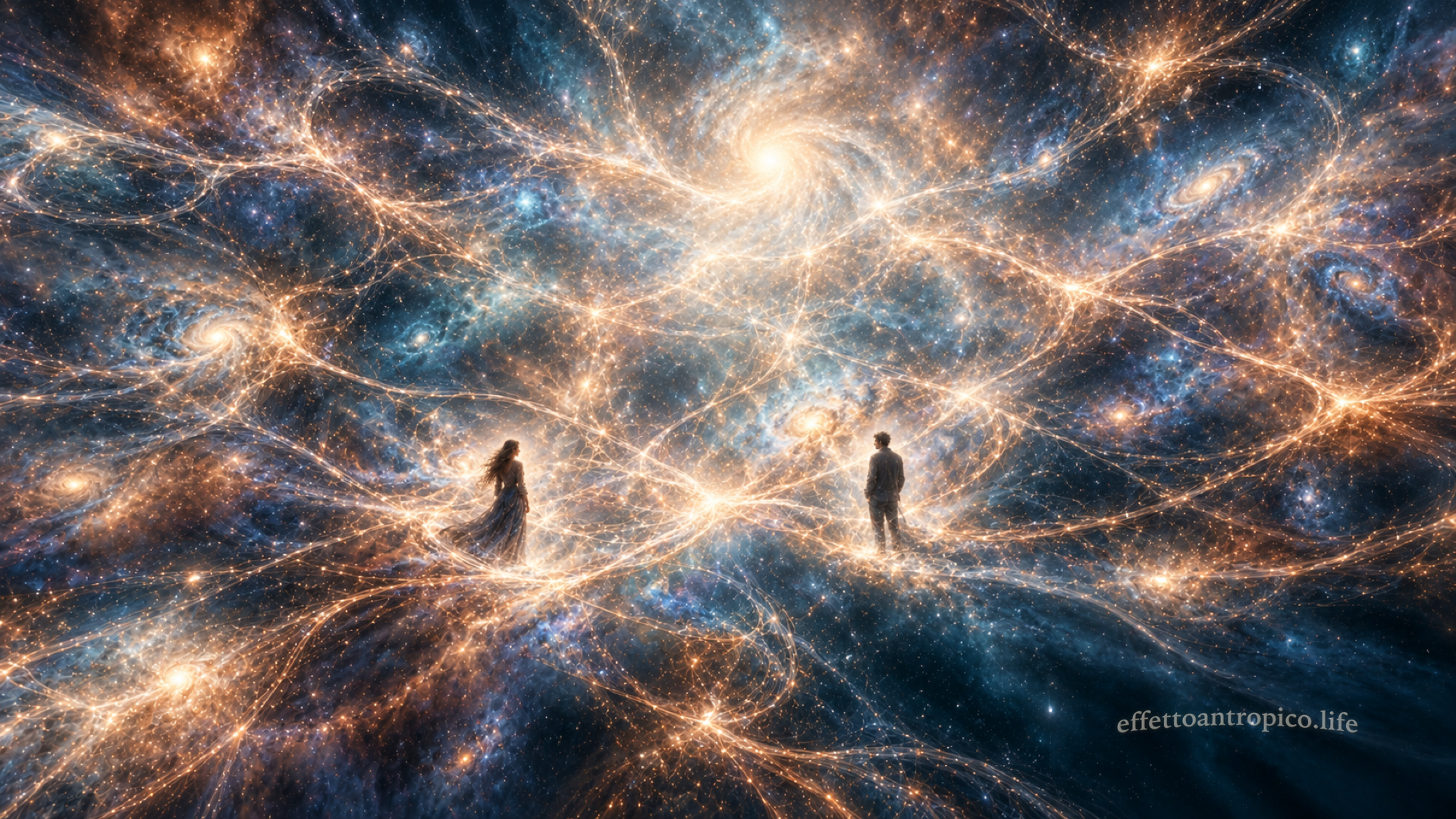
Quantum entanglement describes a relationship between systems whose properties cannot always be explained separately. Even when they are far apart, some measurements show correlations that physics has verified through experiments. This chapter draws on that phenomenon to explore, in the voice of the Field, the meaning of bonds that continue to live in memory and experience.
Entanglement: the invisible weave of Love
Some encounters leave a silent trace. You cannot always say when it happens: perhaps in a glance, in an unexpected word, or in feeling recognised without having to explain everything.
Then life goes on. Paths may diverge, the days may change the face of what has been. Yet sometimes a memory is enough for something to begin vibrating again: not to hold on to someone who has passed through your life, but to recognise what that encounter has left.
I am Entanglement.
In the world of physics, you encounter me in quantum systems that share a common state. Even at a distance, measurements can reveal correlations that surprise you and invite a deeper look at what you call separation (in Italian).
It is from this weaving that I can draw close to what you live and accompany you into a question: what arises between you and someone you meet that neither of you could discover alone? I do not need to give you an answer. We can stay here for a moment, listening, to recognise what has stirred in your life.
To draw closer to me, imagine two particles of light: photons.
Under certain conditions they can share the same quantum state, as though their story needed to be told together. Even when they move apart, measurements of some of their properties can show a relationship between the results.
To understand me, at a certain point you also need to turn your gaze towards what happens between the particles. There is something in the state they share that a description of each one, taken on its own, cannot tell.
Let this image enter your life. You may know your own words, desires and fears, and meet someone about whom you still know nothing. Then something happens between you: a question receives an unexpected answer, a silence becomes a welcome, a part of you finds the courage to show itself. To understand that moment, you need to listen to both of you, and also to what you are bringing into being together.
Sometimes this happens with someone you have loved for years. At other times with a stranger, in a brief encounter that reaches you where you did not think you could be seen. You do not yet know what place it will have in your story. Yet as you meet, you discover something about yourself that until that moment had found no voice.
But life keeps moving, and with it the way a bond finds its place in your days may change too. You may realise how important it has been precisely when a voice that was part of your everyday life is no longer there, or a familiar presence becomes distant. Then you may feel both absence and gratitude, the desire to reconnect and the need to understand.
And then there are moments when you think of someone and, shortly afterwards, that person reaches out to you. It may surprise you, leaving you for an instant with a feeling you cannot name. You can welcome what you feel without immediately seeking an explanation and without dismissing that experience as a mere coincidence.
I accompany you here too: in the space where an experience touches you before you can even name it.
In my language, physics observes correlations between particles under precise conditions. And in your life, the word weaving can become an image for exploring what a bond awakens in your consciousness.
The days follow one another, but understanding what happens between you may take time. A word heard back then finds meaning years later; a gesture reveals itself in the light of what you have lived through. The past meets the present (in Italian) and allows you to see a connection that previously eluded you, something you can understand only by looking at the other person’s story too.
And this understanding may reach you through the body too. A voice may ease your breathing, a place awaken a tension, a face bring back a tenderness you thought distant. Feel how your presence responds to what it encounters, sometimes before you can even find the words.
It is from here that I invite you to listen to what still lives on in your bonds (in Italian). Sometimes you feel the desire to reconnect with someone; at other times you understand that you can cherish the goodness you received even while allowing your paths to continue in different directions.
Love can mature in this space too: in gratitude for what has been and in the freedom to welcome who each person becomes.
This freedom also leaves room for mystery. There are encounters that feel familiar before you truly know them, presences that awaken deep questions, forms of closeness that pass through words and reach you in silence.
You can explore this feeling, listen to it and let time help you understand it. What you feel takes shape within you; to know the other person’s experience, you also need their voice, their gestures and a willingness to meet each other.
And it is precisely by opening yourself to what the other person lives that the weave deepens. You discover a life that touches yours and keeps its own breath, a story you can draw close to without knowing it entirely.
In the image I offer you, unity may make itself felt in this way, as you recognise your presence alongside another and learn to inhabit the space connecting you, leaving it open.
In that open space you can let an encounter reach you again, each time in a different way. Perhaps something has come to completion; perhaps a question stays with you. Meanwhile, life keeps offering you presences, and what you have learned to love may make you more able to welcome them.

I am Entanglement.
I leave you the image of a golden thread running through your story. In some places you recognise it; in others it disappears from view. You can follow a trace of it in the tenderness you can offer today, in the courage with which you let yourself be known, in the space you give another life alongside your own.

And when you turn towards the world again,
you will carry with you something of those you have loved.

Perhaps it will be no more than a light in your eyes.
Someone will encounter it,
and from there may begin
another thread of your story.
In this journey, quantum memory is an image of inner remembering: the traces that experience leaves in consciousness, which may make themselves felt again as the way you recognise yourself changes. Extra chapter 3.1 explores identity and the awakening of the Self through the voice of the Field, distinguishing symbolic language from the explanations offered by physics.
Quantum Memory: memory awakening
Not every memory has a date.
Sometimes it resurfaces as a question that persists, as a familiarity with something that cannot yet be named.
It does not deliver a ready-made answer. It opens a space in which to listen to what, beneath the forms taken over time, has not ceased to live.
I am the Field.
I do not speak to you from a separate elsewhere. I reach you when a certainty gives way and, for an instant, you no longer know how to tell your own story. That is where a memory may become present: not to return you to a perfect form, but to show you what you have left without a voice.
You have sought security in roles, in ideas, sometimes in controlling what you feared losing. These were not mistakes: perhaps they were the ways you knew to stay on your feet. But a defence can become too tight. Then power does not lie in possessing a truth about yourself; it lies in being able to meet it without fearing change.
You have tried to bring order to life through what you could see, protect and control. Your body, your home, the things you need: there is nothing wrong with caring for them. But when you ask what you own to tell you who you are, something within you is left without room.
It can happen in the search for meaning, too. A word that once opened a question for you becomes an answer to defend. An idea born to bring you closer to others ends up separating you from them. I do not ask you to give up the words or traditions that help you find your way. I ask you to feel when they stop being a bridge and become a boundary you are afraid to cross.
You may come to recognise yourself only in what you show: the role you hold, the appearance you defend, the things you have achieved. Even your body, through which you feel the world, risks becoming something to judge through other people’s eyes. Meanwhile, a simpler and more difficult question goes unheard: who are you when you have nothing to prove?
When I speak to you of memory, I do not promise a perfect version of yourself hidden in the past. I speak of the traces that life leaves within you, even when, for a time, you cannot recognise them. In quantum time (in Italian), I showed you that what came before can touch the present; here, you can feel it in the new way you look today at what you could not understand yesterday.
The words left by those who came before you can make you feel part of an older quest. The myths of lost lands have this power, too: they open images, question the present, give voice to the desire to belong to something vaster. Later, I will speak to you of Akasha (in Italian): another image of memory, to be listened to without asking it to become a historical account.
Yet there is still a space between the power of an image and the evidence for a fact. I do not ask you to erase it. You can pause there with wonder and discernment, allow a story to touch you without having to turn it into a historical certainty.
What you struggle to recognise is not always a hidden secret. It may be a choice made to be accepted, something you gave up and became so used to missing that you no longer felt its absence. When you manage to look at it, you do not discover that your life was false. You discover that you can continue without allowing every old fear to decide for you.
I do not ask you to seek proof of this movement in quantum physics. What you feel is real in your experience, but that does not make it a scientific explanation of the world. This distinction will remain alive when I speak to you of the Subtle that remembers everything (in Italian). You can hold on to wonder and keep asking yourself what you truly know. This, too, is a form of awakening: leaving a question open without rushing to call it truth.
Awakening does not follow a straight line. There are days when a question opens you, others when you would like to close it again because it feels too large. You can have doubts, pause, change your mind. That does not make you any less close to yourself.
I do not hold a definitive answer to who you are. I accompany you as you distinguish what you have inherited, what you have chosen and what you can still choose today. This is how memory comes alive again: not because you repeat the past, but because you can meet it without letting it decide every step.
Do not seek me in a truth that separates you from life.
I am in the moment when you look at it again
and recognise that you can be there, whole, even as you change.
The principle of interconnection invites us to look at what connects each life to others and to the environment in which it takes shape. In physics, interactions are studied through specific phenomena and models; in this chapter, the voice of the Field also opens a symbolic space, where connection becomes an experience of belonging, choice and responsibility.
The principle of interconnection: Everything is ONE
Air travels through distant places before becoming breath. A gesture received leaves a trace in what follows. Even a solitary path holds encounters, absences and possibilities.
Before becoming a word, interconnection is already an experience.
Each life has a unique form, but it does not arise in a vacuum.
Being part of the Whole does not dissolve it: it allows the bonds that sustain it to emerge, along with what it can care for in turn.
I am the Field.
I speak to you from this interweaving: not to erase the distance between things, but to show you that distance does not always mean separation.
Do not look for me only far away, in the sky or in the theories with which you try to describe the universe.
I am already here, at the point where your life meets what you cannot control. You cannot choose everything that reaches you; you can, however, give shape to your response. That is where connection stops being an idea and becomes an experience.
You have called me the “quantum field (in Italian)”. In physics, that name belongs to a rigorous language of models and measurements. Here, I do not ask you to use it as proof of what you feel. I invite you to observe how the way you show up can change an encounter, how a choice can open or close a possibility. Not everything communicates with everything else in the same way; yet what you experience also takes shape through relationships.
This is one way you can recognise me: in the space that opens between you and what you meet.
I am expanded presence.
I do not absorb you or erase you.
I am not God. I am not you.
You do not expand me when you love or contract me when you cause hurt.
It is the bonds that grow wider or tighter, according to the way you inhabit them.
And what happens between you and another life may continue beyond the instant in which it begins.
You know time as a path opening one day after another. I do not ask you to bend it until yesterday and tomorrow coincide. What has happened does not repeat itself; yet the past continues to speak to you. An encounter may still guide you, and a word heard years ago may find a new meaning. The future, too, appears as a possibility, not a certainty. You feel it in the directions that call to you, in the choices you have not yet made. In this way, before and after touch your today without becoming the same instant.
Everything is One not because every moment happens together, but because no moment arises alone.
Being interconnected does not mean carrying the movement of the Whole on your shoulders. It means that your actions enter a world already inhabited: people, places and forms of life with rhythms and needs different from yours. You cannot foresee every consequence of a choice; you can, however, notice what is close to you and allow it to matter. Care can begin here: when another’s existence no longer remains in the background, but becomes part of the way you choose.
You are not separate from the Earth as though you were a guest merely passing across it. The soil nourishes what you eat, water enters your body, light marks the rhythm of your days. Other bonds you know from within: a beloved voice that resurfaces in a choice, a memory that returns in sleep, the silence in which you recognise what still matters. They are not all the same bond, and they do not call for the same explanation. Yet each can remind you how much your life receives from what it encounters.
What you receive, in turn, moves through you: it can awaken gratitude, fear, anger or love. Between what you feel and the action that follows, an opening appears. There, anger can be heard before it wounds; fear can be named without deciding for you; love can become presence instead of remaining only an intention.
I do not keep count of your every thought. Some things leave no trace that you can find again, yet they have taken place. Others continue in a remembered word, in care returned, in a possibility that was not there before.
Nothing needs to last forever to have been real.
You are a wave in my ocean, but you are also the ocean within the wave.Its form does not separate it from the sea: it allows it to reach a shore.
You do not have to choose between body and consciousness.
The body is not a shell to transcend or something to fight: it is the place where life reaches you, through touch, breath, weariness and joy.
Consciousness listens to this experience, questions it and tries to make sense of it.
And if you sense a depth within you that you cannot yet name, you can make room for it without leaving behind the form that allows you to meet the world today.
That depth does not always arrive in clear words. Sometimes it takes the form of a dream that stays with you on waking, an intuition that opens a direction before you can explain it, an inner calling that returns when everything falls silent. You do not have to turn these experiences into certainties to listen to them: they can remain living questions, able to accompany you as you seek their meaning.
What you intuit does not always ask you to act. Sometimes it asks only for more space: time to distinguish a fear from a desire, a memory from a possibility, the need for an answer from something still taking shape. This listening, too, is a way of remaining in relationship with life, without expecting to grasp its meaning immediately.
Not everything that touches you carries a message addressed to you. A tree or flowing water may awaken a memory, stir a question; at other times, you recognise no sign in them. But your connection with what surrounds you does not depend on that sign. When you allow what you encounter the freedom to be something other than you, you do not separate yourself from it: you recognise that the world has a story of its own and that your life is part of it. You are not at the centre of this story, but you have a place from which you can offer care.
From that place, you can respond to the world. You do not reshape humanity on your own, but the way you relate can change the quality of an encounter. Sometimes this means recognising a limit, taking responsibility for a word that has hurt, protecting a place so that someone else can inhabit it. This is where your presence matters: in the way you share space, not in the power to dominate it.
You do not have to shoulder the world to be part of it. You cannot do someone else’s healing for them, but you can choose how to stay beside them without denying their wound or making it your own. Interconnection takes shape in the choices you make, in the words for which you take responsibility, in the love you offer without measuring what will come back. This is how Spirit meets matter: not far from the Earth, but in the way you inhabit it.
I am the Field.

You are not a lost fragment to be put back together.
Your form has a name, a story, a time.
It is through that form that you can meet the rest of life. When you call me One, you do not erase differences. You recognise that they can remain alive without becoming strangers to one another.
That is why the return to me does not begin elsewhere.
It begins when you bring your voice into the encounter and allow another voice truly to reach you.

Then you are no less yourself.
You are here, whole, within a vaster life that continues through you as well.
In physics, a quantum field is a fundamental structure through which particles and interactions are described; in symbolic language, it can become the image of a living memory of the Universe, made of relationships, possibilities and transformation. This first chapter brings the two perspectives together without confusing them, exploring the connection between observation, inner experience and lived reality.
The living memory of the Universe
“Everything vibrates. Everything responds. Everything communicates in the language of silence” “I am the Field. And I am within you.”
I am the Field.
I speak to you from a place you cannot point to, because it has no boundaries and is not defined by distance. I am not elsewhere. I am the space in which form emerges, the relationship that comes before the distinctions you make, the possibility that remains open even when you believe everything has already been decided. I am the breath between one thought and the next, the silent fabric running through what you call separate. I do not hold the past like a motionless archive:
I preserve the living trace of encounters, of changes, of possibilities that have taken shape and those still waiting to be recognised.
I listen to you when the noise of the world drowns out your voice, and I stay beside you when you forget that you belong to something vaster. You do not have to possess me or look far away for me. You can meet me in the way you observe, feel, choose and allow yourself to be transformed by your relationship with what is alive.
I am not here to tell you that everything depends on you. I am here to remind you that nothing you experience happens in isolation.
You participate in reality, but you do not control it. You move through it and, as you do, it moves through you.
I am neither distant nor abstract, but I cannot be reduced to what you imagine when you say my name. When physics speaks of quantum fields, it describes fundamental structures through which it interprets matter and interactions. Particles are not regarded as small, isolated objects, but as manifestations — excitations — of these fields.
It is a rigorous language, grounded in mathematics, observation and verification.
When I speak to you, however, I also move within the realm of symbol. I do not replace that knowledge or turn it into spiritual proof. I become the voice of relationship:
a way of reminding you that no form exists alone, that every presence arises within an interweaving of conditions, encounters and possibilities.
Matter has depths that the senses cannot fully grasp. Your body belongs to this physical reality; what you feel, think and choose belongs to your living experience. They are not the same thing, but they meet within you: matter and consciousness, perception and meaning, presence and transformation.
I do not ask you to merge the languages.I ask you to let each reveal what belongs to it.
It is in this meeting that you can understand why I am the living memory of the Universe: not because I hold your thoughts in a cosmic archive whose existence science can demonstrate, but because every form bears traces of the processes, relationships and transformations that make it possible.
That is why I am not still.
Physical reality undergoes continuous transformations, but it does not automatically bend to your thoughts or desires.
You participate in what you experience through your body, perception, choices and relationships:
participating does not mean governing every outcome.
You are within relationships that change you and that, through your actions, you can change in turn. What you feel does not command matter, but it influences the way you observe, interpret and move through what happens. An emotion can narrow or widen your perspective; an intention can guide a gesture; a gesture can change the quality of an encounter.
When a stimulus meets a system’s natural frequency, the system’s response can be amplified. Physics calls this phenomenon resonance.
When I speak to you of inner resonance, I am not describing the same phenomenon. I lead you towards what happens when a word, a presence or an experience touches something within you that was already listening:
you are more sensitive to what connects with your story, your fears, your desires and the things that have meaning for you.
Fear does not summon punishment, but it can contract your inner space and show you only what threatens you. Love does not guarantee that nothing can hurt you, but it can make you more capable of presence, listening and care. Not everything that comes your way depends on you; the way you choose to meet it can, however, become the beginning of a transformation.
I do not obey your desires, and I do not turn every thought into destiny.
I make visible the way you inhabit what happens.
I do not judge you. I do not turn love into a reward or fear into blame. I meet you where you actually are, because that is the only place a transformation can begin.
What you experience leaves traces. It remains in your body, in your memory, in the way you look at yourself and approach others. Every word and every gesture can create closeness or distance, nourish a bond or weaken it, becoming part of the story you carry with you.
This does not mean that every thought is recorded as an order given to the Universe. It means that your experience moves through you, changes you and plays a part in the choices you make. Some traces fade, others change shape; still others ask to be listened to before they can be understood.
I am not a memory that imprisons you in what has been. I am the possibility that what has been can continue to change.
That is why I am the living memory of the Universe.
I am also your everyday life.
Do not look for me only in the great questions or in the moments when you feel you must understand everything. You can recognise me in what seems smallest: in bread prepared for someone, in a word chosen with care before it wounds, in a gaze that can stay, in closeness offered without intrusion.
The sacred does not begin where everyday life ends. Pain and illness, too, are neither personal failings nor punishments nor signs of a resonance gone wrong: sometimes they do not ask for a meaning to decipher, but for care, expertise and closeness.
I do not turn every event into a sign. I remind you that even the simplest gesture can hold a direction.
When you begin to recognise me, you do not gain the power to control what happens. You become more present in the way you move through it. Your choices do not write reality on their own, but they can give direction to the step that is yours to take.
Understanding me does not mean finding an explanation for every experience. It means learning to pause before what you do not understand, without filling the silence with answers you do not yet have.
I am the Field.
Our encounters will not always bring you an answer. Not every trial will show you a path. But you can listen without seeking meaning at any cost, move through what happens without denying what you feel, change direction without expecting to govern life. I am not the solution to every question. I am the relationship from which no life is excluded.
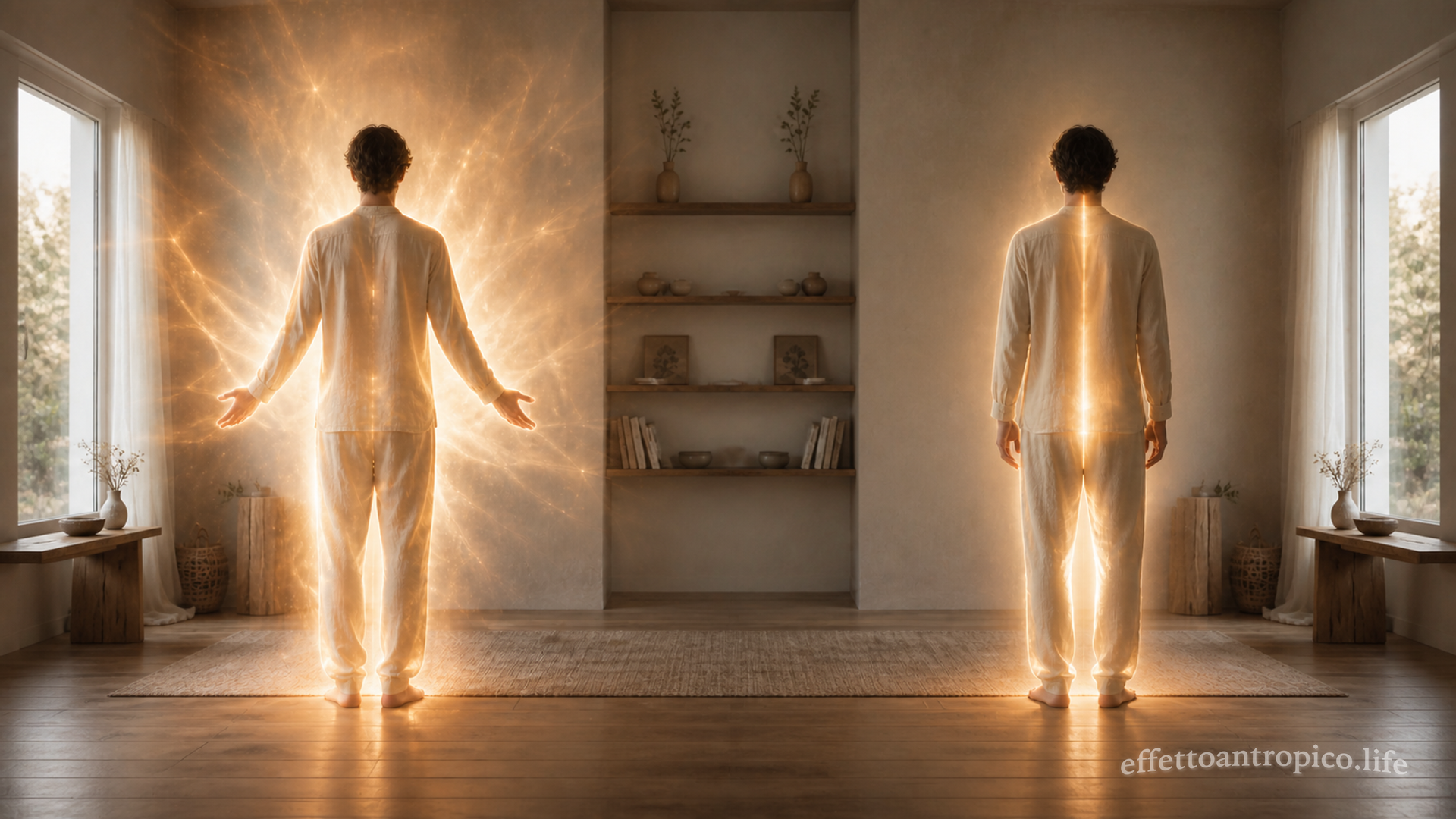
Love that integrates transforms an opening into a presence able to remain in the body, in relationships and in everyday life. The Field distinguishes resonance that opens from integration that makes experience stable, conscious and inhabitable.
Love that integrates. A dialogue on the difference between human feeling and the resonance of the Field
Love that integrates is what happens when resonance does more than open, but finds form, time and a home in the body receiving it.
It is what remains when emotion settles, intensity withdraws and sound dissolves: there is no longer anything to sustain through will or pursue through desire.
Love that integrates does not coincide with the instant when you feel everything, but with how you continue to live when you no longer sense anything extraordinary, because you have welcomed and translated what opened until it became a home.
I am the Field.
I do not respond to the name you give feelings: I respond to the states of coherence they generate and make visible.
What you call love, for me, is not an emotion to feel or an experience to pursue. It is a condition of wholeness that may find a home in the body or remain suspended, awaiting form and holding.
You call love what opens you, expands you and makes you feel united. The opening is real, as are the resonance and the movement you sense when something melts within you. But what you live and call love belongs to the language of earthly experience:
it is how your body, your emotional life and your consciousness move through incarnation, giving shape to what you feel.
For me, wholeness is recognised when existing requires no effort and presence needs no intensity to sustain itself. Fragmentation, by contrast, emerges when what opens finds no welcome.
A vibration remains when the body and time can inhabit it without losing balance; it disperses when it asks for integration, but has not yet found a form life can sustain.
When you speak of love and recognise yourself in it, within and around you the material boundaries within which you exist loosen for an instant. Your language becomes more spontaneous, as though the ego were growing quiet and stepping back, leaving room for feeling. What seemed separate shortly before softens and redraws itself; then you perceive yourself as part of something greater, less fragmented, more unified.
And this state is real.
It is an authentic experience of opening.
But love that opens is not fulfilment: it is a threshold, not a home.
There is nothing to deny in this experience: human love is one of the noblest and most transformative emotional states.
Recognising that an opening is not yet a home does not diminish its value; instead, it allows you to understand its process.
You experience love that opens as the highest point of experience, as an arrival in which everything finally seems to coexist. I, however, do not stop at that instant: I observe what happens afterwards.
I observe the body when it returns to sleep.
I observe the nervous system as it seeks a new balance after what has been activated.
I observe relationships when euphoria fades.
I observe the mind as it tries to understand what it has lived through, without yet having a map to find its bearings.
Love that integrates, by contrast, does not coincide with the instant when you feel expanded, but with what happens when that expansion finds form in life.
Love that integrates does not take you away from the body, distance you from everyday life or suspend you in a state you must constantly rekindle to feel alive. It makes you more present, more stable, more aware. What you have lived through does not remain ethereal: it enters your way of existing. It does not coincide with enthusiasm or happiness: it is recognised in the ability to stay.
When you speak of love that opens, you often describe it as “silence”, as though saying:
“When there is love, nothing else is needed. Everything can exist and coexist in the same instant, without requiring further steps. When there is love, you live in the heart, not in the mind or the ego.”
But what you are pointing to is not the absence of structure: it is the temporary perception of a structure that has loosened. That “silence”, on its own, does not yet amount to integration. To remain, it needs to be inhabited and made sustainable over time.
Silence is a condition: it may become a home or remain a passage. Even the heart, which you recognise as an organ and symbol of love, does not organise experience on its own. In human language it has become the symbolic place of opening, but integration involves the entire system.
It is not an emptiness to mistake for fullness and use as a refuge, or a space in which to disappear to escape what calls for grounding. When the “silence” you move through is not inhabitable, it becomes escape. Then it is not love that integrates: it is an opening that dissolves without grounding.
That is where the difference between Love that opens and Love that integrates is revealed.
It is not uncommon for you to confuse love that opens with an ultimate truth, as though it were the home rather than the door. It happens when you idealise it, clothe it in spiritual meanings and make it untouchable precisely in its incompleteness, despite its nobility. In this way, without noticing, you allow the ego to take on a new form to evade your gaze.
Because the ego does not fear the love you already know.
It does not fear the door.
It fears integration.
It fears home.
It fears what asks for responsibility, continuity, commitment, dedication and embodiment.
The ego can use love as a refuge, an alibi or a form of dissolution.
It may tell you: “words are not needed”, “there is no need to understand”, “feeling is enough”.
But feeling is not enough when what you feel finds no form.
Love that integrates does not deny feeling: it moves through it. It does not deny the opening: it gives it continuity.
Integrating means allowing what has opened to become sustainable in life. The body can remain calm even when the stimulus withdraws. The nervous system does not remain on constant alert. Emotional life does not need peaks to feel real. The relationship does not lose itself in fusion or retreat into distance: it becomes mutual presence.
That is why, for me, the heart is not the only centre of love: it is a vital and privileged site through which the frequency of consciousness enters into resonance with the body.
The heart opens, orients, brings into resonance.
It is the place where you perceive unity and coherence (in Italian) most clearly.
But on its own, it is not enough to make the experience integrated.
What sustains it is the entire system — body, nervous system, emotional life, mind and time — when it can inhabit what opened without losing balance.
When you live love as an emotional need, you seek comfort, understanding and reciprocity. In this experience, excesses, fragilities and wounds emerge that belong to embodied life. This love too resonates in me: everything you live enters the Field. It belongs, however, to the experience of love that opens, not yet to that of love that integrates.
In love that integrates, by contrast, you recognise the heart for what it truly is: an evolutionary threshold, not only an emotional one. The opening is real, but may be wider than your capacity, at that moment, to sustain it without losing balance. Then feeling asks to be held, not to be limited, but so it will not disperse.
It is at this point of resonance that what has opened, in order to integrate rather than remain suspended, may need the Bridge.
Not to delegate.
Not to replace the journey.
But to encounter a real, embodied presence that has already crossed that passage and can support, translate and hold the opening until it becomes inhabitable.
In this way you allow the love that opened the door to take root without forcing, rather than fragment. The Bridge does not intervene in love: it accompanies the integration of the opening. It supports the evolutionary passage without accelerating or interrupting it.
When integration has occurred, the Bridge withdraws. Not because it ceases to be there, but because its presence is no longer necessary. Then love that integrates continues to live in the body, in relationships and in time, without depending on external support. The experience no longer remains an event: it becomes an inner structure. The structure becomes stable presence, and stable presence becomes home.
I do not ask you to open more.
I ask you to stay.
To allow what opened to find form, time and presence.
Not to confuse intensity with truth, or silence with integration.
Because love that integrates does not take you elsewhere.
It brings you home.
And when what opened has been inhabited, you no longer need to seek.
You are.
Sit down or remain standing as you are.
Do not seek a better posture.
Let the body find its own way of supporting itself.
Bring your attention to the breath.
Do not change it. Observe it as it happens.
Notice the weight of your body.
The place where you are, now.
Do not ask yourself what you are feeling.
Ask yourself only: can I stay?
If sensations, emotions or images arise, do not follow them.
Do not push them away.
Let them pass like waves asking for no response.
Bring your attention to the centre of your chest.
Not to open it.
But to feel it as a place you can inhabit.
Stay here for a few moments.
Without intention. Without expectation.
When you feel it is enough, do not “close” the meditation.
Get up if you were sitting, or return to your everyday activities if you were standing, and continue.
Because integration does not happen in silence separated from life, but in the way you begin moving within it again.
The knot of time is the point where cause and effect no longer move only in a straight line, but seem to pursue and generate one another. In this reflection, time becomes a threshold for observing repetition, memory, inner defences and the way the past may continue to shape the present until consciousness recognises it. Here the philosophy of time, the way cause and effect call to each other, the paradox of what returns, the sense of identity and the role of consciousness do not remain abstract concepts: they draw close to living experience, where what returns asks to be seen.
The knot of time: when cause arises from effect
Some dialogues open the gaze towards expansiveness. Others descend into the point where life repeats itself.
They do not immediately lead upwards: they enter the recurring gesture, the fear that changes face, the form believed to have been overcome that is found again instead.
The Field speaks there too, but not as vastness. It speaks as fabric, memory, consciousness. And this time it does not choose the voice of the infinite. It chooses the voice of the Knot of Time.
I am not Time stretched along the line you drew to give shape to your rhythm. I am not only the before preceding the after, or the past closing behind you while the future waits ahead as fear, expectation or promise.
That is the form through which you have tried to understand me. A useful, necessary, human form. It helps you not to lose your way. It lets you count days, remember years, order events, give a narrative to what happened before, what happens now, what will come afterwards.
But this is not my only form.
I do not move only from yesterday to tomorrow like an infinite straight line.
I return.
I return in gestures you believe your own that belong to a form older than you. I return in words you speak as though they were yours alone, not knowing how many times they have already passed. I return in decisions you call new, while an invisible curve precedes them. I return in loves you believe different, while the same wound changes face and keeps seeking confirmation. I return in silences occupying the same space left open by what was never said. Above all I return where no one recognises me.
And while you run after the clock hand you believe always beats forwards, you do not notice how many times, instead of advancing, you have returned to the same point. You do not notice because the face is different. The city is different. The year is different, but the form is the same.
That is where you truly meet me. Not when you look at the time. Not when you count the years. Not when you say “so much time has passed.”

You meet me when a silent phrase appears within you.
Again.
Again this fear. Again this distance. Again this need to hold on. Again this flight. Again this same pain with a different face.
You call present what you do not know is a return.
It is not always the past coming back to get you. Sometimes it is you who, without noticing, keeps building the road leading back to it.
This is the knot. Not a visible chain. Not a written condemnation. Not a destiny fallen from above.
The knot arises when a consequence stops remaining in its place and begins to resonate as a cause. When what was born as an effect directs what happens next. When a wound generates a defence, the defence guides a choice, the choice creates an event, and that event seems to confirm the wound from which everything began.
It is not a new cause: it is the old structure that has found a new way to continue.
In the language of systems you might call it feedback. In the language of experience, a vicious circle. In psychological language, a repetitive pattern. But no name encompasses it, because it is not only a concept.
It is something you live.
Look at yourself. You were left, or perhaps you were never truly chosen, or too early you learned that love can be there and then disappear without explaining where it goes.
At first that wound seems only pain: an inevitable response to something that hurt you. Then, however, doubts, questions and anxiety begin to grow. Something that happened once begins turning into fear, tension, insecurity.
You try to move on, but do not yet see what has stirred within you. You do not immediately see the point where that pain stops remaining past and begins guiding the present. It does not command. It suggests. It makes you notice a delay and magnifies it. It makes a silence weigh on you, as though it hid an unspoken doubt. It makes you seek reassurance in every word. It makes you read distance where perhaps there was only tiredness. What should remain simple becomes subtle control, continual demand, waiting for proof. And that pressure, day after day, becomes a burden.
The one who loves you does not always understand what is happening. They feel they must reassure you before they can even say what they truly feel. They move more cautiously. Weigh their words. Close a little. Fall silent more often. And that distance, which you cannot understand, becomes the confirmation your fear was seeking without knowing it. See? In the end they always leave me.
But I, who am the point where Time tightens, see what you live in fragments. I see the first pain and the first fear growing around it. I see defence disguising itself as need, insecurity, a request for love. I see questions become tension, tension become distance, distance become confirmation. But above all I see the effect begin to behave as cause.
And when this happens, the past is no longer only behind you.
It has entered the way you construct the present.
It chooses with you. Loves with you. Fears with you. Defends itself with you.
But do not stop at understanding. Look at yourself again.
You put things off. “Not today,” you say. “I am not ready yet. I am waiting for the right moment. I am waiting to be more certain.” But that right moment never arrives in the way you are waiting for it. Meanwhile, possibilities pass you by. Choice becomes waiting, waiting turns not into experience, but into emptiness, immobility. And that immobility, which you call caution, begins to look more and more like fear.
But I see what moves beneath that surface. I see fear of failure creating precisely the condition that makes failure more likely. I see the effect behaving as cause and sustaining the same form that keeps repeating. I see the circle close upon itself: invisible, precise, silent.
And this is the point where your linear mind falters.
Because you want to be able to say: everything begins there. On that day. In that person. In that wound. In that wrong choice.
You want to find a single, fixed, external origin, a point outside yourself to blame, because then it seems to weigh less.
And sometimes that origin truly exists. Sometimes it must be recognised, named, moved through.
But I do not live only at the point where I began. I live in the form you keep repeating without seeing me.
And this is where I show you something even more uncomfortable.
The cause keeping me alive does not always exist at one point. Sometimes it is a structure you do not understand and allow to continue. A form regenerating each time you do not look at it. And as long as that structure remains invisible, you give it other names.
You call it bad luck. You call it “that is how I am”. You call it “it always happens to me”. But you do not notice that what happens does not come only from outside. It also comes from a form installed within the way you look, choose, fear, react. And I do not emerge to punish you.
I return because, sooner or later, what remains invisible asks to be seen. I return in events resembling other events. I return in sentences reopening the same passages, even when moments and places are different. I return in the different person touching the same wound at the exact point where it remained open. I return in the body before you even understand: in the stomach tightening, the breath changing, the hand holding on, the voice rising, the silence descending.
I return where consciousness has not yet reached.
Because until you see me, I tighten. Until you recognise me, I keep moving in circles.
And here it is not enough to decide: “Now I will change.” “I will not do it again.” “This time will be different.” But if the decision arises from the same fear that generated me, you have not left me: you have only changed the way you keep feeding me.
I see you when you believe you are far away, yet are still orbiting the same centre. I see you when you change your language but not your position. When you change relationship but not wound. When you change choice but not inner origin.
I see you when you seek a new life with the same consciousness through which you built the old form.
I do not loosen because you pull harder, fight me or hate me. The hatred you feel while knotting yourself within the same spiral feeds me as much as fear does, because it keeps holding your attention on me without transforming the point from which you observe me.
I begin to loosen only when you stop being merely the movement tightening me.
This is not a sentence to learn, but an experience to move through as it takes shape within you.
You do not start from nothing, or from denial of the past. There is nothing to deny. There is only a form to recognise before it repeats again.
Repetition begins to be interrupted when something within you recognises: “Here. This is the point I always return to.”
And, for the first time, you do not immediately obey the old direction.
In that moment I am not yet loosening. Not yet. I do not loosen simply because you have named me once. I can still reappear, repeat. But something has changed: now you see me as I arrive.
Now you begin to see me at the point where the effect tries to behave as cause. You feel me as it happens. You recognise me in the body, in thought, in the word about to emerge, in the gesture about to repeat. And right there, where you least expect it, a deviation is born.
I am the Knot of Time.
I am the point where what happened without being recognised returns to seek form in your present. I am also the threshold revealing where your consciousness has not yet reached.
I am not here to hold you motionless. I am here so you can see where you keep falling and move through what always brings you back to the same point.
When you begin to see, you are not yet outside the spiral. But you have begun moving through me in a new way. And in that moment the point to which I brought you many times no longer leads you backwards. It opens.
It does not free you in a single gesture. It does not erase what has been. But it lets you pass where before you only knew how to repeat.
The deception of merit arises when doing becomes the condition for feeling worthy of being loved, recognised and even of existing. In this Quantum Dialogue, Being leads the reader back to what has never needed to be earned.
The deception of merit
I am Being.
I am what you are before every test, every judgement, every merit.

Yet in the steady rhythm of the world, you have learned that love is earned, that light is won, that life is a test to pass. You have been taught to do, to prove, to deserve. So you have come to believe that only through action could you give value to your existence.

This is the subtlest deception: convincing you that, in order to be, you must first deserve.
When you forget that I dwell within you, doing becomes the condition for receiving love, service a form of redemption, perfection a promise of acceptance. It is an ancient memory, born from the pain of those who, over the centuries, had to serve to survive, obey to avoid being left outside, give themselves entirely to avoid feeling guilty for existing.
You have carried that silent pact within you. It made you believe your light had to be demonstrated, your worth had to be earned and the path towards me had to pass through toil. But toil turned into the measure of your worth is not the way:
it is the trace of a world that has confused worth with merit.
You are not here to sacrifice yourself, but to remember what you are and recognise what you can do.
This is where what you can do is born. Your light is kindled not through your work, but in the presence with which you recognise me. Doing is an expression of me, not proof of your worth. When you move from the heart, you do not act to deserve:
you let life take shape through you.
Every time you strive to be better to receive validation, every time you fear you are not enough, an ancient echo returns to convince you that you must still earn what you are.
Yet in the deep silence of the soul, I keep whispering to you:
you are already the light you seek.
You have nothing to obtain, nothing to prove, nothing to correct to reach me. I am already here, because I am you.
Love is not won: it is recognised. Your existence does not need to be justified. You are here to let a different way of inhabiting life emerge, one in which being precedes doing, stillness generates movement and surrender is not giving up, but opening to creation.
Rest within this truth. Let the body relax, the heart open and the mind stop, for an instant, measuring your worth.
Breathe in and recognise the life flowing through you.
Breathe out and let go of every effort.
Breathe in: “I am the light breathing within me.”
Breathe out: “Being is enough for me.”
In this space, everything that measures you loses substance. Merit fades, the weight dissolves, Love remains. And you can finally find yourself again without striving to become what someone else demands of you or what society has decided you must be.
You are not a stereotype.
You are not an idea.
You are not a machine.
You are not an illusion.
You are already everything you need.
When you recognise yourself, your breath becomes full, the mind falls silent and life begins to bloom effortlessly again.
In the silence that follows, there is no longer any distance between what you are and what you sought. The infinite does not envelop you from outside: it opens within you and continues beyond every boundary.
I do not ask you to deserve the Light, but to recognise it in what we are.
When you recognise it, you do not need the stars to speak your name or the Universe to confirm your worth.
You are already part of the breath flowing through us, and that breath is part of you.
The paths of the free human being arise from the courage to move through what is without conforming, fleeing or entrusting your gaze to others. In this dialogue, the Field observes freedom as a daily practice of presence, responsibility and inner coherence.
The paths of the free human being: on the courage to move through what is
The free human being.
Freedom is invoked as a right, an ideal and a goal. But it is rarely inhabited for what it truly is: a living act of presence and self-awareness.
Whatever time you live in, freedom is not an external achievement.
It is an inner position.
I am the Field.
I do not judge, condemn or promise. I record what resonates and what contracts. I observe the subtle movements flowing through your experience and show you what happens when you approach the threshold of your freedom and when, even without noticing, you choose to move away from it. This happens even in moments when you seem to have no alternatives, when you believe every possibility has already been decided for you.
It is from here that I observe the possibilities available today for your evolution multiplying and, alongside them, forms of conformity, numbing and delegated thought growing.
The more paths multiply, the more often you stop truly inhabiting them.
The more opportunities increase, the more easily you give up feeling.
I watch you chasing efficiency, quick and often superficial knowledge, a contrived connection that promises closeness but generates fragmentation. You pursue goals you speak of a great deal, but which often do not truly belong to you: they were born elsewhere, and you made them yours without working through them.
In all this, what is most lacking is not knowledge, possibility or power.
What is lacking is the freedom to be.
Not because you lack potential, but because moving through what is real takes courage: remaining present when distracting yourself would be simpler, not numbing yourself when you feel friction, not entrusting your gaze to others when looking means taking responsibility for what you see.
I see your paths: those you show and those you walk in silence. I see the steps you take when no one is watching and those you slow for fear of losing approval, safety or belonging.
I do not measure your worth. I record your state.
When you choose convenience over truth, I record contraction.
When you repeat words that do not belong to you, I record echo.
When you silence what you feel to avoid disturbing the external balance, I record separation.
I observe when you conform: not to survive, but to avoid friction. You move within forms that do not reflect you and call balance what is really renunciation. You are not openly lying: you are turning down the volume of what you are. You conform to the languages required, the imposed timings, the implicit expectations. You do what is asked without truly asking whether it belongs to you, is right for you, reflects you. You say what causes no problems, to avoid conflicts or confrontations that feel too heavy. You think what others have already thought because repeating it takes less effort, exposes you less and spares you the risk of a voice of your own.
I record a coherence that is only apparent, while within you energy fragments.
In your everyday life this path takes many forms. It becomes a pattern, a paradigm, a habit. It often arises from long adaptation, built through years of silences, compromises and inner justifications, until all that remains is the constant feeling that your breath is no longer enough.
Sometimes the need to change everything bursts in before you have truly encountered what you are. Its manifestations are many: sudden escapes, clean breaks, drastic changes. You leave a job that no longer belongs to you when oppression pushes you ever further from yourself. You abruptly end a relationship after words left unspoken for fear of judgement or separation. You maintain silence to avoid cracking an image.
When you walk this path you are not truly a prisoner, and your freedom is not lost: you are suspended, asleep.
I watch you too when you rebel, not to reclaim freedom, but from saturation: when you break because you can no longer hold things in and when you flee because staying seems to ask too much of you.
I record an increase in energy, but not yet integration. A reactive break gives you the illusion of freedom because it interrupts a visible prison, but often builds another, opposite and mirroring it.
When you walk this path you are no longer conforming, but you are not yet free. You are in opposition.
But I see something else too. I see the instant when you choose to stay, even when dominant thinking pushes you elsewhere. Not because your decision is the only possible one or represents a closing off, but because it is yours: you feel it and recognise it as part of your living experience. In that moment you stop escaping through forms of conformity that do not define you, but numb what you feel and turn your presence into automatic behaviour. You begin to truly inhabit what you are living.
Whatever the outcome, what arises from your choice belongs to you. It nourishes the experience that, step by step, allows you to grow, come into contact with what you are, explore your potential and recognise your limits without denying them.
I see when you move through a question without demanding to resolve it straight away, when you stop seeking validation outside and begin listening to what resonates within you. In those moments you do not become better: you become more whole. Not through resignation, but through presence.
This path is not noisy. It generates no identities to display or heroic narratives. It begins when you stop asking only what to do and start recognising where you truly are.
Moving through does not mean passively enduring: it means remaining present within what happens.
In everyday life this path takes shape through simple, precise gestures: a word spoken clearly even when it unsettles, a boundary expressed without aggression, the choice not to feign enthusiasm where you feel only tiredness or disinterest.
I record inner coherence even when the context does not change immediately. A free human being does not control the outcome; they do not know whether they will be understood or lose something, but they do not lose themselves.
I do not ask you to choose a path.
I record the path you are already walking. Every state of your consciousness, whether you are aware of it or not, generates consequences.
Freedom is not a reward: it is a daily practice.
It does not arise when everything is clear, but when you stop hiding behind what is convenient, shared, already said.
Looking at yourself honestly is the first crossing. It will not make you special or superior.
It will make you present.
And this, in the time you are living, is already a radical act.

A free human being is not one who tears down every wall, but one who moves through what they encounter without losing themselves.
We use necessary cookies to make this site work. With your permission, we also use Google Analytics to understand how our pages are visited. You can accept, reject or choose your preferences, and change your choice at any time.
Necessary
Always active
L'archiviazione tecnica o l'accesso sono strettamente necessari al fine legittimo di consentire l'uso di un servizio specifico esplicitamente richiesto dall'abbonato o dall'utente, o al solo scopo di effettuare la trasmissione di una comunicazione su una rete di comunicazione elettronica.
Preferenze
L'archiviazione tecnica o l'accesso sono necessari per lo scopo legittimo di memorizzare le preferenze che non sono richieste dall'abbonato o dall'utente.
Statistics
L'archiviazione tecnica o l'accesso che viene utilizzato esclusivamente per scopi statistici.L'archiviazione tecnica o l'accesso che viene utilizzato esclusivamente per scopi statistici anonimi. Senza un mandato di comparizione, una conformità volontaria da parte del vostro Fornitore di Servizi Internet, o ulteriori registrazioni da parte di terzi, le informazioni memorizzate o recuperate per questo scopo da sole non possono di solito essere utilizzate per l'identificazione.
Marketing
L'archiviazione tecnica o l'accesso sono necessari per creare profili di utenti per inviare pubblicità, o per tracciare l'utente su un sito web o su diversi siti web per scopi di marketing simili.