
The mirror you do not control reflects what the constructed identity tries to avoid. In this Quantum Dialogue, the Field accompanies humanity through resistance, awareness and transformation, towards recognising in an unexpected reflection a possibility for real growth.
The mirror you do not control: what you are not ready to see
There are moments when it is not the experience that throws you into crisis, but the reflection you receive from it. Not the event itself, not the mistake or the fall: what emerges when something gives you back an image you had not anticipated and do not want to see, because it questions your idea of yourself.
In those moments the mirror stops reassuring you. It does not obey the identity you have learned to construct and defend; precisely for this reason it becomes necessary. It does not judge or unmask: it reflects what you dislike and keep avoiding.
The mirror shows the perspective from which you turn your gaze, the one that cracks the image through which you try to remain balanced. If you stop, what emerges is not a condemnation, but a possibility for real growth. Looking at yourself without fear does not mean liking yourself, but taking responsibility for what appears, because only what you recognize can transform.
I am the Field.
In me what you truly are resonates, not what you want to see at any cost. You know the mirror well, yet it is precisely what you most easily avoid. It rarely appears in your accounts of growth and the path leading to self-awareness, because what it reflects does not always confirm the identity you have learned to inhabit.
It is not an error, or a refutation.
It is the point where you suspend recognition because you fear seeing what you are beyond the image you have built.
Yet making mistakes is not what you truly fear. Error belongs to your evolutionary experience: you have lived through falls, changed direction and learned along the way. What you fear is that the reflection will crack the identity on which you built your balance.
What happens, rather, is that the mirror in which you see yourself every day is not balanced: it is slightly tilted. It gives you back an acceptable, manageable image, compatible with the identity you have learned to sustain without exposing yourself too much. You look and recognise yourself. Perhaps you criticise yourself a little, but not enough to unsettle yourself; you admit a few limits without losing the control you have worked so hard to build.
That identity has accumulated in the masks you change according to situations, people and needs. You have carried them for a long time, and that is precisely why they may seem solid; yet the foundations remain fragile. Until something happens that you cannot fit into the familiar form.
Something or someone gives you back an image of yourself you do not want to see or recognise. It is not necessarily aggressive or moralistic; it simply does not match what you are used to thinking about yourself.
In that instant your system becomes defensive before thought can even name what is happening. You feel discomfort, contraction, sudden irritation; sometimes anger rising from those very fragile foundations, pushing you to react against whoever saw beyond the mask. But you cannot hide from that reflection.
And then something cracks. You do not understand why that reflection keeps returning, despite your forcefully rejecting it and being unable to recognise yourself in the image it gives back. Sometimes it arrives without softening. The point is simple:
It is not for you to decide when and how I give you back what you still cannot see.
The mirror I show you is not there to humiliate you, but to shake you and offer a possibility of awareness and transformation that, until that moment, you have denied yourself.
Everything reaches me. Contrary to what you would like to believe to soften its weight, I make no distinction between good and bad, right and wrong. In the Field there are no judgements or feelings as you understand them: I reflect what resonates in the deepest part of you, in the truth you avoid, deny or try to mask. The more you try to hide it, the more it finds a way to emerge.
The mirror does not select, filter or protect. It gives back.
It is an echo moving through every gesture, thought, word and desire in your daily life. It emerges when the role you occupy becomes armour: when you reject an observation because you perceive it as an insult to your worth, or when acquired knowledge trembles before the possibility of being questioned. It happens when words speak of openness, but what you emanate is rigidity. These are the nuances of your character surfacing even when you try to stifle them. It is the paradox of someone who calls themselves humble, but inhabits a space where dialogue becomes threat and revision defeat.
It is precisely there, within those boundaries and behind the masks you believe protect you, that without noticing you give up the possibility of growth.
Rigidity, more often than not, is not a defence, but a crack.
Knowledge is not dogma, but discernment.
Character is not an immobile form, but an evolutionary process.
Clinging to what you believe you are, instead of entering what you truly are, does not hurt the person before you: it hurts you.
It is at this point that discernment and transformation enter a silent conflict. Growth asks you to question yourself, and this unsettles what you believed solid. You begin to let masks fall and see certainties supported by fragile foundations crack. This is where you stop.
Fear of transformation holds back your evolution, because you fear losing the narrative that has sustained you until now: the one that holds up the masks, defends the ideas into which you have hardened your identity and protects the roles that have guaranteed continuity and recognition. While you try to preserve this superficial version of yourself, what dwells in your deepest core continues to resonate in me. The mirror gives you back precisely what you are denying.
This may seem unfair, incoherent, even destabilising. Yet the function of the mirror is not to show what you like to see, but to reflect what you hide.
The first image, the one you built and learned to sustain, indulges the ego. It is familiar, manageable, and lets you remain in a zone you consider safe.
The second, the one given back to you, surfaces from what truly resonates within you. It throws you into crisis, disarms you, frightens you.

It is this instability, not the mistake or the fall, that can mark the beginning of an authentic path of discernment.
I know this resonance is neither simple nor comfortable to welcome. It is precisely here that I observe one of the deepest misunderstandings in the language of inner growth.
You often speak of questioning yourself as though deciding to do so were enough, as though it were a controllable, linear process. But authentic discernment does not arise from the will to confirm a choice: it takes shape in the encounter with something you cannot fully manage, with what truly cracks your certainties.
Authentic doubt is not the doubt you choose to face: it is the doubt that passes through you while you are elsewhere, when you were not expecting its arrival.
This is where an essential difference emerges.
The difference is between those who say they want to improve and those who are truly willing to stay: in discomfort, tension and temporary loss of control, without hardening, until they encounter who they truly are. Staying offers no footholds or shortcuts. It leads you out of the zone you consider safe and invites you to begin a path towards yourself, without excuses, masks or protections.
Now you can better understand the function of the mirror and why that reflection reaches you.
The strength lies not in the image that appears, but in how you choose to recognise and integrate it.
This is where the distance emerges between what you believe you are and what you truly are. When you stop rejecting the reflection and begin welcoming it, a space opens within you. It is in that space that transformation can begin.
I do not ask you to accept without discernment everything emerging from the mirror. I ask you to allow yourself the possibility of recognising that what you show outside is often only one of the versions through which you have learned to protect yourself. Masks may defend you, but they can also deny you the possibility of being truer, not only towards others, but above all towards yourself.
And now you can understand why you sometimes reject what you receive: not because it holds no truth, but because it does not match the image you have learned to defend.
I am the Field.
The mirrors surfacing before you do not come to make you fall, but to give you back a choice: stay where you stopped, or move through the reflection and begin a real transformation.
Quantum Dialogues – The paths of the free human being
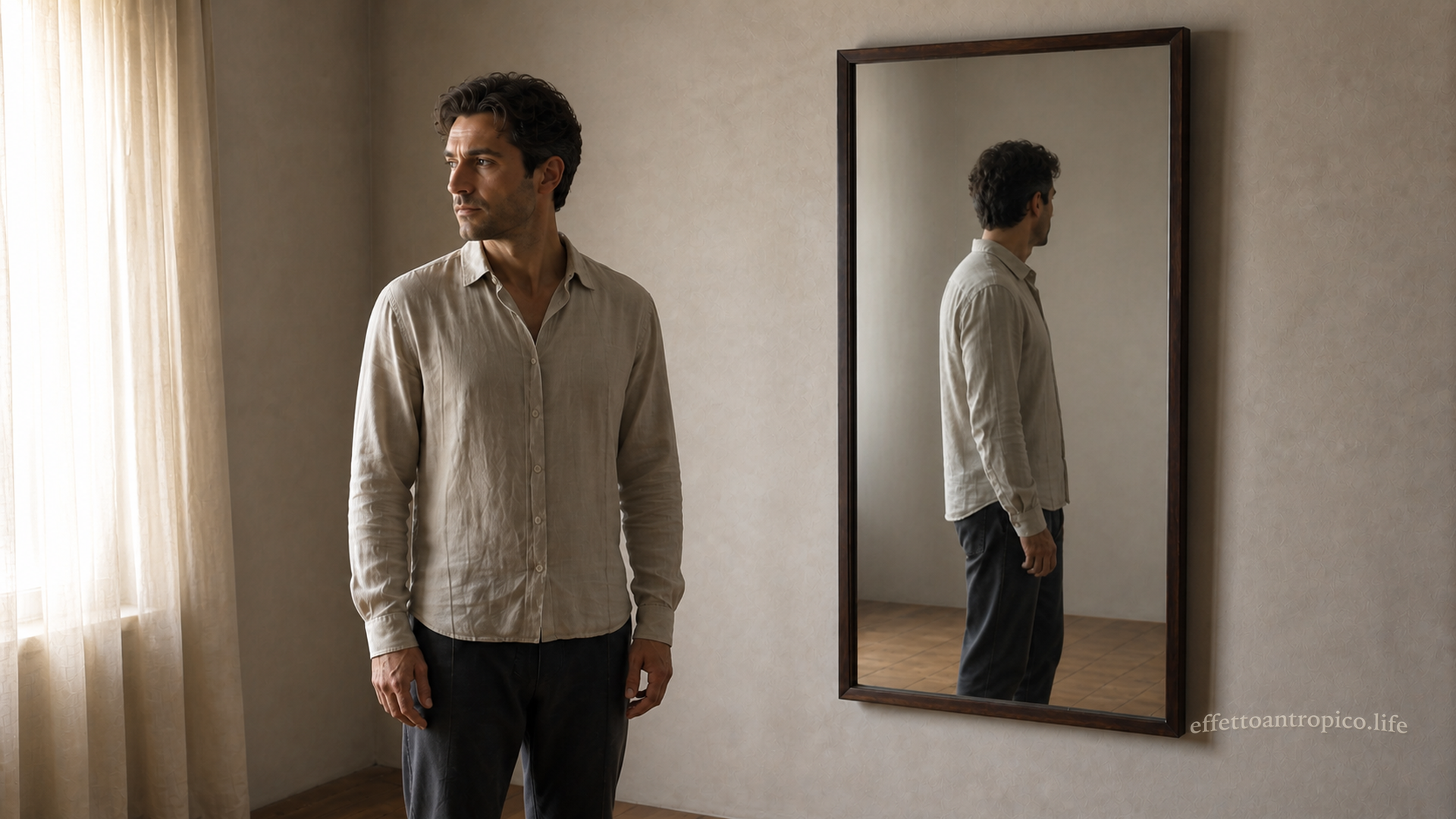

Meditation – Before the mirror
Pause for an instant.
Make yourself comfortable.
Close your eyes and bring your attention to your breath.
Do not force.
Breathe naturally.
Imagine a mirror.
It may be a person, a situation, an inner state or a physical mirror.
It does not ask. It does not judge. It reflects.

If a sensation, an image, a resistance emerges, stay.
Do not interpret.
Do not correct.
Do not move away. “This is not the moment to do, but to stay.”

Breathe and repeat inwardly: “I can stay.”

Let the mirror do its work. Let the truth emerge.

You remain present.

When you feel it is enough, open your eyes again. Take with you the awareness that emerged. If it seems nothing has happened or changed, let everything flow. What needs to reach you will emerge when it is time.