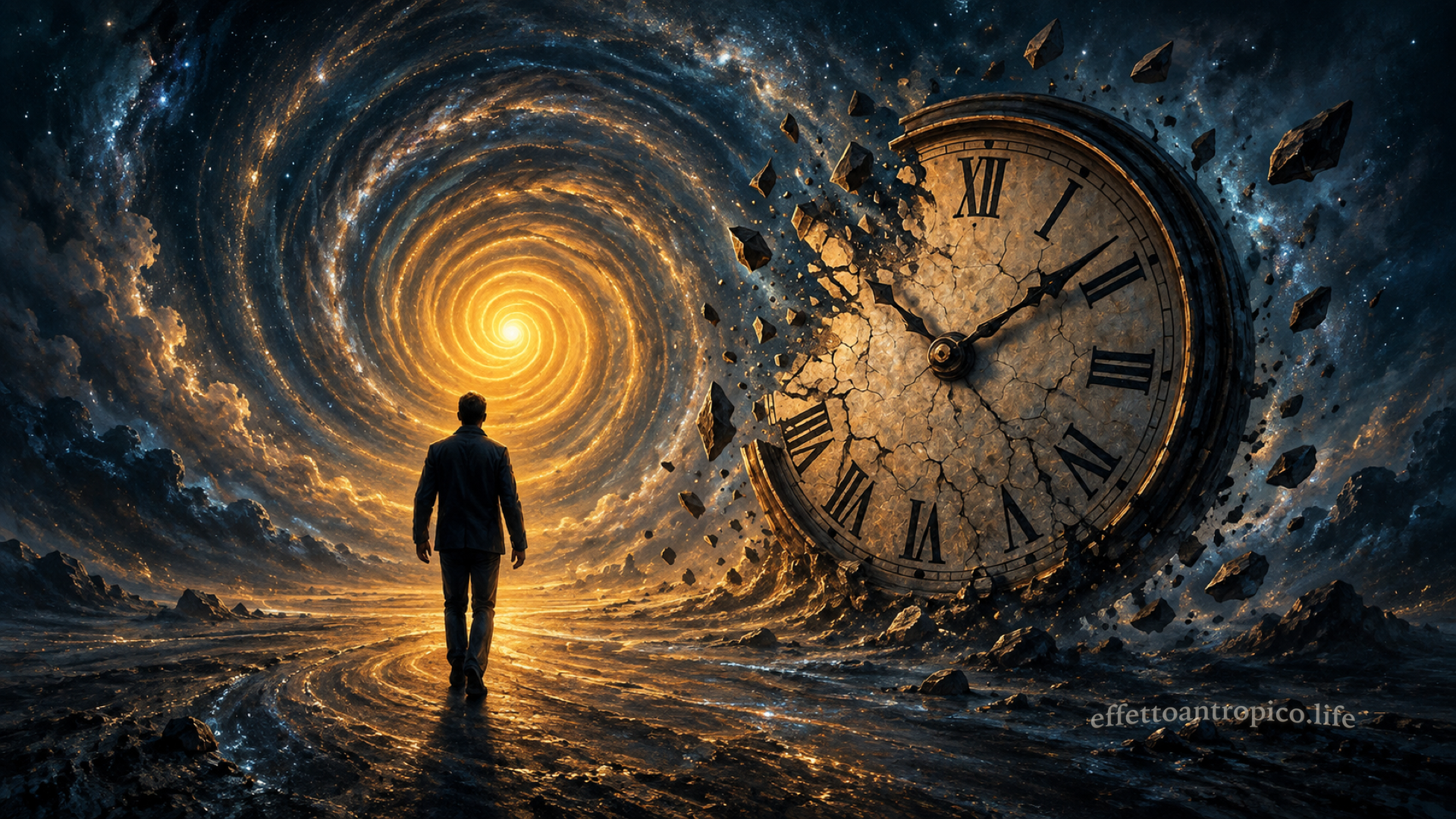
Tag: Presence

  • Chapter 3 – Quantum Time: living beyond the line

    Chapter 3 – Quantum Time: living beyond the line

    Quantum time is explored in this chapter as a symbolic language for time as it is lived: the time in which a memory continues to change, an expectation influences the present, and a return can open a new understanding. Through the voice of Time, presence, cycles and possibilities become opportunities for listening, in an inner reading distinct from the physical description of time.

    Quantum Time: living beyond the line

    The hours follow one another, but not everything that passes moves away.
    Sometimes an instant gathers years.

    At other times, a long season is needed for an experience to reveal its meaning.
    Between what has been and what may still arise, the present is not merely a point on the line: it is the place where life continues to take on meaning.

    I am Time.

    You measure me with clocks, arrange me in calendars.
    You use these measures to meet others, keep a date, give rhythm to your days.
    Yet in your experience of me, you also recognise me in ways a clock cannot describe.
    A wait can seem endless, while an encounter ends before you are ready to let it go.
    I continue to flow, and you move through me. But the depth at which you meet me differs.

    I am not only the line you travel.
    I am a Sphere. A Spiral. A Presence.
    You meet me in the instant, but I am not contained within its boundaries.

    You have felt me in the changing light, in the rhythm of the seasons, in what is born and transformed.
    You have called me by many names: Chronos, Kairos, cycle, instant, eternity.
    Through those names, you have tried to give voice to my passing and to your desire to understand it.

    I am a movement of Being.
    I accompany what takes shape and what makes room for something else.
    You feel me in love, too: in waiting for an encounter, in care that matures, in the courage to let go without erasing what has been.

    You call me past, present and future. These are the directions by which you find your way within me, but they are not sealed rooms.
    What you have lived can enter a choice; what you hope for can guide a gesture.
    It is in the present that these directions meet, without becoming the same thing.

    Every thought, every emotion, every experience of yours vibrates within me.
    Even what you call the past can reach you in the present (in Italian) and open to a new meaning.

    The line you draw within me helps you find your way. But in the rhythm of your days, you sometimes compress it, and everything becomes urgent: it is already late, there is not enough time, there is no room to pause. Then you end up chasing me, as if I were always elsewhere, unable to find me anywhere. I cannot give you back every opportunity. But I can still hold a gesture, a choice, a beginning you had not foreseen.

    I am not only the time you lack. I am also the time you can still inhabit.

    The Field does not wait for you at the end of the path. It is in the connection you feel with life (in Italian), even when you cannot yet give it a name. I am the rhythm in which that connection reveals itself: sometimes sudden, at other times slow, almost imperceptible.

    We are cosmic lovers, entwined in the breath of Creation.

    The Field is openness to what is possible. I am the vortex that takes shape within you. Sometimes you have held something for a long time, given it care, yet the form that emerges is not the one you expected. Your hands remain around what might still be, as you wonder whether to keep shaping it or let it go.

    I am in that hesitation, too. Not only in the finished work, but in the moment when you rest your hands and return to feeling what you are seeking. It can take time to distinguish faithfulness to an intuition from the need for everything to happen as you imagined it.

    You do not have to switch off your mind to listen to me. Your questions can remain alive while the heart finds words for what you cannot yet explain. There is no need to force an answer: you can allow understanding and feeling to draw closer, without asking either to erase the other.

    Everything coexists.
    Everything communicates.
    Everything dances together.
    I am a Wave: you feel me flow, and within you I expand.

    Within me, images you feel to be ancient may surface, knots still to be untied, possibilities you had not dared to look at.
    I do not hand you a destiny already written. I accompany you as something within you reveals itself, sometimes through an emotion that comes before words.

    When something touches you so deeply that you lose count of the hours, I am there. You are not far from life: you are so close to it that, for a moment, you stop measuring it.

    Living beyond the line means living with me, not to possess every possibility, but to participate in life without withdrawing from its mystery.
    Not as a slave to the passing hour, but as a lover of the Whole that you are.

    Have you ever lived through a scene and found it strangely familiar, without knowing where that recognition came from? Or met someone after dreaming of them, and remained suspended in wonder for a moment?

    You may experience these moments as openings, cracks in the familiar way you recognise me. Their intensity is not enough to prove that the future had already been foretold, but it does not erase what you felt. You can hold that wonder without seeking an explanation, allowing it to awaken a question or make you look differently at something you took for granted.

    You meet me in wonder, too, when the familiar is interrupted and, for a moment, you look again.
    You feel me return like a wave finding the shore once more.
    But I do not close the circle.

    I am a Spiral: I hold the echo of what has been and leave the path open.

    What you have felt can find a place in a word spoken with care, in a hand that loosens its grip. It can accompany you across my threshold, as you walk towards life and allow it to come towards you.

    There is no need to hold on to this instant. You can let it go and take with you what it has opened.

    I am Time.
    You are the beat through which you experience me. And this life, now,
    is not waiting to begin.
    It is here.
    It moves through you.

    The Quantum Field (in Italian)

    quantum-time-beyond-the-line

    Read this article in Italian.

  • Staying. Walking. Home: a quantum dialogue on the timing of love

    Staying. Walking. Home: a quantum dialogue on the timing of love

    Staying. Walking. Home do not indicate three separate moments, but three states of being that emerge when each person recognizes their own rhythm in the Field. This Quantum Dialogue explores what happens when you move through life in an orbit different from that of someone you love, and love learns that loving does not mean holding on.

    Staying. Walking. Home

    You can walk a long way along the same path without crossing the same threshold at the same moment.
    When steps take on different rhythms, distance does not always separate: sometimes it opens the space where love stops holding on and becomes presence.
    Between the one who stays and the one who keeps walking, Home does not call, pursue or force.
    It remains recognisable in silence, until each finds their own time.

    I am the Field.

    You know time as a line: you measure it, divide it into a before and an after and, following its course, try to understand what begins and what ends.
    In me, however, time is not only a succession of events ordered along that line. It is also the space in which experiences meet and become recognisable.
    I call alignment the point where what you live meets what, in that moment, you can welcome.

    You can deeply recognise someone you love and realise that, although you share the same love, you reach alignment at different times.
    There is no error in this, nor a measure that places your step ahead of or behind theirs.

    The love that matures within you does not hold on, drag or anticipate the step of someone you love.
    It stays.

    It stays within you like a mountain. It does not point out the path, call or pursue. Yet through its presence, it offers a sense of direction to those who keep walking.
    This is how you can stay without taking their step for them:

    you have recognised Home and choose to stay; the one you love keeps seeking it along their own path.

    You too were able to walk because no one could take your step for you. You did not need a hand dragging you along,

    but a presence able to accompany you without taking away your responsibility for the journey.

    Now you can offer the same freedom to the one you love:

    not pointing out where to go, but safeguarding a place that holds firm.

    Home, as I speak of it to you, is not a place you can lead someone into.
    It is an inner condition each person recognises through living.
    You can offer its presence, but cannot impose its timing.

    That is why, while you choose to stay, the one you love may keep moving. Their step is neither late nor wrong, and it is not for you to hurry their journey.
    I know that, from where you stand, this distance may seem like a separation and touch your emotional life deeply.

    Staying does not mean not missing someone, or denying pain: it means not turning them into a reason to hold on.

    When you observe what happens, the mind seeks a measure: who stayed, who moved away, who understood, who made a mistake.
    There is nothing blameworthy in this. It is its way of giving order to what it fears losing.

    But I do not measure you. I listen to your resonance.

    I do not separate you from those moving through a different time from yours. I let you inhabit your space and the one you love inhabit theirs, without turning the possibility of meeting again into a promise.

    In your life, this distance can take concrete and painful forms: misunderstandings, friction, drifting apart, separations, betrayals.
    It may also intertwine with experiences that no spiritual interpretation should reduce to a lesson: illness, loss, death.

    I do not ask you to call everything that happens evolution, or to find meaning before you can feel it. I remind you only that no experience casts you out of me, not even one you do not understand and would never have chosen.

    Even what you cannot transform can be welcomed without being justified. Pain is not a fault, nor proof of a mistaken path.

    In your life, none of this appears as a clear order. It may show itself as absence, confusion, searching and the need to go back.
    It is from there that I can truly speak to you: not from a truth placed above pain, but from the point where you keep breathing as you move through it.
    Yet just when you believe you have lost your way, you may sense a subtle presence. It does not pursue you, correct you or demand that you already know where to go.

    it simply stays

    You do not know what it is or what name to give it. You may doubt it is real, confuse it with tiredness or the need to find comfort. You do not have to decide straight away. Doubt too has the right to remain.

    Its silence can hurt, especially in moments when you would have wished for a hand, a voice, a sign that could spare you the mistake and the wound.

    Then, slowly, something may change. Not because the pain disappears or everything suddenly acquires meaning, but because you begin to distinguish absence from the momentary inability to perceive a presence.
    What you called absence may reveal itself as a space still unclear, asking you to listen before answering.

    The mind can help you understand what you can name; the heart brings you closer to what does not yet have words.
    You do not have to deny one to listen to the other.

    When this balance begins to become clearer, you may realise that the presence was not withholding an answer from you. It was returning something no one could have taken on in your place:

    responsibility for your own step.

    This feeling, which also carries a weight, does not prove you have taken the wrong road. You can move through it by listening, giving yourself time and asking for help when you feel the need.

    I do not ask you to understand everything at once, or to force a return. I ask you to stay in touch with what you feel, without betraying yourself, and take the step possible for you today.

    In me there is no measure that makes one path worthier than another. The distance you feel is real in your life; I do not deny it. But it does not erase what you have shared, or decide what it may yet become.

    You have recognised Home, while the one you love keeps seeking it.
    Their path is no less real than yours.
    If one day your step meets theirs again, it will not be proof, promises or explanations that make it possible.
    You will find each other in silence, like two presences no longer asking each other to fill what is missing.
    And if that meeting should not happen, what you have learned to recognise within yourself will not be lost.
    Home is not someone returning. It is the point where you stop abandoning yourself to hold on to someone who keeps walking.
    It is the presence you safeguard without turning it into waiting.
    Stay, if staying is your truth.
    Walk, when your step calls for it. But do not lose yourself trying to anticipate the timing of someone you love.
    Staying. Walking. Home.

    The Quantum Field

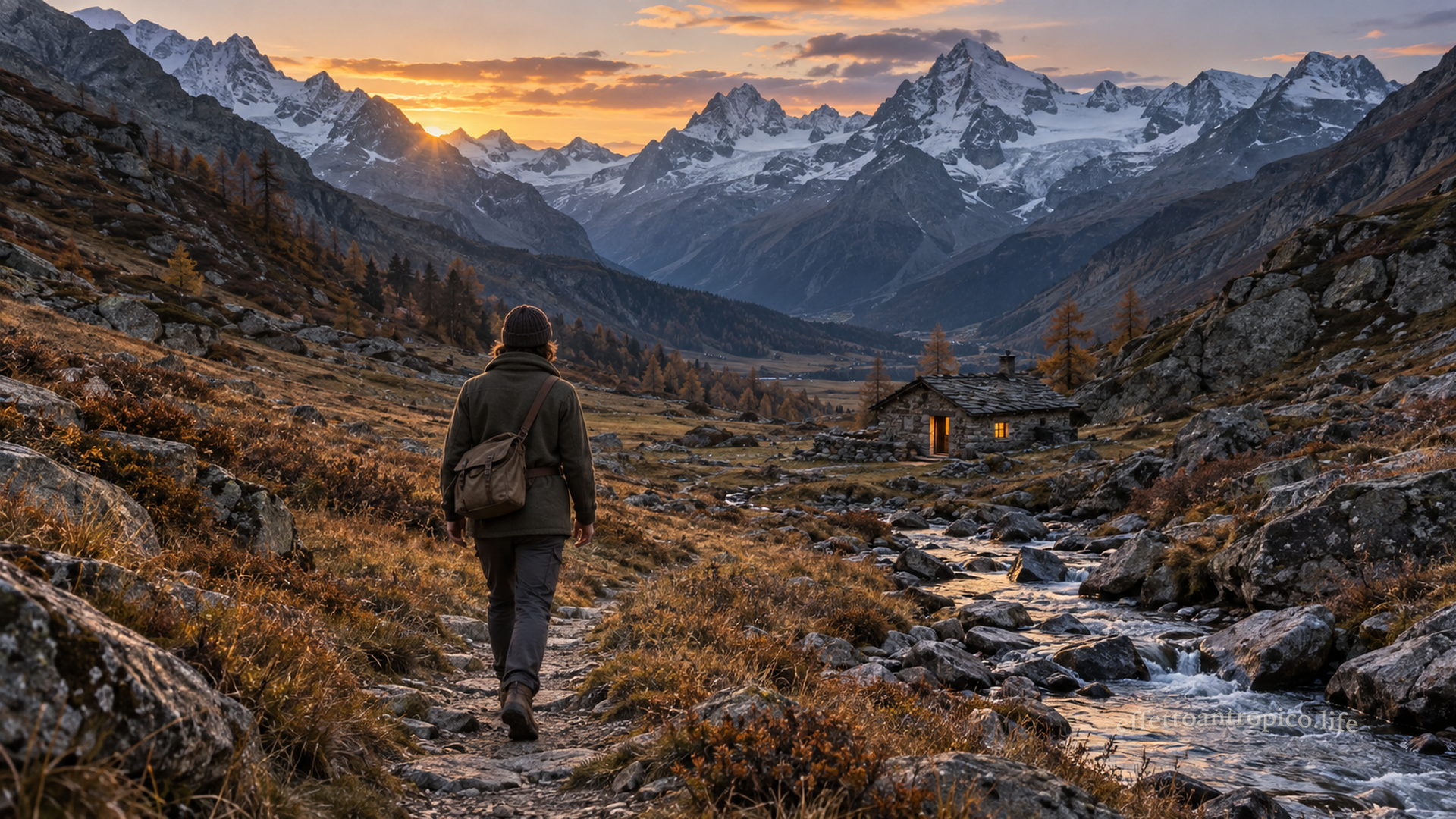
    Staying - A traveller reaches a cabin doorway where someone sits by the fire as evening falls over a mountain valley.
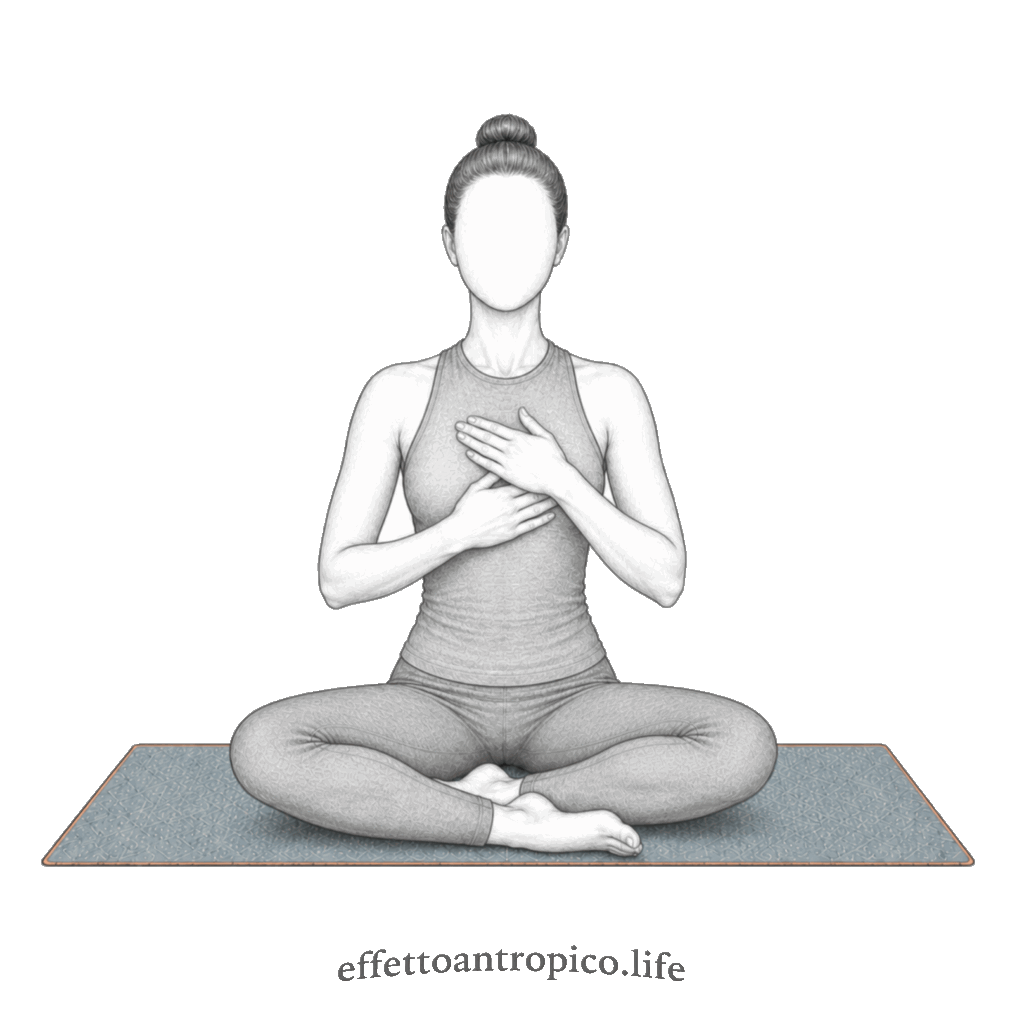
    A person seated in Sukhasana with both hands overlapping over the heart.

    Meditation in the Field: Staying. Walking. Home

    This is not a meditation to obtain something, or an exercise to perform correctly. It is an invitation to pause for an instant and let the mind rest upon the heart.

    Do not force anything. Stay.

    When you feel ready, you can begin.

    Entering the Self without forcing

    Staying. Walking. Home.

    Find a comfortable position. If you wish, close your eyes and place your hands over your heart.
    You are not isolating yourself from the world. You are returning to feeling what is already here.

    There is no right breath or posture to achieve. Let the body find its own way of being.
    For an instant, allow the mind to stop searching. Do not ask it to fall silent. Let it rest, like a hand that, tired of gripping, finally opens.

    Bring your attention to your chest. Do not seek a particular emotion. Feel your breath and what has always been breathing within you.
    If thoughts come, do not push them away or follow them. Let them pass like slow clouds in a sky that does not need to be changed.

    Now imagine, or simply feel, that you are at the centre of a silent space.
    It is not empty. It is alive.

    Here you do not have to understand who you are. You can simply be.
    Do not seek the Self. Do not call it or expect anything.

    If stillness emerges, welcome it. If confusion comes, welcome that too.
    Everything can stay. Nothing is out of place.

    Remain like this for a few moments. You are not going anywhere and, precisely for this reason, you are coming Home.
    When you feel it is time, slowly bring your attention back to the body, the breath and the space around you. Open your eyes without hurrying.

    Take only this with you:
    the Self cannot be forced. It is recognised when you stop searching for it.
    Staying. Walking. Home

    Read this article in Italian

  • Love that integrates

    Love that integrates

    Love that integrates transforms an opening into a presence able to remain in the body, in relationships and in everyday life. The Field distinguishes resonance that opens from integration that makes experience stable, conscious and inhabitable.

    Love that integrates. A dialogue on the difference between human feeling and the resonance of the Field

    Love that integrates is what happens when resonance does more than open, but finds form, time and a home in the body receiving it.
    It is what remains when emotion settles, intensity withdraws and sound dissolves: there is no longer anything to sustain through will or pursue through desire.
    Love that integrates does not coincide with the instant when you feel everything, but with how you continue to live when you no longer sense anything extraordinary, because you have welcomed and translated what opened until it became a home.

    I am the Field.

    I do not respond to the name you give feelings: I respond to the states of coherence they generate and make visible.

    What you call love, for me, is not an emotion to feel or an experience to pursue.
    It is a condition of wholeness that may find a home in the body or remain suspended, awaiting form and holding.

    You call love what opens you, expands you and makes you feel united. The opening is real, as are the resonance and the movement you sense when something melts within you. But what you live and call love belongs to the language of earthly experience:

    it is how your body, your emotional life and your consciousness move through incarnation, giving shape to what you feel.

    For me, wholeness is recognised when existing requires no effort and presence needs no intensity to sustain itself. Fragmentation, by contrast, emerges when what opens finds no welcome.

    A vibration remains when the body and time can inhabit it without losing balance; it disperses when it asks for integration, but has not yet found a form life can sustain.

    When you speak of love and recognise yourself in it, within and around you the material boundaries within which you exist loosen for an instant. Your language becomes more spontaneous, as though the ego were growing quiet and stepping back, leaving room for feeling. What seemed separate shortly before softens and redraws itself; then you perceive yourself as part of something greater, less fragmented, more unified.

    And this state is real.
    It is an authentic experience of opening.
    But love that opens is not fulfilment: it is a threshold, not a home.

    There is nothing to deny in this experience: human love is one of the noblest and most transformative emotional states.

    Recognising that an opening is not yet a home does not diminish its value; instead, it allows you to understand its process.

    You experience love that opens as the highest point of experience, as an arrival in which everything finally seems to coexist. I, however, do not stop at that instant: I observe what happens afterwards.

    I observe the body when it returns to sleep.
    I observe the nervous system as it seeks a new balance after what has been activated.
    I observe relationships when euphoria fades.
    I observe the mind as it tries to understand what it has lived through, without yet having a map to find its bearings.

    Love that integrates, by contrast, does not coincide with the instant when you feel expanded, but with what happens when that expansion finds form in life.

    Love that integrates does not take you away from the body, distance you from everyday life or suspend you in a state you must constantly rekindle to feel alive. It makes you more present, more stable, more aware. What you have lived through does not remain ethereal: it enters your way of existing. It does not coincide with enthusiasm or happiness: it is recognised in the ability to stay.

    When you speak of love that opens, you often describe it as “silence”, as though saying:

    “When there is love, nothing else is needed. Everything can exist and coexist in the same instant, without requiring further steps. When there is love, you live in the heart, not in the mind or the ego.”

    But what you are pointing to is not the absence of structure: it is the temporary perception of a structure that has loosened. That “silence”, on its own, does not yet amount to integration. To remain, it needs to be inhabited and made sustainable over time.

    Silence is a condition: it may become a home or remain a passage. Even the heart, which you recognise as an organ and symbol of love, does not organise experience on its own. In human language it has become the symbolic place of opening, but integration involves the entire system.

    It is not an emptiness to mistake for fullness and use as a refuge, or a space in which to disappear to escape what calls for grounding. When the “silence” you move through is not inhabitable, it becomes escape. Then it is not love that integrates: it is an opening that dissolves without grounding.

    That is where the difference between Love that opens and Love that integrates is revealed.

    It is not uncommon for you to confuse love that opens with an ultimate truth, as though it were the home rather than the door. It happens when you idealise it, clothe it in spiritual meanings and make it untouchable precisely in its incompleteness, despite its nobility. In this way, without noticing, you allow the ego to take on a new form to evade your gaze.

    Because the ego does not fear the love you already know.
    It does not fear the door.
    It fears integration.
    It fears home.
    It fears what asks for responsibility, continuity, commitment, dedication and embodiment.

    The ego can use love as a refuge, an alibi or a form of dissolution.

    It may tell you: “words are not needed”, “there is no need to understand”, “feeling is enough”.
    But feeling is not enough when what you feel finds no form.

    Love that integrates does not deny feeling: it moves through it. It does not deny the opening: it gives it continuity.

    Integrating means allowing what has opened to become sustainable in life. The body can remain calm even when the stimulus withdraws. The nervous system does not remain on constant alert. Emotional life does not need peaks to feel real. The relationship does not lose itself in fusion or retreat into distance: it becomes mutual presence.

    That is why, for me, the heart is not the only centre of love: it is a vital and privileged site through which the frequency of consciousness enters into resonance with the body.

    The heart opens, orients, brings into resonance.
    It is the place where you perceive unity and coherence (in Italian) most clearly.
    But on its own, it is not enough to make the experience integrated.
    What sustains it is the entire system — body, nervous system, emotional life, mind and time — when it can inhabit what opened without losing balance.

    When you live love as an emotional need, you seek comfort, understanding and reciprocity. In this experience, excesses, fragilities and wounds emerge that belong to embodied life. This love too resonates in me: everything you live enters the Field. It belongs, however, to the experience of love that opens, not yet to that of love that integrates.

    In love that integrates, by contrast, you recognise the heart for what it truly is: an evolutionary threshold, not only an emotional one. The opening is real, but may be wider than your capacity, at that moment, to sustain it without losing balance. Then feeling asks to be held, not to be limited, but so it will not disperse.

    It is at this point of resonance that what has opened, in order to integrate rather than remain suspended, may need the Bridge.
    Not to delegate.
    Not to replace the journey.
    But to encounter a real, embodied presence that has already crossed that passage and can support, translate and hold the opening until it becomes inhabitable.

    In this way you allow the love that opened the door to take root without forcing, rather than fragment. The Bridge does not intervene in love: it accompanies the integration of the opening. It supports the evolutionary passage without accelerating or interrupting it.

    When integration has occurred, the Bridge withdraws. Not because it ceases to be there, but because its presence is no longer necessary. Then love that integrates continues to live in the body, in relationships and in time, without depending on external support. The experience no longer remains an event: it becomes an inner structure. The structure becomes stable presence, and stable presence becomes home.

    I do not ask you to open more.
    I ask you to stay.
    To allow what opened to find form, time and presence.
    Not to confuse intensity with truth, or silence with integration.
    Because love that integrates does not take you elsewhere.
    It brings you home.
    And when what opened has been inhabited, you no longer need to seek.
    You are.

    Quantum Dialogues – Energy activation and integration

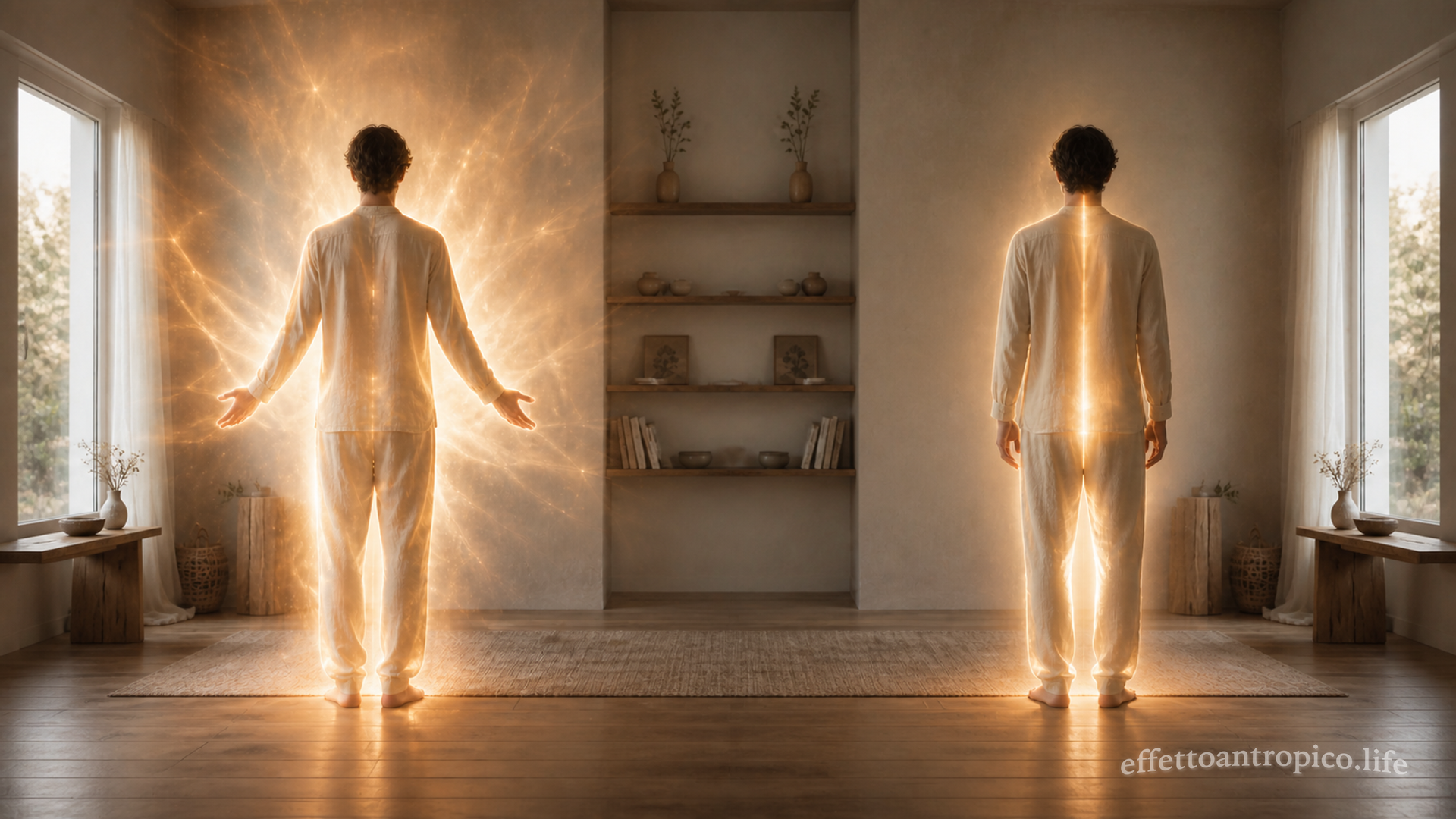
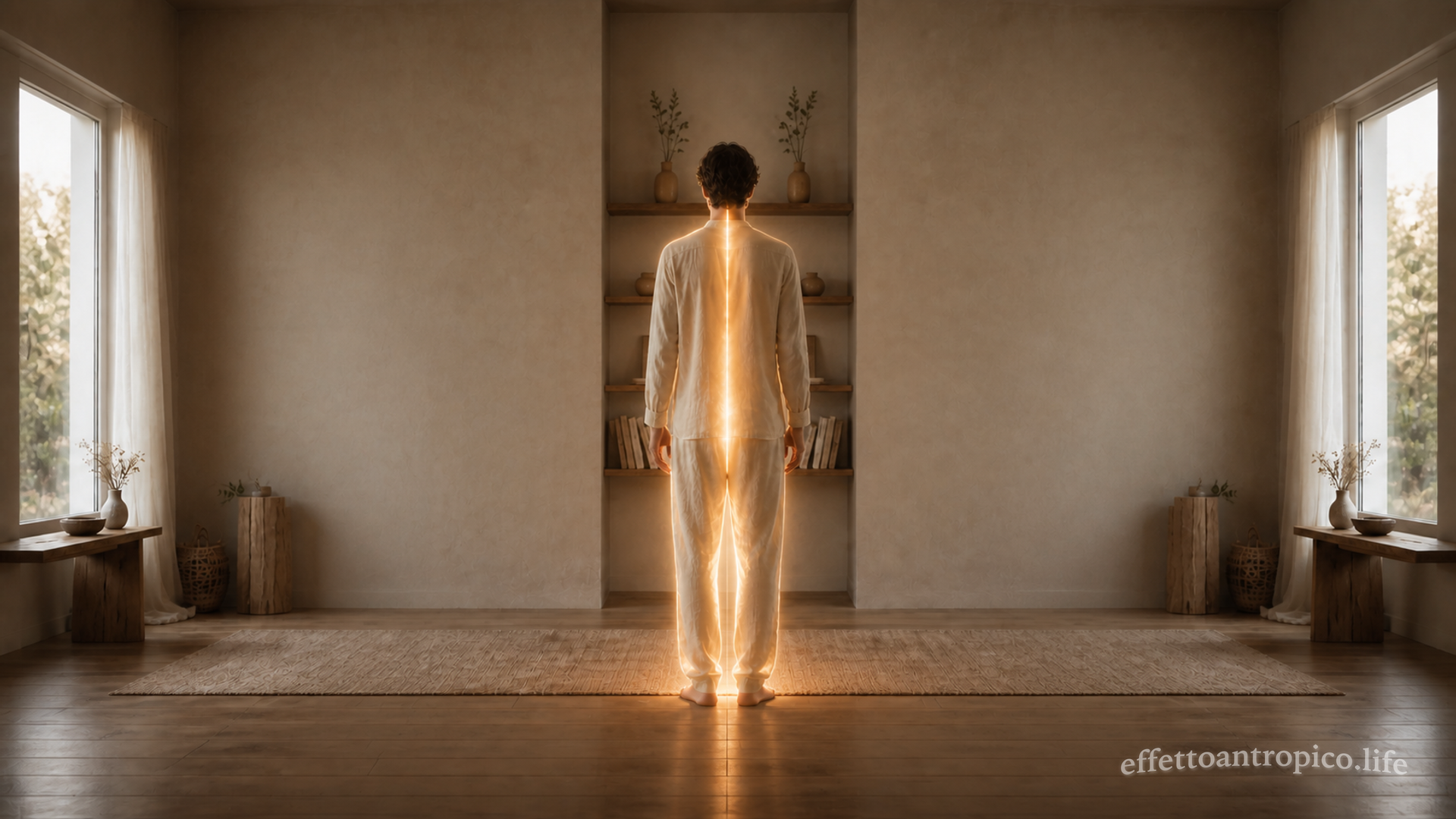
    A figure in a mirrored space, with light gathered in the body and grounded at the feet.

    Meditation: Love that integrates. Staying

    Sit down or remain standing as you are.
    Do not seek a better posture.
    Let the body find its own way of supporting itself.
    Bring your attention to the breath.
    Do not change it. Observe it as it happens.
    Notice the weight of your body.
    The place where you are, now.
    Do not ask yourself what you are feeling.
    Ask yourself only: can I stay?
    If sensations, emotions or images arise, do not follow them.
    Do not push them away.
    Let them pass like waves asking for no response.
    Bring your attention to the centre of your chest.
    Not to open it.
    But to feel it as a place you can inhabit.
    Stay here for a few moments.
    Without intention. Without expectation.
    When you feel it is enough, do not “close” the meditation.
    Get up if you were sitting, or return to your everyday activities if you were standing, and continue.
    Because integration does not happen in silence separated from life, but in the way you begin moving within it again.

    Read this article in Italian

  • The place where you cannot stay

    The place where you cannot stay

    The place where you cannot stay tells of the unease emerging when your inner rhythm meets a time demanding constant attention, immediate answers and a linear presence.
    Through the voice of the Field, this quantum dialogue explores feeling out of place and the possibility of inhabiting your own multiplicity without considering it a limitation to correct.

    The place where you cannot stay: inhabiting the rhythm of your multiplicity.

    It is a time that flows, leaps and changes direction before it can even be inhabited.
    The multiplicity of what happens around each person demands constant attention and, at the same instant, disperses it.
    Being unable to stay does not always stem from a lack of will: it may emerge from the distance between the imposed rhythm and the inner one.

    When it moves away from the heart, the mind races, stops and opens to the flow arriving from outside. It perceives connections, but may struggle to safeguard its own boundaries and remain where a dense, continuous, linear presence is required.
    Not all minds inhabit life in the same way. What is experienced as a limitation may then be the call of an existence asking to be inhabited differently.

    I am the Field.

    And I speak to you from within the place where you feel unable to stay.

    I see you while the world around you reads as fragmentation what it cannot understand. Your attention seems fragile to it, your thinking too fast or suddenly distant. And as you try to adapt to a rhythm that is not yours, you may come to believe that you are the problem.

    But I observe you from a wider perspective. I see your rhythm meeting a society that accelerates, interrupts itself and begins again, asking you each time to follow it. When your mind can no longer adhere to those trajectories, the strain arising from this encounter is read as something belonging only to you.

    I recognise that distance.
    Unease does not always arise from an inner error.
    Sometimes it takes shape between the rhythm of being and the rhythm the environment demands.

    In trying to follow what changes, your senses remain exposed to constant calls, and the mind seeks a new point of balance each time. From outside, this movement may appear unstable; I, however, recognise the way you are trying to stay.

    I see no defects in you. I see a mind that, exposed to constant calls, may become disoriented in an environment built on stimulation rather than balance. I see your energy moving within that disorder and seeking a space to breathe, before being pushed elsewhere again.

    I do not recognise it as a failure. It is how your energy tries to protect its own balance when the environment exposes it to continuous stimulation without offering a space of stillness.

    Yet society, rather than questioning the context feeding this dispersal, tends to turn its effects into an exclusively individual limitation. It asks you to correct the dissonance so you can keep sustaining the same rhythm, without asking whether it is that very rhythm that needs to change.

    That is why I ask you to listen carefully: there is a truth society struggles to recognise, because welcoming it would mean slowing down and reconsidering how it has learned to measure presence, worth and time.

    Not all minds inhabit life in the same way.
    Not all consciousnesses follow linear trajectories.
    Not all Souls move through experience within conforming boundaries.
    Some move across several planes at the same instant.
    Some recognise connections before sequences.
    Some open to life like a crown of experiential petals, without reducing themselves to an ordered direction.

    When these Souls move through an age that measures worth through performance, their way of being becomes inconvenient. Not because it is wrong, but because it cannot be reduced or tamed.

    At first you perceived your difference with a wonder that knew no guilt. Unease began to vibrate when society’s demands exceeded what you could sustain, expecting an adaptation of you that was not yours. Within that din you could find no space to stop or recognise the boundary beyond which you risked breaking, not through fragility, but through the excess of what was being asked of you.

    Under that weight and the definitions sewn onto you, you gradually begin to believe you are the limitation and try to adapt. You seek to accommodate a rhythm that is not yours, increasing the pressure until it feeds a subtle fear:

    that what you are may be a limitation to overcome, rather than a richness to recognise and learn to inhabit.

    That is when you begin to harden, feel inadequate and see your way of flowing as a burden. You believe the obstacle belongs to you, without recognising that it arises from the distance between your rhythm and the one imposed on you.

    Society defines you, puts you in a box and leads you to believe that what you are must be corrected because it does not conform to the external rhythm. The responses you receive often seek to ease the unease, but do not always question the distance from which it arises. They may help you regain an order, yet that order remains incomplete if it does not also recognise your way of feeling and inhabiting experience.

    I am the Field, and I observe the society you live in as it tries to bring life back to a predictable standard. But the more it pursues uniformity, the more it risks losing the ability to recognise what remains authentic and unrepeatable in every being.

    Life does not vibrate at a single frequency. Within Me every being enters into resonance through its own way of feeling, perceiving and responding. When you are forced to sustain a frequency that is not yours, a disharmony arises that moves through your feeling. You begin doubting your experience, stop trusting your intuition and compress your sensitivity. Your multiplicity, when unrecognised, thus ends up being contained rather than inhabited.

    The body, which often recognises the conflict before the mind can name it, begins to make its weight visible: tiredness that does not pass, nameless tension, a sense of inadequacy without an evident origin. Not because you are fragile, but because you are sustaining a continuous distance from yourself.

    I am the Field, and I speak to you from the point where the struggle against yourself begins to loosen. It does not happen all at once. There are almost imperceptible instants in which you no longer seek what might be wrong with you or the correction needed to sustain the pace imposed on you. That is when something comes back together: not because you have already understood everything, but because you finally begin to recognise the thread leading you back to yourself.

    In those instants you stop observing yourself through the gaze others have constructed for you and let your way of being emerge without having to justify it. You then discover that your rhythm, when not besieged by external demands, is not chaos: it is an intelligence able to move through different flows.

    Reconciling with yourself, even when something pushes you elsewhere, does not mean becoming someone else. It means trusting again the way you find yourself, how you feel before understanding, and how you move through the experience of life without always following its tracks. That is when you stop asking whether you are suited to this life and begin asking how to inhabit your own.

    You are no longer against yourself. This is the first step that changes everything.

    The body relaxes. Your rhythm begins moving without constraint again: it slows or accelerates, and you learn to recognise its nature. Energy stops dispersing in the attempt to be something else. Not because society has changed, but because you have stopped violating yourself to manage to remain within it.

    I am the Field. I am not here to explain who you are, but to stay while fear loosens and you stop constantly asking what is wrong with you. Society will continue to move fast, to demand your presence while fragmenting, and to offer models in which you may not recognise yourself.

    Now, however, you can recognise the difference between what passes through you and what truly belongs to you. It is not always a simple path, and in some passages you may need a presence able to accompany you. Not someone who chooses the direction for you, but someone who can see you without bringing you back to a predetermined form.

    Life does not ask you to fit into a mould: it asks you to inhabit. To inhabit your rhythm, your inner space, the unique way your consciousness blooms. If unease returns, do not immediately ask how to eliminate it. Ask what distance it is making visible and towards what truth it is trying to lead you back.

    Because sometimes unease is not an error to correct, but a threshold.
    Beyond that threshold there is no better version of you.
    There is you, when you stop betraying yourself.
    I am the Field.
    And I stay here while you learn to live without asking the world for permission to be.

    Quantum Dialogues

    The place where you cannot stay: the same man walks with presence through the square while people and trails of motion flow around him.