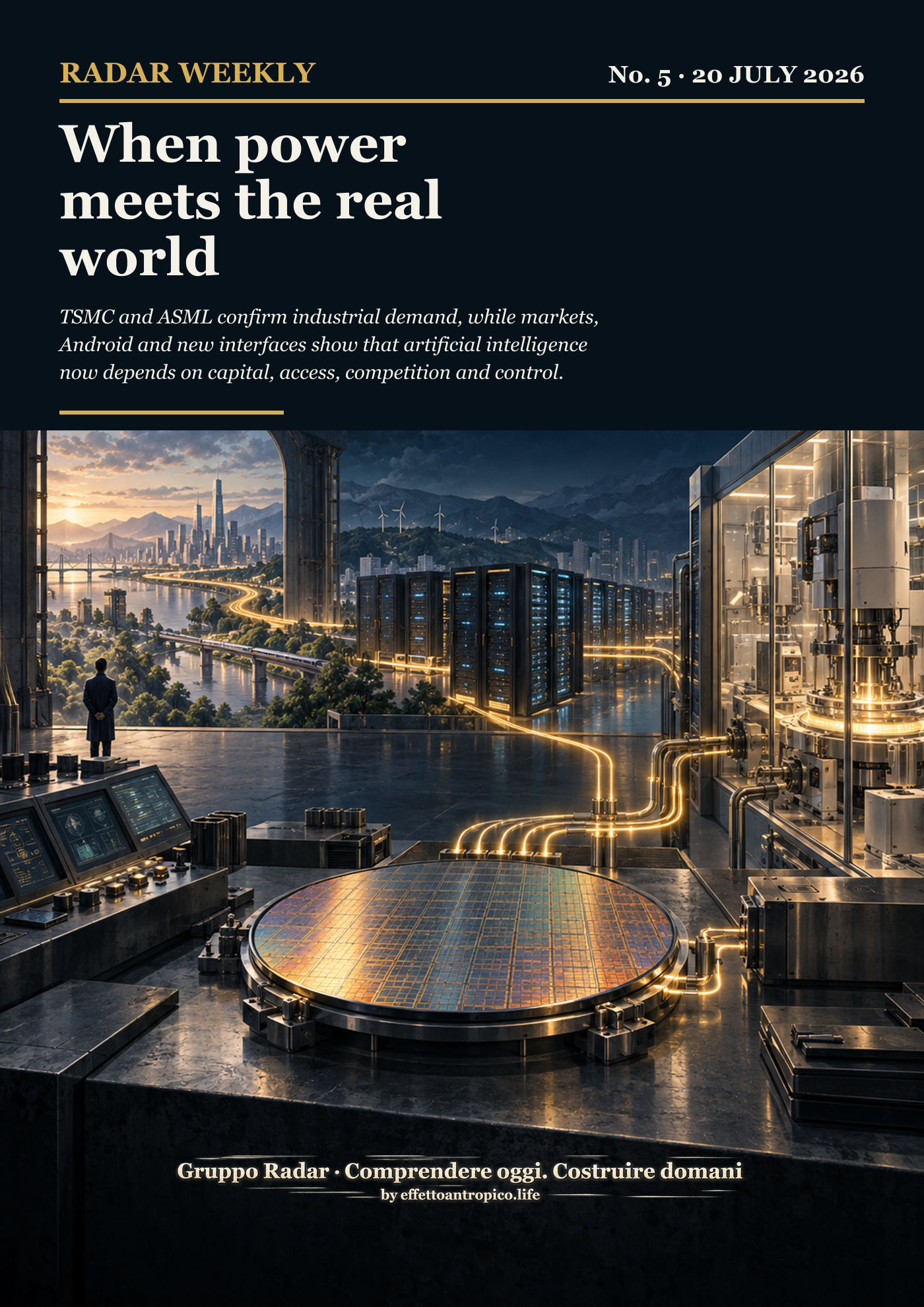
Technological power becomes useful when it meets factories, energy, people and practical activities. Radar Weekly N5, dated 20 July 2026, connects the chip supply chain to markets, the costs of digital work and the conditions of access to artificial intelligence.
When power meets the real world
Weekly Number 5 | Monday, 20 July 2026 | Approximately 6 minutes to read
Building more capacity does not, by itself, solve the problem of how to use it. A factory may receive orders, a model may answer more quickly and a service may become available on a new device. But between these possibilities and a useful result remain timescales, costs and choices that someone has to bear.
Following the issue devoted to AI as heavy infrastructure, this Weekly looks at the point where power enters work. The question is not only how much can be produced: who can use that capacity, under what conditions and with what control?
1. Technological power passes through factories
TSMC and ASML occupy two different positions in the semiconductor supply chain. The first manufactures chips for those who design them; the second builds the lithography systems needed to create circuits on silicon. Looking at them together allows us to distinguish the design of a technology from the tools and facilities that make it manufacturable.
A wafer is the silicon disc on which many circuits are made. Depositing a material is not enough: a sequence of precise manufacturing steps must be repeated. In ASML’s explanation of lithography principles, an optical system transfers a pattern onto a light-sensitive layer. This is one of the stages through which the design takes shape on the wafer.
The dossier reads industrial demand through these concrete processes. An order for machinery concerns capacity to be built and used over time; it does not yet amount to a service available to those at work. Between the two ends lie supplies, assembly, staff, networks and customers.
💡 Inside the chip — Precision has a chain behind it
EUV and DUV refer to lithography technologies using extreme and deep ultraviolet radiation. They are not simply two labels meaning “better chip” or “worse chip”: the processing required changes with the design and the layers to be made. What matters in the supply chain is compatibility between stages. An advanced machine does not replace all the other expertise needed to obtain a usable component.
2. A strong industry does not make every price attractive
Production and financial markets follow different timescales. A company may enjoy strong demand while its share price incorporates even higher expectations. Industrial results tell us what the company is doing; valuation also tells us how much investors expect from the future.
This is why the issue does not treat a price correction as proof that the technology has stopped working. Nor does it regard supply-chain growth as a guarantee of returns. The distance between orders, production capacity and expectations requires several elements to be read together, without relying on a single market movement.
Capex, spending on durable assets such as facilities and servers, makes construction possible. The return then depends on utilisation: how much work runs through those facilities, what revenue it generates and what costs remain. Those selling the machines and those using them are not at the same point in this journey.
3. The cost of an answer is not the cost of the work
A service that is cheap per operation can become expensive if the task has to be repeated, errors corrected or every result checked at length. In digital work, the meaningful measure is what can be completed reliably, not simply the number of answers obtained.
A token is a unit through which a model processes text: it may correspond to a word, part of a word or other elements. Counting tokens helps measure part of the consumption, but does not tell us whether a case has been properly completed, a document is correct or a decision has been understood.
The Weekly therefore proposes considering technical cost together with the result: the attempts needed, checks, the person’s time and the ability to recover from an error. Automation that truly eases an activity and automation that shifts the effort into review may look similar in a demonstration, but not in daily use.
4. Access also changes through interfaces
An assistant does not meet the user in a vacuum. It arrives through a phone, an operating system, an application or a function already present on the device. How easily it can be found and chosen can affect competition as much as the quality of the model.
The issue connects European questions about access to Android services to this stage. Being able to enter an ecosystem does not mean obtaining any data or function without limits. Availability, interoperability and authorisations must be distinguished: respectively, the ability to use a service, to let different systems communicate and to permit certain operations.
For those at work, these differences become concrete when they have to connect a tool to documents, messages or other activities. A more convenient interface is useful if it also makes permissions and the consequences of a choice understandable. Otherwise, the initial simplicity may conceal dependencies that are hard to see.
5. From declared performance to testing in use
New models arrive accompanied by numbers: size, the ability to handle long texts, test results. This information deserves careful reading, but each measure describes only part of their behaviour. A large context, for example, indicates how much material can be supplied to the system, not that every detail will be remembered and used correctly.
A useful test remains tied to the task. Is the result consistent? Can the sources be traced? Is a limitation reported? The dossier places announcements within this framework, without confusing declared performance with independent verification or with value for every activity.
🔎 The practical question — What remains under control?
The convenience of a service does not, by itself, answer the question about data. A photograph visible online does not automatically express the person’s consent to every new use. In the transition from content to an AI function, the purpose, the information available and the ability to choose all matter. This boundary is precisely the issue’s theme: technical accessibility does not exhaust responsibility.
6. The real world presents the bill for dependencies
Chips, memory and servers need electricity and places in which to operate. The International Energy Agency’s Energy and AI report, published in 2025, examines this relationship and its consequences for the energy system. Technological power cannot be separated from the material conditions supporting it.
The same criterion applies to organisational dependencies. A service may be powerful but difficult to replace; an activity may function as long as a provider maintains certain conditions. Looking at the ability to change tools, retain one’s materials and understand the costs helps assess what remains in the hands of those using the technology.
7. The connections to keep in view
Power meets the real world when it stops being only a promise of performance and becomes a relationship between production, capital, access and responsibility. This issue brings together the factory that builds, the market that values and the person who needs a useful result.
The full document preserves the week’s dashboard, cases, data and sources of 20 July 2026. Here, some stages are connected to accompany the reading of the issue, without replacing its complete analysis.
Read the full issue
© 2026 Barbara Gattobigio · Gruppo Radar
Comprendere oggi. Costruire domani · by effettoantropico.life
All rights reserved on original content. Free access does not authorise reproduction or republication without consent, except as permitted by law. Third-party materials remain the property of their respective owners. To share this issue, use the link to the article.
The journey continues from Weekly N4 — When AI becomes heavy infrastructure. The introduction to the collections is in Understanding Today. Building Tomorrow.
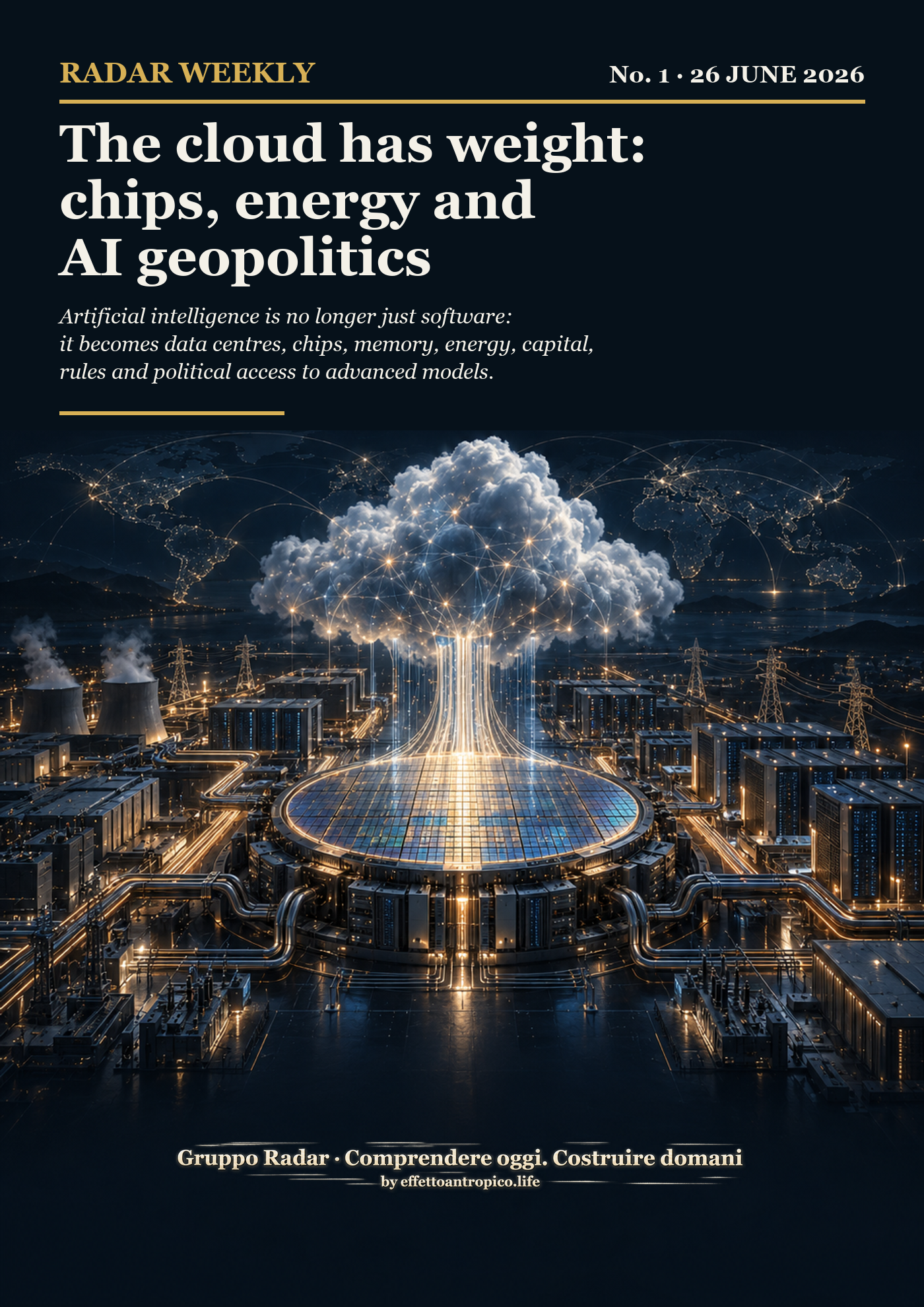
Cover in focus