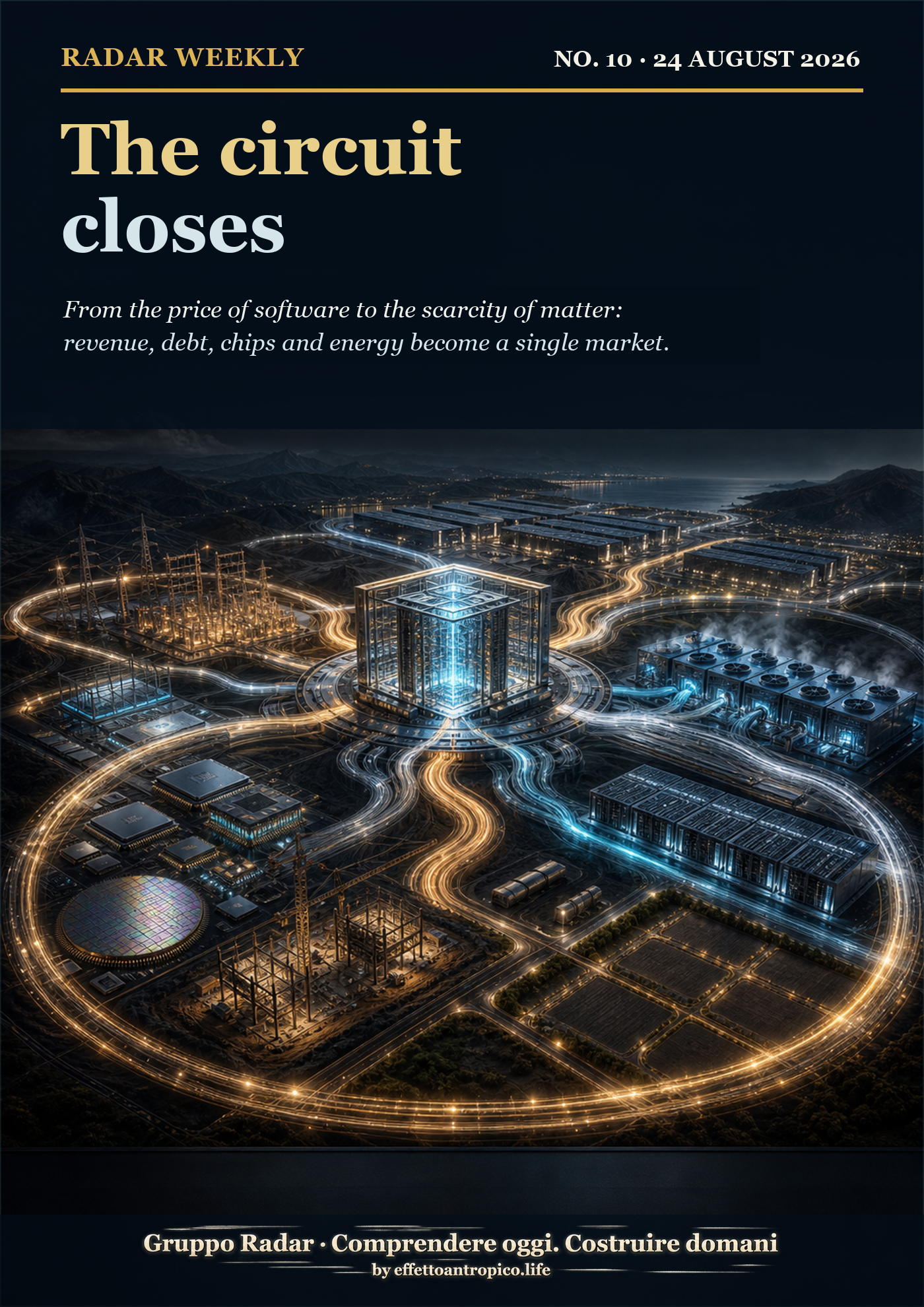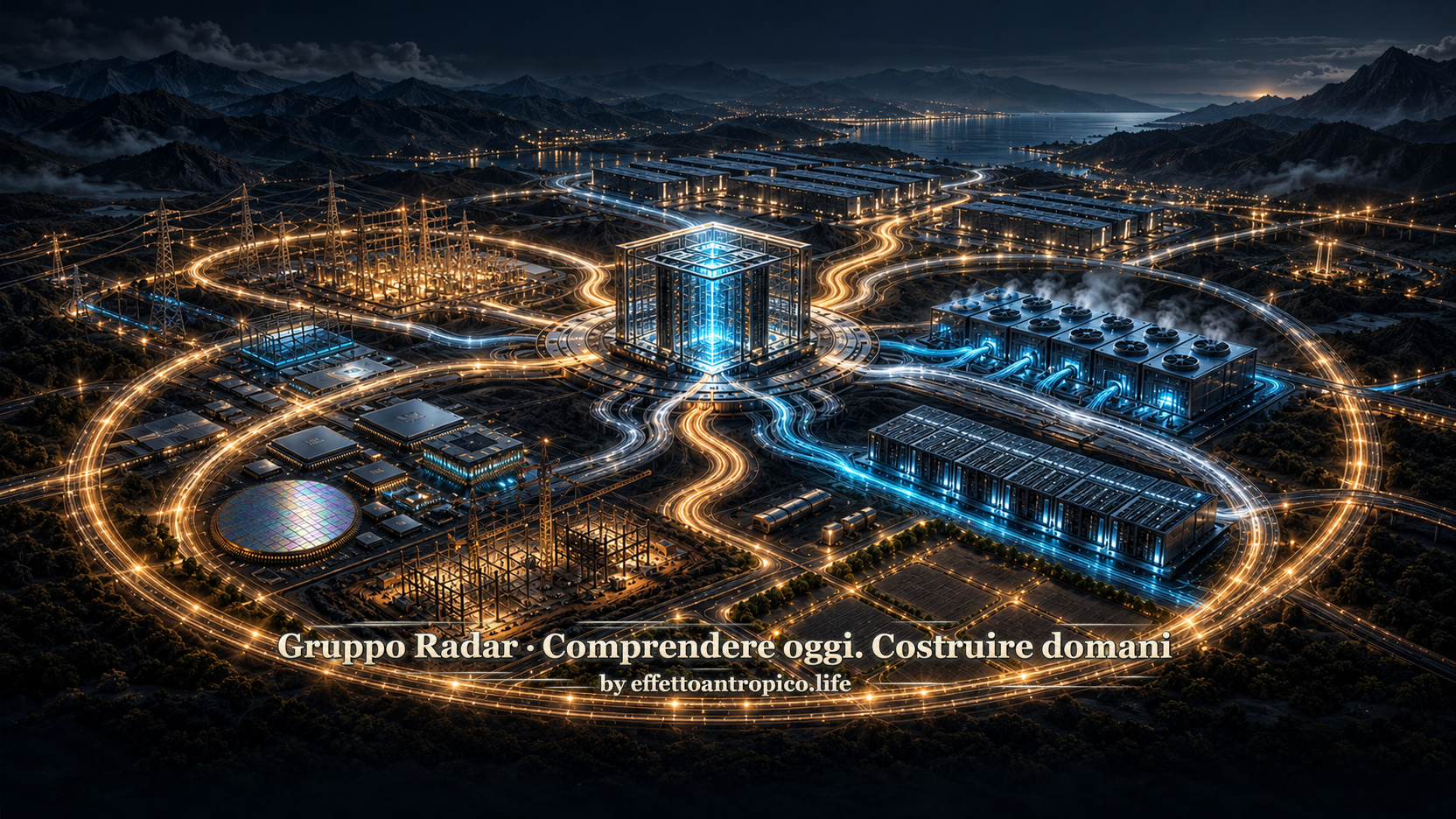
The circuit closes when revenue, investment, debt, chips and energy cease to be separate chapters. Radar Weekly N10, dated 24 August 2026, follows the money building artificial intelligence: who advances it, which resources become scarce and how risk passes from one business to another.
The circuit closes
Weekly Number 10 | Monday, 24 August 2026 | Approximately 6 minutes to read
1. Money does not stay on balance sheets
Behind an artificial intelligence service that seems light lies a very concrete construction. Processors, memory, buildings, electricity connections and cooling systems are needed. Money raised today is turned into capacity that will have to find customers and generate revenue in the following years.
The issue begins with Alibaba: its cloud sells more and improves operating results, while infrastructure expansion continues to absorb cash. The two do not contradict each other. A business can have customers willing to pay and, at the same time, invest more than it can retain after expenses and facilities.
This distinction matters outside technology too. Revenue growth tells us something about demand; available cash tells us how much money remains to sustain commitments, investment and unexpected events. Reading only one means losing part of the story.
Radar’s question is therefore very practical: will the capacity being built now be used enough, and for long enough, to provide a return on the capital making it possible? Market growth is not enough. The service’s price, operating costs and how quickly equipment becomes less competitive also matter.
💡 Selling does not mean having already recovered the investment
Free cash flow is the money remaining after operating activity and investment. It can be negative during rapid expansion even when sales rise. This is not, by itself, proof of failure; it does, however, require an understanding of how growth will be financed.
2. Customer, supplier and financier move closer together
The supply chain is no longer only a sequence of sales between independent parties. A supplier may invest in its customer’s infrastructure; the customer may obtain rights to the supplier’s equity. In both cases, a financial relationship accompanies the commercial one.
The dossier follows two directions: NVIDIA supports infrastructure intended to host its systems; Google, in its relationship with Marvell, obtains equity rights linked to growth in purchases. These are not identical agreements, but they help show how demand, production and a share in a partner’s value can become intertwined.
A warrant is a right to buy shares in the future under contractual terms. It does not automatically amount to a purchase already executed, nor turn a revenue threshold envisaged by the agreement into guaranteed orders. Confusing these stages would make the circuit more robust on paper than it actually is.
These structures can coordinate timescales better: building a data centre and producing components require advance commitments. But they also make it harder to separate what is sold to independent demand from what is encouraged by financing the commercial relationship itself.
3. The customer’s constraint becomes the producer’s constraint
On 21 August, Cloverleaf announces a partnership with NVIDIA, accompanied by a minority investment. Land, energy availability and data-centre buildings thus enter more directly into the sphere of those supplying computing systems.
If an electricity connection is missing or a site is not ready, a processor cannot be installed merely because an order exists. The customer’s difficulty passes to the producer: the sale depends on the material conditions that allow the product to be used.
This is why a fall in the price of a digital service does not necessarily tell the whole supply-chain story. Software can be distributed very quickly; increasing memory production, obtaining permits or building a new connection takes different timescales. Value can concentrate precisely in the resource that others cannot replace.
⚙️ Software can be copied. A megawatt cannot
Computing capacity, often called compute, is the work infrastructure can actually perform. It is not an immaterial resource: it depends on chips, energy, memory and cooling. If one element is missing, promised power does not become an available service.
4. Capital has a price too
Building capacity requires financing. When a sector issues a great deal of debt, investors have to decide how much more to absorb and on what terms. The premium demanded can rise even without an immediate fear that the largest companies will default.
The spread is the difference between the yield demanded on a bond and that of a comparable benchmark security. One hundred and twenty basis points means an additional 1.20 percentage points, not a total rate of 1.20%. This distinguishes the general cost of money from the premium demanded of the borrower.
Radar also observes another stage: the CFTC consultation on compute derivatives. The US authority seeks information on computing-capacity markets, surveillance and customer protection. At the issue’s date, it is a consultation, not a final rule or proof of an already liquid market.
A derivative is a contract whose value depends on another asset or quantity. It can help manage price risk, but does not remove the physical constraint: financially hedging a cost does not make a facility available when it has yet to be built.
5. The circuit reaches people too
Upstream, there is an attempt to price computing capacity. Downstream, that capacity may be used to estimate how much a person is willing to spend. The FTC consultation on personalised pricing moves the question from the industrial supply chain to transparency in everyday experience.
The problem is not only that two customers pay different amounts. It is knowing whether a price presented as general is instead built from an individual’s data, without that person being able to understand the rule behind it.
The circuit closes, but does not thereby become neutral. It can accelerate AI construction and distribute some commitments better; it can also transmit a correction from demand to suppliers, credit and infrastructure. The question remaining open is who controls the nodes, who bears the risk and how much room for choice remains for people.
Read the full issue
This reading presents some stages of Radar Weekly N10. The full issue contains the complete journey, data, in-depth analysis and sources of the dossier of 24 August 2026.
© 2026 Barbara Gattobigio · Gruppo Radar
Comprendere oggi. Costruire domani · by effettoantropico.life
All rights reserved on original content. Free access does not authorise reproduction or republication without consent, except as permitted by law. Third-party materials remain the property of their respective owners. To share this issue, use the link to the article.
Continue reading
Understanding Today. Building Tomorrow: the project and the Radar collection.
Cover in focus