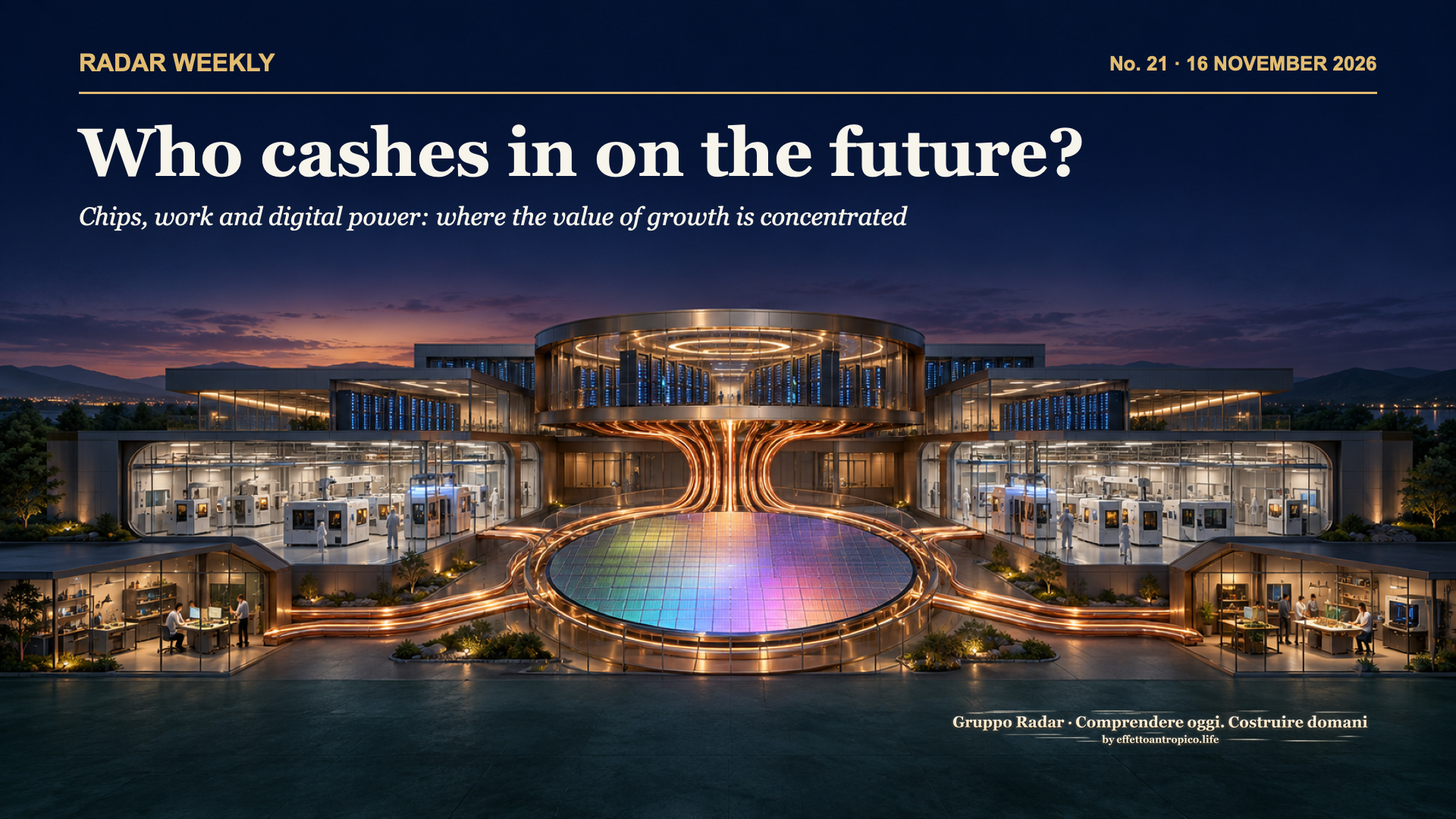
Who cashes in on the future when AI becomes part of the way we work? The first thing we notice is what it helps us do. It takes a little more digging to see where the value goes. Radar Weekly N21 follows it from chipmakers and the companies that finance computing capacity to workers and the platforms that set the terms of access.
Who cashes in on the future?
Weekly No. 21 | Monday, 16 November 2026 | About 4 minutes to read
In Weekly 20, Who supports growth?, we followed the money needed to build digital infrastructure. This week we look at where the returns go. A supplier can earn revenue from sales and take a stake in a customer. A company can more than double its revenue and still need credit. Someone can save hours at work without seeing any change in their pay. Each tells us something about who shares in growth.
1. Chipmakers can also become investors
On 12 November, NVIDIA announced Jensen Huang’s resignation and named Colette Kress interim chief executive. For companies that depend on its processors, the practical questions concern deliveries, product plans and existing commitments. The board says it expects continuity while it looks for a permanent successor.
Meanwhile, TSMC’s board approved possible investments of up to $500 million each in OpenAI and Anthropic. For Anthropic, the resolution specifies the price of any future initial public offering. The terms of the investments and whether they go ahead will help show what changes for the companies involved.
2. Higher sales and the cost of growth
In CoreWeave’s quarterly results, revenue rose from about $1.37 billion to $3.66 billion year on year. The company reported $207 million in operating income, $846 million in net interest expense and a net loss of $709 million. Read together, these figures show how much the financing costs matter when a company is putting more computing capacity into service.
🧠 In simple terms — Revenue and repayment dates
A company can sell more computing capacity and still have to pay for facilities and equipment up front. To see how much room it has to grow, we need to look at when the money comes in alongside investment plans and debt payments.
3. How much of the benefit reaches workers?
In his speech on artificial intelligence and inequality, Michael S. Barr points to a long decline in the share of US income that goes to labour. It began well before AI was widely used, and measuring it is difficult. If a tool helps us produce more in the same amount of time, the gains can go into training or wages, lower prices or higher profits.
In Weekly 17, The Weight of Growth, we came to the same question by looking at the time people save. To see who benefits, we need to look at changes in working conditions, opportunities to learn and workers’ ability to negotiate.
4. Digital payments and the people we trust
In PNC’s pilot programme, some corporate and institutional clients can receive payments in USDC, a digital unit designed to track the dollar. PNC says the payments use Ethereum and Coinbase’s services and that the amount is converted and credited in dollars. The costs, terms and benefits will become clearer as customers use the service.
We return to the Binance case from Weekly 19, The Price of Trust. The US Department of Justice reports that more than $2.7 billion in assets have been frozen. Within that total, courts authorised seizure or restraint of more than $1.2 billion. For people waiting to recover their assets, the decisive step will be whether they get them back.
5. Who decides how information reaches us?
The European Commission’s consultation on election guidelines proposes measures for large platforms and search engines. They include checks on recommendation systems, guidance on deepfakes and measures to counter coordinated manipulation. The consultation runs until 23 November. The Commission says the proposals must respect freedom of expression and information.
Across the issue, we follow who can invest, who has access to the tools and who can ask for an explanation when decisions affect them. In the full issue, Italy Watch continues that thread with lending to households and businesses in Tuscany and Lazio.
Read the full issue
© 2026 Barbara Gattobigio · Gruppo Radar
Comprendere oggi. Costruire domani · by effettoantropico.life
All rights reserved for original content. Free access does not authorise reproduction or republication without consent, except for uses permitted by law. Third-party materials remain the property of their respective rights holders. To share this issue, use the link to the article.
Cover in focus
