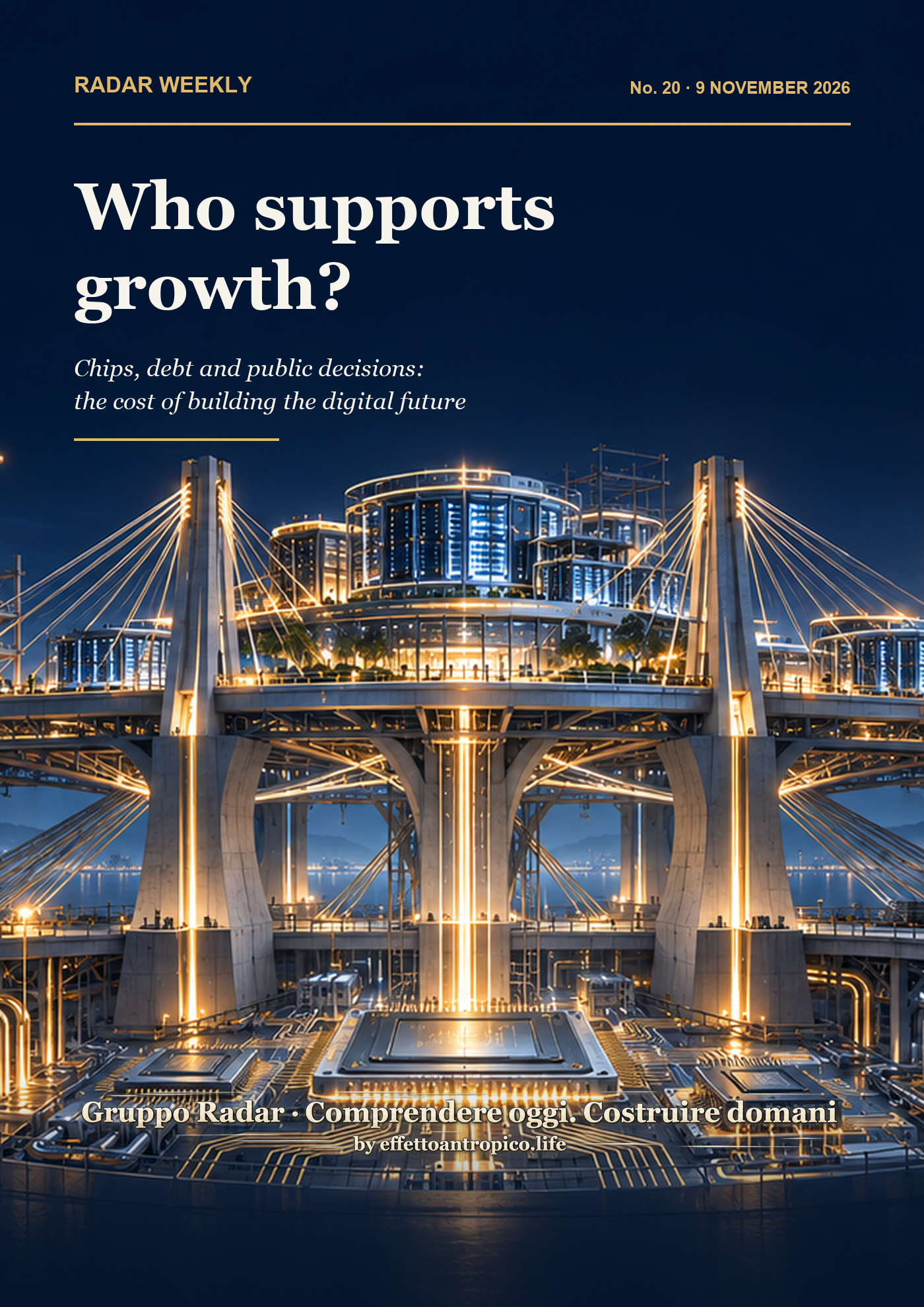
Who supports AI growth when an order for chips becomes a construction project, a loan or a commitment involving shares? Radar Weekly N20 follows AMD, IREN and the project linking TeraWulf, Google and Anthropic, alongside robotics and blockchain. Sales, contracts and approvals help us understand how digital infrastructure is built and how costs and risks are distributed.
Who supports growth?
Weekly No. 20 | Monday, 9 November 2026 | About 6 minutes to read
We open an application and find a window ready to respond. For that service to be available, however, someone has designed the processors, built the facilities, secured energy and put up money in advance. In Weekly 17, we followed the weight of growth along this value chain. Now we return to it through the documents collected up to Friday, 6 November: demand for technology is growing, while the conditions for supporting it differ from one business to another.
1. AMD: a sale can continue beyond the invoice
The results published by AMD on 3 November show demand already turning into economic activity. Third-quarter revenue reached approximately $13.4 billion, up 45% from a year earlier, with net income of approximately $2.4 billion. The data centre division recorded revenue of $8.5 billion, almost twice as much as a year earlier.
The relationship with some major customers also includes rights over shares. These are warrants: they allow shares to be purchased on specified terms when the agreement’s conditions are met. The quarterly report filed on 4 November specifies that, as of 26 September, none of the shares covered by these rights had yet vested, become exercisable or been exercised.
AMD records a liability of approximately $1.2 billion linked to the warrants and a non-cash charge of the same order of magnitude, mainly due to their revaluation. Selling a processor can therefore open a relationship that continues over time and also affects the financial statements. Understanding it requires looking at both commercial results and the terms offered to customers.
2. IREN: between the contract and the service are facilities to pay for
For businesses that build and sell computing capacity, growth also means putting up resources in advance. In IREN’s quarterly results, total revenue was $228 million, including $200 million from AI cloud; the net loss was $263 million. The portfolio of future contracts reached $20.3 billion, but that revenue still depends on delivery and the availability of the services.
The company expects approximately $15 billion in remaining investment for fiscal year 2027. In its estimates, it links $9 billion to cash, committed financing and customer prepayments; the other $6 billion requires sources that have yet to be secured, also depending on market conditions. This is where the strength of demand meets the practical ability to build what has been promised.
The target of more than $4 billion in contracted annualised revenue remains distinct. IREN states that this target is funded and has moved it to January 2027, with a possible extension to February. An annualised rate expresses revenue as though that pace continued for a year: it is not an amount already invoiced.
🧠 In simple terms — A contract also has a timetable
Turning a multiyear agreement into a service requires spending before all the payments arrive. Payment schedules, deliveries and availability conditions help us understand how many resources are needed in the meantime. The contract’s value alone does not tell us about this stage.
3. Google and TeraWulf: one party’s financial strength supports another’s project
On 4 November, TeraWulf announced credit support agreements with Google for Project Justified in Kentucky. The infrastructure is linked to lease commitments with Anthropic for approximately $19 billion over the contractual period. An agreement with Fluor covers the construction of three buildings, with deliveries scheduled from the end of 2027 to the second quarter of 2028.
The $19 billion describes the lease commitments: it is not the amount of Google’s guarantee or revenue already received. Credit support can help obtain loans on more favourable terms, while timelines, obligations and implementation of the project still need to be followed.
In Weekly 19, we explored the price of trust between capital and infrastructure. Here that relationship takes a specific form: one party’s financial strength helps support another’s project. Risk is distributed through the agreements and remains linked to the conditions that will need to be met.
4. Robotics: capital meets decisions made by states
Even an acquisition that has already been agreed can depend on decisions outside the businesses involved. SoftBank stated on 6 November that it had received a Chinese notification two days earlier prohibiting the acquisition of ABB Robotics’ operations in China. The overall agreement for the robotics division had been announced in 2025 and was subject to the necessary approvals.
The scope matters: the announcement concerns the Chinese operations and does not announce the cancellation of the entire worldwide transaction. SoftBank reports that it is in discussions with ABB; the practical consequences will depend on the next steps. For customers and people working in the value chain, the transaction’s timelines and conditions therefore remain part of the story, alongside the agreement’s economic value.
5. Canton Coin: understanding what the clarification covers
In blockchain, on 3 November, the staff of the SEC’s Division of Corporation Finance published a response concerning Canton Coin. On the basis of the information received, it considers the token a digital good in the category described as a digital commodity and indicates that it will not recommend enforcement action for the specific programmatic creation described in the request.
To understand the scope of the clarification, we need to preserve the connection between that position and the activity described. The token is a digital unit recorded on a network; the response examines certain conditions of its operation. On its own, it does not allow the same conclusion to be extended to every service or use involving it.
📌 Did you know? — What a no-action letter communicates
The staff of an authority indicates that, in the circumstances described, it will not recommend enforcement action. It is a limited position: it is not equivalent to a court ruling, does not eliminate risks and is not a general approval. If the facts or conditions change, the assessment can change too.
Who supports AI growth, then? The answer runs through customers who buy and pay in advance, businesses that invest, parties that provide credit support and institutions that approve or restrict transactions. Expectations also matter: share prices can change rapidly, while a facility takes years and resources before it enters service.
These stages also reach everyday life through energy, credit and the terms of digital services. Following the path of money helps distinguish what is already working from what still awaits financing, delivery or decisions. Growth becomes easier to understand when, alongside its speed, we can see the commitments that make it possible.
Read the full issue
© 2026 Barbara Gattobigio · Gruppo Radar
Comprendere oggi. Costruire domani · by effettoantropico.life
All rights reserved for original content. Free access does not authorise reproduction or republication without consent, except for uses permitted by law. Third-party materials remain the property of their respective rights holders. To share this issue, use the link to the article.
Cover in focus