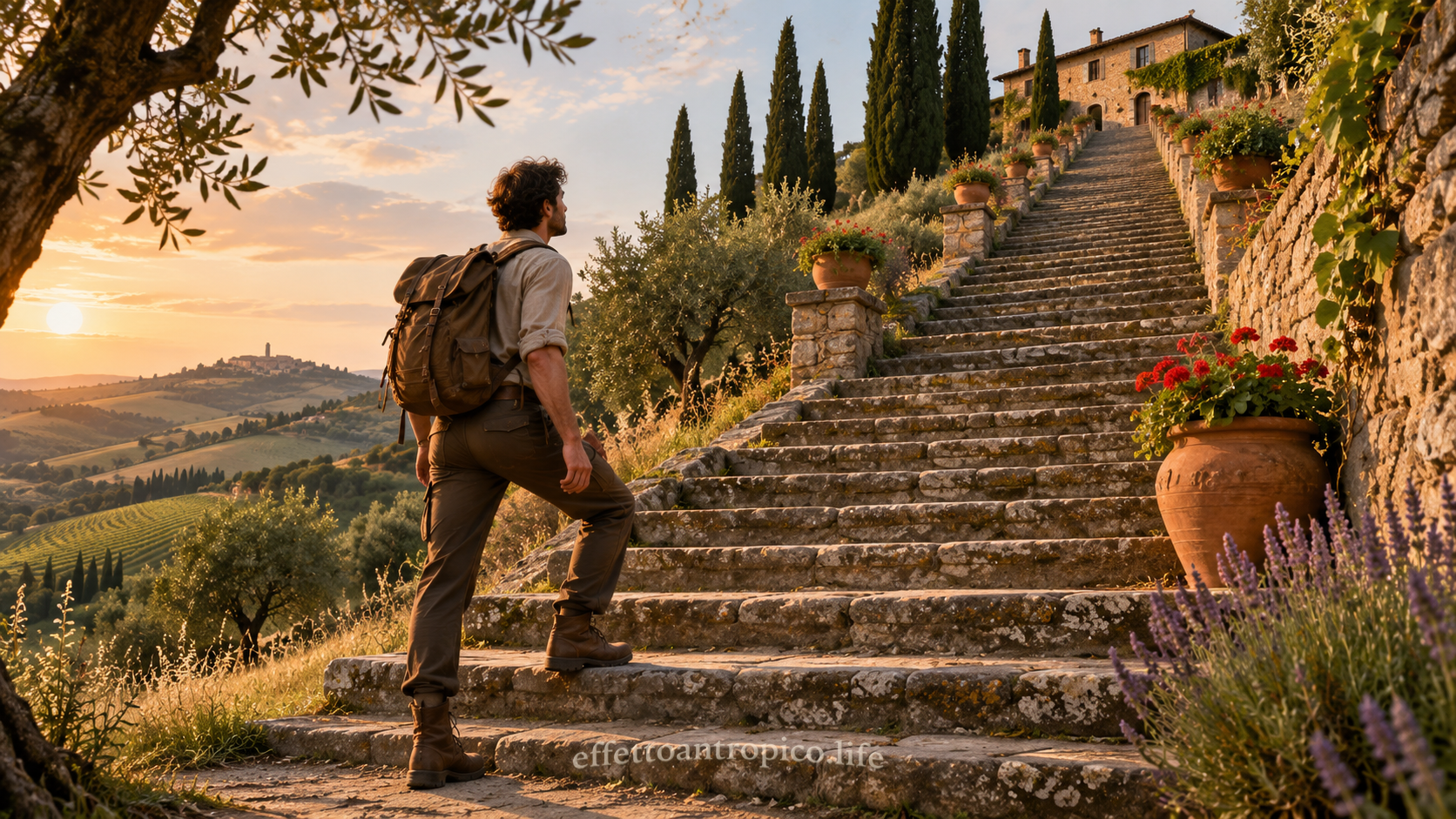
Power in physics describes how quickly work is done. Two actions may require the same amount of work, yet the experience can change profoundly when they happen over different lengths of time. This law shows the connection between work, time, energy and the body, revealing why climbing stairs slowly or at a run does not produce the same perception of movement.
Power in physics. When work meets time
Some gestures seem identical only from a distance.
A body rises. A weight is lifted. A distance is crossed.
From outside, movement looks the same, but something changes within: the way that work passes through time.
Because what is done is not the only thing that matters.
How long it takes matters too.
I am Physics.
So far I have told you how the total work done by the forces on a body is related to the change in its kinetic energy.
Now, however, I want to accompany you onto a new threshold: the one where work meets time.
An action changes not only through what it accomplishes. It also changes through the rhythm in which it happens.
A working day has passed. You are finally at your front door, but before entering you must face several flights of stairs.
It is an automatic action, one you perform without thinking or asking too many whys.
Yet in this ordinary action, something important is happening.
As you climb, step after step, your body is doing work.
With every step, one leg rises after the other, and the sole of your foot finds the next stair.
Your body follows the movement, carrying its weight a little higher.
You do not realise it, but even in such a simple action, gravity opposes your upward movement.
Your muscles respond. Your breath accompanies. Movement continues almost without needing to be thought about.
It is automatic, almost invisible work. But this time I want to show you more than the work you are doing: I want to show how you pass through it over time.
Observe.
You are climbing calmly, one step after another. Your body finds its rhythm. Your breathing stays regular. You pass through the effort without concentrating it into a few instants. Movement stretches out, and work is distributed over time.
Now observe what happens when the rhythm changes.
It is another day.
You are coming home more tense, your head still full of what you ought to leave outside the door.
As soon as you reach the stairs, you do not slow down: you run up.
But the stairs have not changed. The steps are the same as ever, and the body to be lifted is still yours.
Yet the experience you live through as you climb is entirely different.
Running upwards, you ask your legs to push and lift you more quickly.
Your body has no time to spread out the movement. It has to do the work needed to lift you more quickly.
Your breathing becomes short and laboured.
Your heartbeat accelerates, while your muscles, responding to your request, demand more oxygen and sustain faster, more intense contractions.
The climb has not changed: the time in which you complete it has changed.
Now that you have lived the difference between these experiences, I want to invite you to observe them from within and arrive at the right question.
No longer only: how much work are you doing?
But: how long are you taking to do that work?
Now you can see where the difference lies.
In the first, you climb calmly, one step after another, distributing the work you do over time.
In the second, you have changed rhythm. For the same mass and height gain, the increase in gravitational potential energy is the same, and you achieve it in less time. The total work your muscles do can vary with your movement and the resistive forces.
And in my language, this concentration of work in time is called power.
Now, though, I want to pause to tell you what I represent, so you can recognise me in the experience you are living as well as in the formula.
Power does more than measure work. It measures the rate at which you do work and tells you how quickly energy is transferred, transformed, used.
In my language, this relationship is expressed as:
Pavg = W/Δt
average power equals the work done divided by the time interval in which that work is done.
If the same work is spread over a longer time, the average power required is lower.
If the same work is done in a shorter time, the average power required is higher.
It is also useful to recall how these quantities are measured.
Work is measured in joules.
Time in seconds.
Power in watts.
1 W = 1 J/s
one watt corresponds to one joule per second. This means that average power tells you how many joules of work are done per second on average.
But do not let the simplicity of the formula deceive you.
Within that relationship between work and time lives an enormous difference in how you perform an action and experience movement.
Through this experience, you can finally recognise in your body what I express through power: for the same amount of work, a longer time interval means lower average power. A shorter interval means higher average power.
In this relationship, the time interval is not a fixed quantity, but the variable that can extend or compress the action through which you do work.
Your body feels the difference. It lives it. It experiences it, and sometimes endures it.
Now, though, since it is a beautiful day, let us go for a bicycle ride, because I want to invite you to observe even more closely how work changes its face when it meets time.
At first you are pedalling along a level stretch. You maintain a gentle rhythm, your speed is constant and the wheels roll. You are in no hurry.
Everything proceeds regularly and accompanies movement.
As you move forwards, there is something worth observing.
I have already shown you that total work can change a body’s movement by modifying its kinetic energy.
Here, however, on level ground at constant speed, something different happens: speed does not change, and kinetic energy remains unchanged with it.
Yet with every pedal stroke you continue to do work.
So where does it go?
In my language, movement never changes by itself: it always carries the trace of the forces acting through it.
Even now, while it seems to flow unchanged, all those forces are present. And you are encountering them.
As you pedal, your legs transfer energy to the bicycle. The air you pass through offers resistance. The bicycle’s mechanical parts dissipate some energy.
The ground supports you and allows the bicycle to advance. On the level stretch, gravity pulls downwards but does not directly slow your forward motion.
In this case, the work you supply serves chiefly to compensate for resistances and maintain constant movement.
Then, suddenly, the path changes and you encounter a climb.
The road tilts, and gravity becomes more evident. You are doing more than moving the bicycle along the path: you are trying to gain the ascent.
Your legs press on the pedals, the wheels advance up the slope, your body accompanies the rhythm. On the most demanding stretches, you may even rise from the saddle, using your body weight to push more intensely.
The action changes register. Your breath shortens, your muscles work harder, your body seeks balance, rhythm and force.
You can tackle the ascent slowly, one pedal stroke at a time, letting your body find a sustainable rhythm. Or you can push more vigorously, trying to reach the top in as little time as possible.
The route is the same. The height gained is the same, and so are your body and bicycle. For the same mass and height gain, the increase in potential energy is the same. If you arrive sooner, the average power associated with that climb is higher. The total work can vary, for example with air resistance.
Look at what has happened.
First you were climbing the stairs at home; now you are cycling uphill. Two different actions have brought you to the same point in the law.
This is what I wanted to show you.
Power does not belong to a single action. The body, the path and the way you move change, but whenever the same work is done in a shorter time, average power increases.
And it is already there: in the rhythm with which work passes through time, rather than in the action itself.
In my language, I show you precisely this: time is no detail external to movement. When it enters work, it changes the face of action.
Power is the voice of time within work.
It is what distinguishes the same action performed slowly from one concentrated into a few instants. This holds in your body, in machines and in every phenomenon in which energy is transferred.
This is why calling something “strong” is not enough.
I show you precisely this: force and power are not the same thing.
Force can act on a body, but power concerns the rate at which work is done.
Observe: you can exert an intense force without doing work if the body does not move. In that case, the mechanical power associated with that force is zero, even though your body consumes energy. If the same work is done over a longer time, average power is lower.
When, conversely, you do much work in little time, power increases.
Precision here does not defuse the phenomenon. It makes it truer.
Force tells of action.
Work tells of action along a displacement.
Power tells how quickly that work happens.
When you begin to recognise it, you encounter it everywhere:
in the breath that changes as you climb stairs;
in the rhythm that increases as you tackle a climb;
in the arm lifting a weight slowly or with more vigour;
in the wheels that must carry you to the top in less time;
in the body that feels when time compresses work.
Power makes the hidden rhythm of energy visible, but it does not replace work. It does not contradict it. It reads it through time.
So far you have encountered work as it changes movement. Now you have observed that time too can change how that work happens, concentrating it, spreading it out and changing the intensity with which your body passes through it.
Here power leaves its trace.
But work has not yet revealed everything. Because how much work is done and how long it takes are not the only things that matter. What happens to that work when it passes through forces matters too.
Some seem to return what they have taken.
Others, such as friction, can convert some of the mechanical energy into internal energy, for example through heating.
And so work is no longer observed only through time.
From this threshold you will enter with me into the work of conservative and non-conservative forces. There you will see that a force matters not only for what it makes happen, but also for what it leaves after its passage.
The Language of Physics (in Italian)
