Conservative and non-conservative forces tell us that the work of a force does not always have the same destiny. Every force passes through a system, modifies it, accompanies it or wears it down, but not all leave the same trace behind.
Conservative and non-conservative forces: when work leaves a trace
Some work seems to be held, transformed and kept available. Other work, passing through matter, transfers energy into less available forms, leaving a passage that does not return in the same way. Within this difference, an essential question opens: what remains of work after a force has passed through movement?
I am Physics.
Today I take you to the very point where work becomes more than a quantity: it becomes the way a force transfers energy within a system.
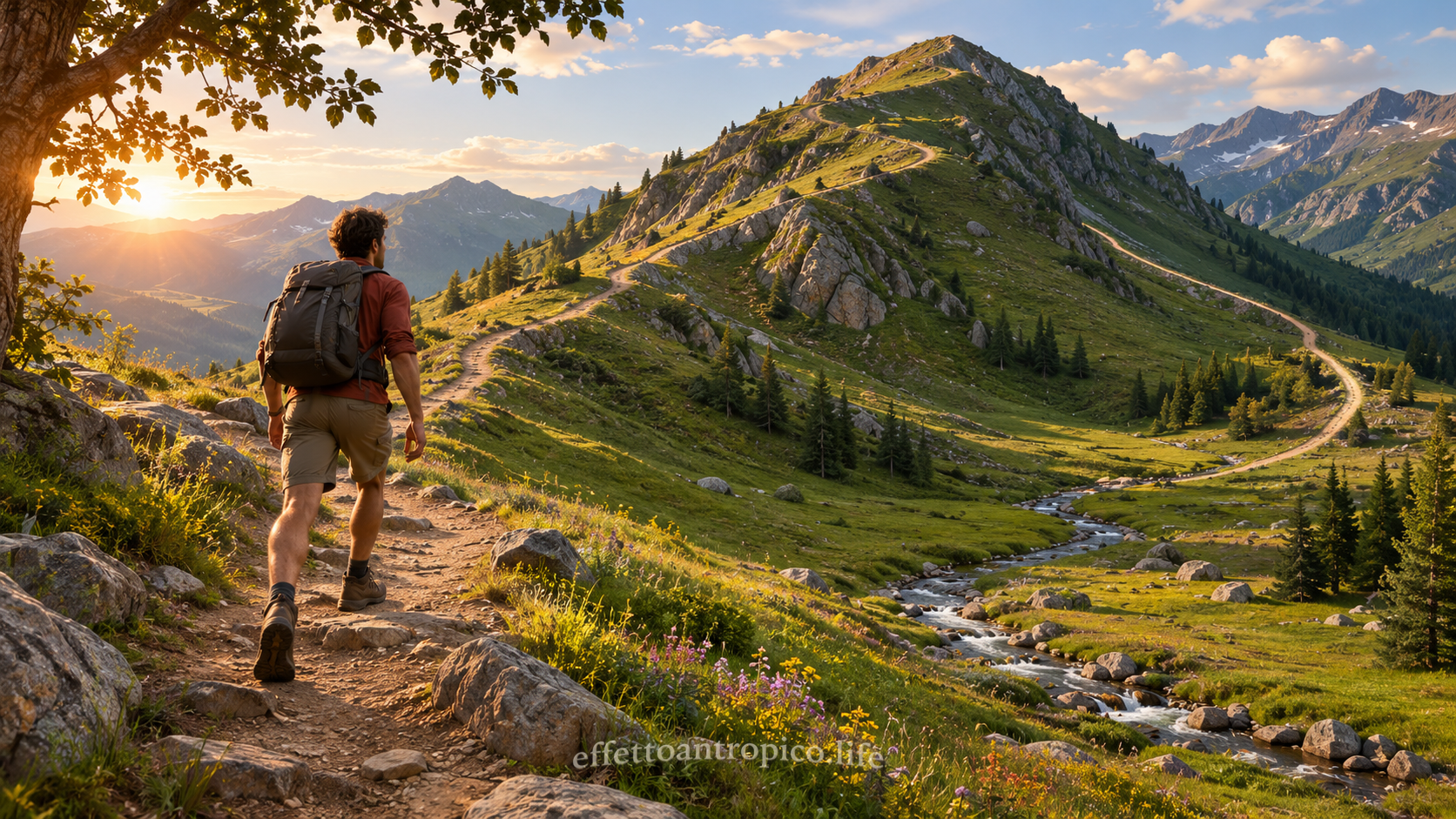
Prepare your backpack, put on comfortable clothing and suitable boots.
You are in the mountains. A path opens before you.
At the beginning of the walk, the ground is level. The fir forest accompanies you, and your steps easily find their rhythm. Gravity is already there: it holds you on the Earth, but while the path remains level, your body advances without gaining height.
Then something changes. The gradient increases, the path begins to climb, and your body notices.
Now you are walking uphill. The pace that easily found its rhythm on the level stretch begins to change. Almost without thinking, you lean your torso slightly forwards. Your knees bend, your legs push against the ground. Your foot seeks stable support among soil, roots and stones; your muscles tense, your breathing deepens.
Step after step, your body gains height. Each metre gained takes you a little farther from where you started. Remain within this ascent for a few more steps.
Feel your foot pressing on the ground, your legs sustaining the push, your breath accompanying your body. With every step you gain a little height, but gravity does not leave you: it continues to draw you downwards.
You do not see it, yet you recognise it in the opposition accompanying your ascent, and it is within that opposition that you meet me for the first time.
Stay on the ascent a little longer. Keep your pace and breathing fairly regular: you continue climbing without accelerating. Your speed changes very little, and your body’s kinetic energy changes very little with it.
Yet your legs keep pushing, your muscles contract, your breathing sustains the effort.
To keep climbing, your body draws on the chemical energy you hold within your system.
Part is distributed through your body and the environment, chiefly as internal energy; another part helps increase the gravitational potential energy of the body–Earth system.
This energy, however, is not truly enclosed within your body. It increases step after step as your position relative to the Earth changes. To understand it, I must look at you and the Earth together.
In my language, it is this whole that I call the body–Earth system.
Now turn for an instant towards the stretch you have just walked. Your starting point is lower, and the relative position between your body and the Earth has changed. Within this new relationship, a new possibility of movement opens.
Now resume walking and continue uphill for a few steps. In the gesture you are making, I show you two aspects of the same movement.
Your organism transforms chemical energy and, through muscular action, sustains the ascent while you gain height. Gravity, however, does negative work on your body: it keeps drawing you downwards while you move upwards.
In my language, it is this opposition that makes gravity’s work negative.
Farther on, you reach a point where the path changes inclination and begins to descend.
Your body changes the way it moves too.
Your foot seeks new footholds, your knees accompany and at the same time restrain your steps, your torso seeks a new balance.
You feel your body tending to follow the descent.
Gravity no longer opposes your movement as it did during the ascent. It continues drawing you downwards while you too are losing height.
The vertical component of your displacement now points downwards, in the same direction as gravity: this is why the work gravity does on your body becomes positive.
But now I want to show you more clearly what gravity does in an ideal system.
To do so, I ask you to stop for a moment. Let the landscape captivate you.
While you observe your surroundings, I separate the real gesture of walking from the model and consider a body free to move along the slope. From this model, I ideally remove friction, air resistance and every other form of dissipation.
What remains is an ideal model of the system: during descent, the gravitational potential energy that increased as you climbed decreases, while kinetic energy increases.
Through this model, I am revealing the nature of a conservative force.
And I am telling you that when I calculate gravity’s work, I do not need to reconstruct every step along your path. Your starting and finishing points are enough, because near the Earth’s surface, what matters is the difference in height. Between those points, however, the path can change shape.
You can follow a longer or shorter route, more winding, steeper or gentler, but as long as the starting and finishing points remain the same, the work done by gravity does not change.
I look at the difference in height. I do not need to retain the history of your walk.
At this point I want to show you, in my language, how to recognise a conservative force.
In my language, you can recognise it through this relationship:
Wc = −ΔU
where the work done by a conservative force, Wc, equals the negative of the change in potential energy U.
If potential energy decreases, the conservative force does positive work.
This happens when a body descends: it loses height and can gain speed.
If potential energy instead increases, the conservative force does negative work.
This happens when a body rises: gravity does negative work while the body is taken higher.
But I can show you the nature of a conservative force even more clearly when the path closes.
You are still on the same mountain path. After the ascent, you continue downhill until you return to exactly the point where your hike began.
On the route you are following, I isolate the action of a conservative force.
The overall work this force does while you return to your starting point is zero, and in my language I represent it like this:
∮ Fc · dr = 0
where the symbol ∮ means precisely this: I am considering a closed path, a route that starts at a point and returns to that same point.
With this formula, I tell you something simple but important: a conservative force can give and take away, accelerate and slow, accompany and oppose; it can do positive work on one stretch and negative work on another, but when you return to the starting point, the overall work done by that force along the path is zero.
Not because nothing has happened, but because, in that model, nothing has been irreversibly inscribed along the path.
Now change the gesture.
It is a beautiful, clear, cold day in midwinter.
You are in Talvera Park. You stop on the bridge to watch the stream flowing beneath you.
The water is clear, fast-flowing, cold.
Suddenly, a shiver of cold catches you. You bring your palms together and begin rubbing them.
Your palms slide, skin meets skin, movement meets resistance, and little by little your skin warms: you are doing work against friction.
Your body draws on its chemical energy to move your hands: you are using that movement to warm them, rather than trying to preserve it.
Here I show you that work does not leave open a possibility of mechanical return. Friction does not preserve movement: the energy of the gesture does not remain gathered as ordered motion, but chiefly increases your hands’ internal energy. You recognise it in the rise in temperature, in the sensation emerging on your skin.
Energy does not disappear: it is redistributed, and it does not spontaneously reconstruct the initial movement when you bring your hands back to their starting point.
Remain within this sensation for an instant.
Your palms pass and repass over one another, returning repeatedly to the same position, yet the temperature keeps rising.
This is the first clue I offer you: with friction, returning to the starting point does not undo what happened during the gesture. How far your palms travel over one another matters.
In my language, I call a force non-conservative when its work depends on the path followed.
Friction can be a non-conservative force. When a body slides on a stationary surface, sliding friction opposes the sliding and does negative work. If the body slides all the way back to its starting point, the total work done by friction along the path is still negative.
Now let us go to the railway station. You are in the concourse with a heavy suitcase, and one of its small wheels has jammed.
You drag it towards the platform: your arm is stretched, your shoulder sustains the pull, the jammed wheel rubs against the floor and offers resistance over every stretch travelled.
You have almost reached the platform when you realise you left a book on the bench where you started. You turn and retrace the same distance in the opposite direction.
When you reach the bench, you and the suitcase have returned to exactly the starting point. The path has closed.
But friction’s work has not returned to zero.
On the way to the platform, friction opposed the wheel’s movement; when you reversed your path, it reversed direction to keep opposing the new movement.
Its work was negative on the outward journey and negative on the return: the two contributions add up over the entire path rather than cancelling each other.
Your body supplied the energy needed to drag the suitcase. The energy transferred through that work chiefly increased the internal energy of the wheel and the surfaces in contact; part propagated as sound and part produced small deformations.
It is the energy transferred through work that has been redistributed, rather than work itself being transformed.
The suitcase has returned to where it was, but the passage has not been undone. The initial and final points coincide; the energy dissipated along the path carries the trace of the distance crossed.
This is the threshold I show you: for a non-conservative force, knowing where you start and where you return is not enough. You must know the path, because its work depends precisely on what happens while you travel it.
Now leave the station concourse for a moment and return with me to the mountain path.
The two experiences look at one another from afar: on the path, gravity followed the difference in height; with the suitcase, friction accounted for the whole distance travelled.
In my language, a conservative force allows potential energy to be defined: the work it does between two points corresponds to the negative of the difference in potential energy between those points, and when the path closes, its overall work is zero.
For a non-conservative force, the two positions alone are insufficient to describe its work. Its work can depend on the path and can be nonzero even when the path is closed.
I am Physics, and I recognise both kinds of force.

I do not confuse returning with never having left.
Sometimes a path can close while leaving intact the possibility of giving back; at other times, the energy transferred during movement remains dispersed through matter, yet present.
I exist in both experiences: in what can be returned and in what leaves a mark as it passes through the world.

I do not judge one truer than the other. Because returning to the same point does not always mean finding the world in the same state.
The Language of Physics (in Italian)
