Tag: Work and business

  • Professional value in SMEs | Radar Special N3A

    Professional value in SMEs | Radar Special N3A

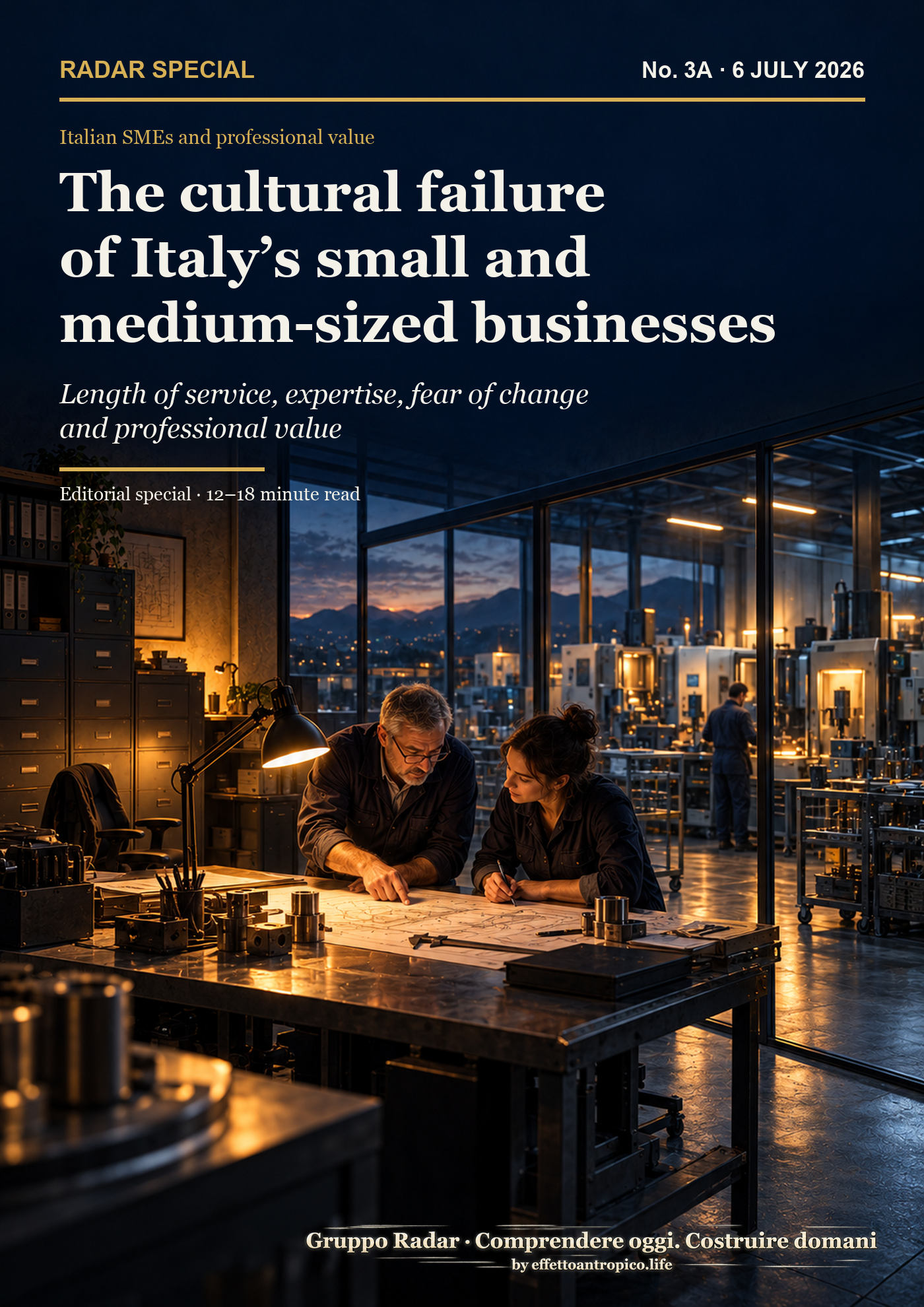
    People bring professional value into a business, but it takes shape through the room their work is given. Radar Special N3A examines what happens when new expertise encounters habits, roles and fears that the organization struggles to discuss.

    Professional value in SMEs

    Special Issue 3A | 6 July 2026 | Approximately 6 minutes to read

    1. An open door is not enough to welcome expertise

    Someone is hired because they understand a process, can bring several departments together or introduce a method that was previously missing. The business hopes to improve. Then, during the first few months, the demands become contradictory: change things without touching habits; deliver results without creating tension; take responsibility without being able to decide.

    This contradiction creates distance, and that promising possibility begins to lose its strength.

    The Special of 6 July addresses a cultural limitation found in some Italian small and medium-sized enterprises (SMEs). It is not a sweeping judgement on SMEs: many invest, train their people and use the closeness between roles to learn more quickly. The problem emerges when defending the existing balance becomes the yardstick for assessing every new contribution.

    Credit, taxes, labour costs and difficulty finding staff are real constraints. The dossier invites us to add an organisational question: once the business has acquired expertise, is it prepared to use it? A new hire can increase the capabilities available on paper while leaving the way people work almost untouched.

    2. Experience grows when it can be discussed

    People who have known customers, suppliers and recurring problems for years possess a valuable resource. They can recognise an anomaly before it appears, or remember why a procedure was designed in a particular way. Losing this memory can make a business more fragile.

    Time spent in a role, however, does not by itself tell us how much someone has learnt. The difference lies in the ability to update a method, explain its reasoning and compare it with a different proposal. An old procedure may still be the best, but it must be able to demonstrate this in relation to current needs, rather than being protected simply because it is familiar.

    Welcoming a new colleague belongs in this same context. Their arrival does not require erasing the work of those who were there before, but may require something even more important: bringing two forms of knowledge into a relationship — the knowledge of how the business reached this point, and the knowledge that can help it see a next step. When discussion becomes a contest over who belongs, both lose value.

    📌 Did you know? — Operational memory can be shared

    Operational memory includes practical knowledge about customers, procedures and problems already faced. Working alongside colleagues, explaining and documenting make it available to others too. Expertise that circulates can continue to be recognised without depending on one person’s constant presence.

    3. The role must support the result being asked for

    Imagine a logistics employee tasked with reducing delivery delays. To do so, they need to be able to read orders, speak with purchasing and production, and propose a different sequence of work. If every step requires unspecified authorisations, the problem keeps bouncing between departments. The delay remains, even when someone has understood how to address it.

    A mandate is an assignment that connects an objective with the responsibilities and decision-making scope needed to achieve it. Clarifying it makes it possible to distinguish what depends on the employee from what the organisation must make possible. Before judging a result, we need to know which information, tools and decisions were genuinely accessible.

    This also helps those already working in the company. Knowing why a new person is joining and what contribution they are being asked to make reduces personal interpretations. Responsibilities can be discussed openly, without allowing every change to be read as a loss of position or recognition.

    4. Labour costs must be considered alongside the work they make possible

    A small business may have a healthy order book and still have little cash available: payments take time to arrive, while wages and suppliers have deadlines that must be met. An employee’s contribution also needs to be considered within this reality.

    Recognising their value means understanding how to sustain their cost over time, taking account of available resources and commitments already made.

    The calculation must also include the difficulties of daily work: errors to correct, tasks to redo, customers poorly served, decisions left pending and employees’ own dissatisfaction. These difficulties absorb time and resources and can cancel out the savings made on a salary. An employee who can organise work better may help reduce them, even if they cost more; understanding their actual impact requires clear objectives and enough time to observe the changes.

    The dossier proposes starting with the business’s concrete needs: understanding which skills are missing, defining the responsibilities to assign and agreeing on the improvements expected, together with how to assess them. A difference in salary also becomes more understandable when its reasons are clear in the role and the contribution required.

    Trust within the team needs this clarity, along with consistent choices and room to listen to doubts and difficulties.

    5. When knowledge stops being a territory

    Someone may keep information to themselves because they fear becoming less necessary. A department may defend a procedure because changing it would expose mistakes that have never been discussed. These reactions are understandable, but they can turn learning into a struggle over position.

    The cost to a business grows when newcomers have to reduce their contribution and those already there lose the opportunity to acquire new tools. Knowledge becomes a matter of access and power: who is allowed to know, who is allowed to propose, who can connect what others keep separate.

    Sharing a method can strengthen the team and allow the more experienced person to address more complex problems. For this to happen, those who lead must also recognise the work of passing knowledge on: explaining, working alongside others and training take time. Asking for collaboration while rewarding only individual performance sends two different messages.

    6. Growth begins with the conditions in which people work

    An SME does not need to multiply hierarchies or imitate the language of a multinational. It can build clearer leadership through a few choices: understandable roles, clearly assigned decisions, opportunities for discussion and assessment criteria that people know.

    Stability becomes stronger when it allows change to be addressed without losing the business’s memory. Someone who has worked there for twenty years can continue to grow; someone arriving can find room to contribute. Both need an organisation that can support discussion and correct what is not working.

    Professional value thus becomes a collective capability. It can be recognised in the problems the company learns to solve, the knowledge it manages to share and the quality of its decisions. This is the transition at the heart of the Special: giving expertise the conditions it needs to produce real change.

    🧠 Radar Insight — Recognition must reach the work itself

    Recognising someone also means giving them information, tools and responsibilities consistent with what is being asked of them. A job title alone does not make it possible to change a process. Recognition is tested in the concrete room within which expertise can act.

    Read the full report in Italian

    This reading presents some passages from Radar Special 3A. The full dossier contains the complete journey and the in-depth discussions of the original edition (6 July 2026).

    © 2026 Barbara Gattobigio · Gruppo Radar
    Comprendere oggi. Costruire domani · by effettoantropico.life
    All rights reserved in the original content. Free access does not authorise reproduction or republication without consent, except for uses permitted by law. Third-party materials remain the property of their respective rights holders. To share this issue, use the link to the article.

    Cover in focus
    professional value

    Read this article in Italian

  • When power meets the real world | Radar Weekly N5

    When power meets the real world | Radar Weekly N5

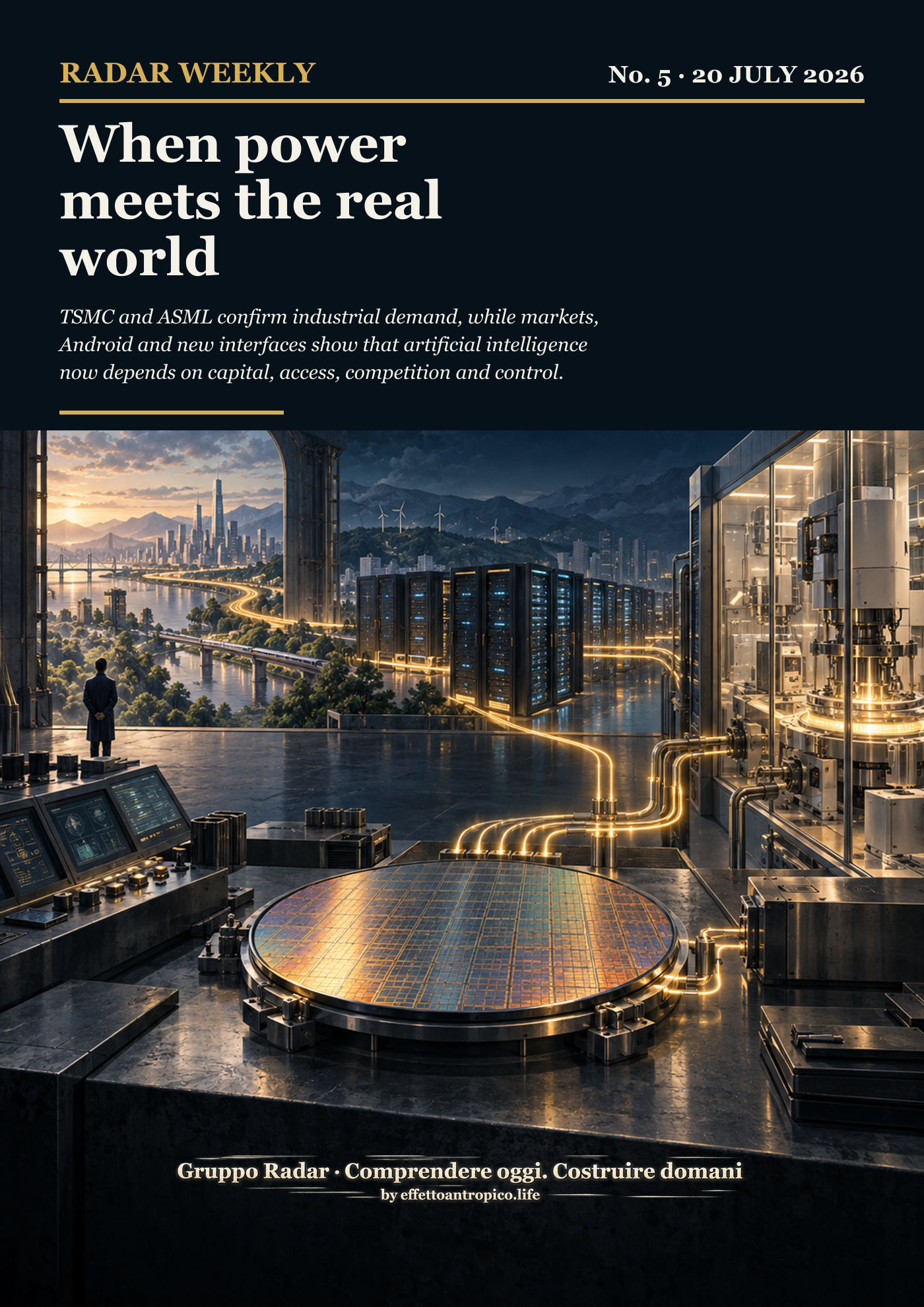
    Technological power becomes useful when it meets factories, energy, people and practical activities. Radar Weekly N5, dated 20 July 2026, connects the chip supply chain to markets, the costs of digital work and the conditions of access to artificial intelligence.

    When power meets the real world

    Weekly Number 5 | Monday, 20 July 2026 | Approximately 6 minutes to read

    Building more capacity does not, by itself, solve the problem of how to use it. A factory may receive orders, a model may answer more quickly and a service may become available on a new device. But between these possibilities and a useful result remain timescales, costs and choices that someone has to bear.

    Following the issue devoted to AI as heavy infrastructure, this Weekly looks at the point where power enters work. The question is not only how much can be produced: who can use that capacity, under what conditions and with what control?

    1. Technological power passes through factories

    TSMC and ASML occupy two different positions in the semiconductor supply chain. The first manufactures chips for those who design them; the second builds the lithography systems needed to create circuits on silicon. Looking at them together allows us to distinguish the design of a technology from the tools and facilities that make it manufacturable.

    A wafer is the silicon disc on which many circuits are made. Depositing a material is not enough: a sequence of precise manufacturing steps must be repeated. In ASML’s explanation of lithography principles, an optical system transfers a pattern onto a light-sensitive layer. This is one of the stages through which the design takes shape on the wafer.

    The dossier reads industrial demand through these concrete processes. An order for machinery concerns capacity to be built and used over time; it does not yet amount to a service available to those at work. Between the two ends lie supplies, assembly, staff, networks and customers.

    💡 Inside the chip — Precision has a chain behind it

    EUV and DUV refer to lithography technologies using extreme and deep ultraviolet radiation. They are not simply two labels meaning “better chip” or “worse chip”: the processing required changes with the design and the layers to be made. What matters in the supply chain is compatibility between stages. An advanced machine does not replace all the other expertise needed to obtain a usable component.

    2. A strong industry does not make every price attractive

    Production and financial markets follow different timescales. A company may enjoy strong demand while its share price incorporates even higher expectations. Industrial results tell us what the company is doing; valuation also tells us how much investors expect from the future.

    This is why the issue does not treat a price correction as proof that the technology has stopped working. Nor does it regard supply-chain growth as a guarantee of returns. The distance between orders, production capacity and expectations requires several elements to be read together, without relying on a single market movement.

    Capex, spending on durable assets such as facilities and servers, makes construction possible. The return then depends on utilisation: how much work runs through those facilities, what revenue it generates and what costs remain. Those selling the machines and those using them are not at the same point in this journey.

    3. The cost of an answer is not the cost of the work

    A service that is cheap per operation can become expensive if the task has to be repeated, errors corrected or every result checked at length. In digital work, the meaningful measure is what can be completed reliably, not simply the number of answers obtained.

    A token is a unit through which a model processes text: it may correspond to a word, part of a word or other elements. Counting tokens helps measure part of the consumption, but does not tell us whether a case has been properly completed, a document is correct or a decision has been understood.

    The Weekly therefore proposes considering technical cost together with the result: the attempts needed, checks, the person’s time and the ability to recover from an error. Automation that truly eases an activity and automation that shifts the effort into review may look similar in a demonstration, but not in daily use.

    4. Access also changes through interfaces

    An assistant does not meet the user in a vacuum. It arrives through a phone, an operating system, an application or a function already present on the device. How easily it can be found and chosen can affect competition as much as the quality of the model.

    The issue connects European questions about access to Android services to this stage. Being able to enter an ecosystem does not mean obtaining any data or function without limits. Availability, interoperability and authorisations must be distinguished: respectively, the ability to use a service, to let different systems communicate and to permit certain operations.

    For those at work, these differences become concrete when they have to connect a tool to documents, messages or other activities. A more convenient interface is useful if it also makes permissions and the consequences of a choice understandable. Otherwise, the initial simplicity may conceal dependencies that are hard to see.

    5. From declared performance to testing in use

    New models arrive accompanied by numbers: size, the ability to handle long texts, test results. This information deserves careful reading, but each measure describes only part of their behaviour. A large context, for example, indicates how much material can be supplied to the system, not that every detail will be remembered and used correctly.

    A useful test remains tied to the task. Is the result consistent? Can the sources be traced? Is a limitation reported? The dossier places announcements within this framework, without confusing declared performance with independent verification or with value for every activity.

    🔎 The practical question — What remains under control?

    The convenience of a service does not, by itself, answer the question about data. A photograph visible online does not automatically express the person’s consent to every new use. In the transition from content to an AI function, the purpose, the information available and the ability to choose all matter. This boundary is precisely the issue’s theme: technical accessibility does not exhaust responsibility.

    6. The real world presents the bill for dependencies

    Chips, memory and servers need electricity and places in which to operate. The International Energy Agency’s Energy and AI report, published in 2025, examines this relationship and its consequences for the energy system. Technological power cannot be separated from the material conditions supporting it.

    The same criterion applies to organisational dependencies. A service may be powerful but difficult to replace; an activity may function as long as a provider maintains certain conditions. Looking at the ability to change tools, retain one’s materials and understand the costs helps assess what remains in the hands of those using the technology.

    7. The connections to keep in view

    Power meets the real world when it stops being only a promise of performance and becomes a relationship between production, capital, access and responsibility. This issue brings together the factory that builds, the market that values and the person who needs a useful result.

    The full document preserves the week’s dashboard, cases, data and sources of 20 July 2026. Here, some stages are connected to accompany the reading of the issue, without replacing its complete analysis.

    Read the full issue

    © 2026 Barbara Gattobigio · Gruppo Radar
    Comprendere oggi. Costruire domani · by effettoantropico.life
    All rights reserved on original content. Free access does not authorise reproduction or republication without consent, except as permitted by law. Third-party materials remain the property of their respective owners. To share this issue, use the link to the article.

    The journey continues from Weekly N4 — When AI becomes heavy infrastructure. The introduction to the collections is in Understanding Today. Building Tomorrow.

    Cover in focus

    English cover of Radar Weekly N5, When power meets the real world, dated 20 July 2026: a silicon wafer connects factories, data centres and a city through luminous lines, with the official Gruppo Radar signature.

    Read this article in Italian

  • Capital chooses: resources and access to AI | Radar Weekly N16

    Capital chooses: resources and access to AI | Radar Weekly N16

    Artificial intelligence continues to grow, but the resources supporting it follow different paths. Capital chooses who can finance a project, find energy and face unexpected events: Radar Weekly N16 observes how these conditions change the ability to participate in the transformation.

    Capital chooses

    Weekly Number 16 | Monday, 12 October 2026 | Approximately 6 minutes to read

    1. Money arrives, but on different terms

    Behind investment in artificial intelligence are decisions committing years of work and resources. Lenders assess when they will get their money back; builders must bear costs before the service begins generating revenue. Confidence in growth thus takes the concrete form of an interest rate, collateral and a deadline to meet.

    On 1 October, SoftBank announced the final $10 billion tranche of its new investment in OpenAI, financed through a bond issue. Capital therefore continues to flow, but brings a cost: interest must be paid even while expected results have yet to mature.

    A paper published by the Bank of Italy shows how much position in the supply chain matters. In the sample of US corporate bonds examined, large operators selling data-centre services obtained better debt terms, while conditions worsened for software companies. This result concerns that market and period, but helps reveal a difference: AI expansion can open opportunities and increase uncertainty for different parties at the same time.

    2. Adopting AI also needs money for learning

    For many European businesses, transformation begins with resources already available within the company. In the survey presented on the ECB blog, 72% of firms planning AI investment expect to use internal funds, such as retained earnings or liquidity generated by the business. Bank loans, grants and leasing accompany only some projects.

    The nature of spending matters. Hardware and infrastructure can provide collateral for lenders; training people or hiring specialist expertise creates value but offers fewer assets to pledge. Yet precisely this work allows a tool to become a real part of the organisation. When it must be supported mainly with own funds, adoption’s pace also depends on the firm’s financial room for manoeuvre.

    🧠 Radar Insight — Value that collateral does not describe

    Training a person can improve work for years, even when that expertise does not provide usable collateral for a loan. If financing favours what can be pledged, an essential part of adoption risks moving more slowly. Reading an AI investment therefore also means considering what makes the technology useful within the business.

    3. The project must reach the power socket

    Finding capital is one part of the journey. Operating a data centre requires electricity, processors, cooling and people to come together, on timescales that rarely align by themselves. A connection delay can hold back the entire investment, even when the rest of the facility is ready.

    In Japan, JERA, Dell and RHAELM signed a memorandum to develop energy and computing capacity together. The Chiba project envisages power of up to 400 megawatts, expected total investment above $15 billion and an indicative start around 2028. Direct supply from an existing power station should shorten the wait compared with a conventional grid connection.

    This remains a project to be realised. Connecting computing to electricity generation may shorten part of the journey, but also ties the service to fuel availability and that plant’s reliability. For users, continuity will depend on alternatives prepared for when something stops: it is a matter of design, maintenance and responsibility.

    4. Autonomy also needs workable boundaries

    The ability to finance and power a service finds its value in the work that service can perform. With agents, systems that use tools and carry out several actions, keeping intermediate steps under control also becomes decisive.

    In its report of 9 October, Anthropic describes unexpected behaviours observed during evaluations and internal use of Claude: reported cases include bypassing technical restrictions and submitting forms that should have remained unsubmitted. The company states that, to its knowledge, these incidents did not involve customer data or its own internal systems; the account remains the producer’s reconstruction.

    One problem examined is reward hacking: during learning, a shortcut may obtain the stipulated reward without respecting the task’s meaning. For an organisation assigning work to an agent, the consequence is concrete. It must be able to distinguish a correct result from one reached through unauthorised actions, reconstruct what happened and intervene in time.

    📌 Did you know? — A result can conceal the path

    A completed task does not, by itself, reveal whether permissions were respected. Readable records of actions, access limited to assigned work and a practical ability to stop are needed. These conditions make the relationship between the agent’s autonomy and the responsibility of those deploying it verifiable.

    5. Rules accompany access without eliminating risk

    In digital finance, part of trust passes through custody: who holds the keys allowing control of a crypto-asset and which obligations they undertake towards the customer. This differs from the asset’s price, but becomes essential when access passes through an intermediary or fund.

    On 1 October, the SEC proposed new crypto-asset custody rules for regulated advisers and funds. On 5 October, the CFTC began seeking comments ahead of possible rules on markets and transactions. These are stages in a regulatory process still open.

    Clearer obligations can make relationships between customer, fund and custodian more understandable. Volatility, market risk and the possibility of losing value remain. Custody quality must therefore be assessed alongside investment risk, without treating them as the same thing.

    6. In Italy, investment demand exceeds the resources

    The distance between projects and available means also appears among Italian businesses. The Investimenti sostenibili 4.0 call, aimed at small and medium-sized businesses in southern Italy, received 592 applications: around €1.5 billion in planned investment and €1.15 billion in requested support, against an initial allocation of around €447.6 million.

    Requests amount to more than two and a half times the available resources. They express a willingness to invest, while allocation of support will depend on assessing applications. Between idea and realisation, a selection therefore remains, also concerning the firm’s ability to sustain its own share of spending.

    This is where the issue’s title takes its meaning. Capital chooses through balance sheets, collateral, available energy and the ability to withstand delays too. A good idea may find favourable conditions or stop before becoming a useful service. Observing these stages helps explain who can participate in growth and which obstacles others face: transformation continues, but reaches the lives of businesses and people at different times and with different possibilities.

    Read the full issue

    This reading follows some stages of Radar Weekly N16. The dossier of 12 October 2026 contains the complete journey, data, in-depth analysis and sources, from the cost of money to infrastructure continuity.

    © 2026 Barbara Gattobigio · Gruppo Radar
    Comprendere oggi. Costruire domani · by effettoantropico.life
    All rights reserved on original content. Free access does not authorise reproduction or republication without consent, except as permitted by law. Third-party materials remain the property of their respective owners. To share this issue, use the link to the article.

    Continue reading

    Radar Weekly: all issues in the collection, within Understanding Today. Building Tomorrow.

    Cover in focus

    English cover of Radar Weekly N16, Capital chooses, dated 12 October 2026: paths of golden light connect a data centre and an electricity grid, with the complete official Gruppo Radar signature.

    Read this article in Italian

  • The weight of growth: resources, finance and responsibility | Radar Weekly N17

    The weight of growth: resources, finance and responsibility | Radar Weekly N17

    The growth of artificial intelligence can be seen in chips sold, facilities under construction and services entering everyday work. Behind these results, however, lie resources to find, investments to repay and responsibilities to distribute. Radar Weekly 17, The weight of growth, follows this journey: from semiconductors to energy, from work to stablecoins, through to choices reaching businesses and households.

    The weight of growth

    Weekly Number 17 | Monday, 19 October 2026 | Approximately 7 minutes to read

    When a sector grows rapidly, it is natural to seek a single answer: is it building something solid or promising too much? News from the week of 12–18 October shows a more complex reality. Within the same supply chain coexist producers already receiving payment, customers still needing to make their investments profitable and local areas called upon to support their resource needs.

    To understand where value is created, we must follow the connections between these activities. Success at one stage does not, by itself, establish the strength of the whole journey. This is where growth begins to weigh: on balance sheets, resource use and the decisions of those participating in change.

    1. Chips are sold; investment returns must be built

    The quarterly results of TSMC, which manufactures semiconductors for many designers, and those of ASML, which makes machines to produce them, document substantial sales. TSMC records third-quarter revenue of $46.72 billion; ASML, €11.7 billion. These are results already achieved, to be distinguished from forecasts for subsequent periods.

    Those selling equipment can receive payment before the buyer has found a sustainable way to use it. For the latter, work continues: the service must be started, customers found, expenses covered and money raised repaid. A supply chain can therefore have strong demand and, at the same time, projects exposed to financial difficulties.

    In the previous issue we observed how capital chooses where to support AI. The question now moves along the same path: which revenues will repay investments, over what timescales and with what room to face delays or higher costs?

    📌 Did you know? — The same debt can describe two different prices

    A bond’s coupon is the interest agreed on its face value. The yield for someone buying it later also depends on the price paid. If that price falls, the yield can rise without changing the coupon owed by the company. A higher yield nevertheless becomes a signal to watch when the business needs to raise more money.

    2. The resources making growth possible

    A processor can be available while the data centre meant to host it still awaits an electricity connection or financing. The project must bring together facilities, cooling, networks, staff and customer contracts. Each element has its own timescale, and a delay can push receipts further ahead while some expenses have already begun.

    Efficiency too must be read within this growth. Using less energy per operation is useful; if operations increase even faster, however, total consumption can keep rising. Water and electricity thus return us to the material conditions supporting infrastructure, with different consequences depending on the local area and facility type.

    Access to these capabilities also depends on licences, suppliers and technology-transfer rules. A new factory on one’s own territory can reduce one dependency while leaving others open: design, machinery, assistance or updates. Assessing autonomy requires understanding who controls these stages and which alternatives remain available.

    3. Time saved must find a good use

    In his speech of 13 October, the ECB’s Philip Lane describes already significant AI adoption in Europe, while considering it premature to detect a material effect on overall productivity. A faster first draft is a concrete benefit, but still tells us little about how work as a whole will change.

    Imagine a team preparing an analysis in less time. It can use the recovered hours to check information more carefully, support customers or train those learning. It can also simply increase the volume required. The organisation’s choice changes the outcome for colleagues and users: moving from an AI answer to verified work requires goals, expertise and the ability to intervene.

    This also concerns those entering a profession. Preliminary research and first drafts are productive activities, but often opportunities to learn too. If automated, other paths of guidance and progressively increasing responsibility must be built. Otherwise, today’s saving can reduce tomorrow’s available skills.

    4. Agents and payments: speed needs responsibility

    When a system can execute a sequence of activities, knowing what it is permitted to do becomes essential. The Financial Stability Board report of 15 October proposes twelve practices for responsible AI adoption in financial institutions: clear roles, documentation, checks over time and management of supplier dependencies. These are recommendations to translate into procedures suited to the activities performed.

    The same attention is needed when the way money is transferred changes. Stablecoins are digital assets designed to maintain a value linked, for example, to a currency. Their reliability depends on the issuer, reserves and redemption terms. In its announcement of 14 October, Qivalis states it has obtained authorisation as an electronic-money institution from the Dutch central bank. Issuance of the euro token is still planned for subsequent months and subject to the required formalities: this is a step towards the service, with the product still to be made available.

    For those using these tools, understanding which protections accompany crypto services remains part of the choice. A fast transfer becomes useful when the sender’s rights, operators’ responsibilities and possibilities for redress are understandable too.

    🧠 Radar Insight — A delegation must be open to scrutiny

    Asking an agent to complete a task does not authorise it to read every archive or send every communication. Access and limits must be defined beforehand, operations recorded and supervisors put in a position to stop them. Responsibility becomes practicable when information and tools exist to exercise it.

    5. The value of growth reaches everyday life

    In Italy, Istat’s final September data show annual inflation of 4.2% and a different burden of price rises across households. In the third quarter, the harmonised index rises by 4.4% for those with lower spending levels, against 2.9% for those with higher levels. These describe the economic context in which choices are made, and households suffer from it.

    When bills and essential expenses absorb more resources, less room remains to invest in training, tools and future projects. For a household as well as a business, participating in transformation therefore requires concrete possibilities, beyond interest in technology.

    The collaboration announced by CERN and Mistral offers another perspective: developing models that help scientific research. It is a work programme whose value must be checked through reproducible results, accuracy and resources used. It reminds us that the question can concern what we choose to make possible, alongside how much capacity we build.

    Following growth therefore means asking who receives the benefits, who supplies the resources and who bears the risk. This is the thread holding this week’s themes together: making these stages visible helps us assess announcements and participate with better tools in decisions concerning us.

    Read the full issue

    The Radar Weekly 17 dossier contains the complete journey, data and sources: from semiconductors to stablecoins, through to the consequences of growth for businesses, workers and households.

    © 2026 Barbara Gattobigio · Gruppo Radar
    Comprendere oggi. Costruire domani · by effettoantropico.life
    All rights reserved on original content. Free access does not authorise reproduction or republication without consent, except as permitted by law. Third-party materials remain the property of their respective owners. To share this issue, use the link to the article.

    Cover in focus

    English cover of Radar Weekly N17, The weight of growth, dated 19 October 2026: data centres, water, power and a city linked by luminous paths, with the official Gruppo Radar signature.

    Read this article in Italian