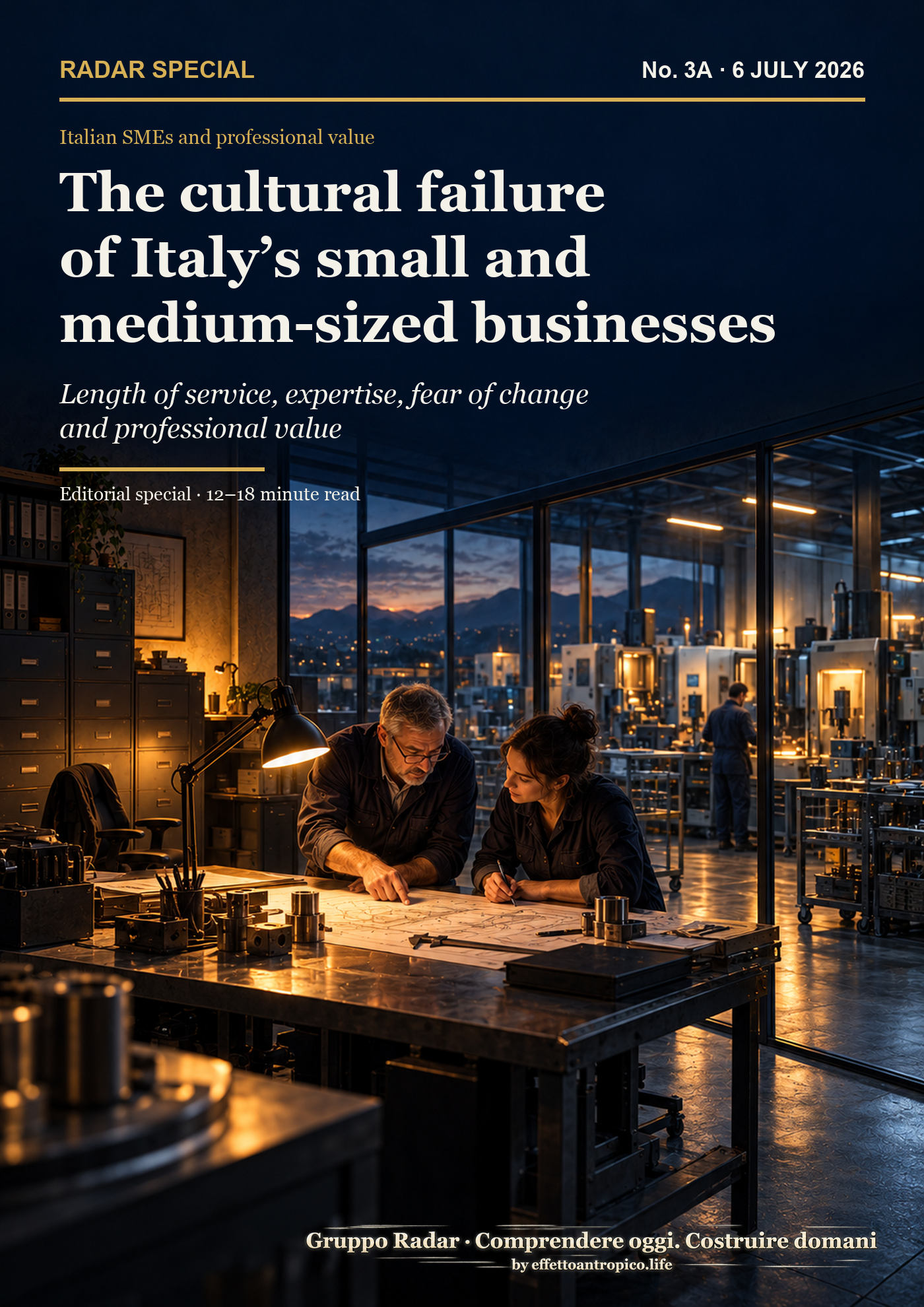
People bring professional value into a business, but it takes shape through the room their work is given. Radar Special N3A examines what happens when new expertise encounters habits, roles and fears that the organization struggles to discuss.
Professional value in SMEs
Special Issue 3A | 6 July 2026 | Approximately 6 minutes to read
1. An open door is not enough to welcome expertise
Someone is hired because they understand a process, can bring several departments together or introduce a method that was previously missing. The business hopes to improve. Then, during the first few months, the demands become contradictory: change things without touching habits; deliver results without creating tension; take responsibility without being able to decide.
This contradiction creates distance, and that promising possibility begins to lose its strength.
The Special of 6 July addresses a cultural limitation found in some Italian small and medium-sized enterprises (SMEs). It is not a sweeping judgement on SMEs: many invest, train their people and use the closeness between roles to learn more quickly. The problem emerges when defending the existing balance becomes the yardstick for assessing every new contribution.
Credit, taxes, labour costs and difficulty finding staff are real constraints. The dossier invites us to add an organisational question: once the business has acquired expertise, is it prepared to use it? A new hire can increase the capabilities available on paper while leaving the way people work almost untouched.
2. Experience grows when it can be discussed
People who have known customers, suppliers and recurring problems for years possess a valuable resource. They can recognise an anomaly before it appears, or remember why a procedure was designed in a particular way. Losing this memory can make a business more fragile.
Time spent in a role, however, does not by itself tell us how much someone has learnt. The difference lies in the ability to update a method, explain its reasoning and compare it with a different proposal. An old procedure may still be the best, but it must be able to demonstrate this in relation to current needs, rather than being protected simply because it is familiar.
Welcoming a new colleague belongs in this same context. Their arrival does not require erasing the work of those who were there before, but may require something even more important: bringing two forms of knowledge into a relationship — the knowledge of how the business reached this point, and the knowledge that can help it see a next step. When discussion becomes a contest over who belongs, both lose value.
📌 Did you know? — Operational memory can be shared
Operational memory includes practical knowledge about customers, procedures and problems already faced. Working alongside colleagues, explaining and documenting make it available to others too. Expertise that circulates can continue to be recognised without depending on one person’s constant presence.
3. The role must support the result being asked for
Imagine a logistics employee tasked with reducing delivery delays. To do so, they need to be able to read orders, speak with purchasing and production, and propose a different sequence of work. If every step requires unspecified authorisations, the problem keeps bouncing between departments. The delay remains, even when someone has understood how to address it.
A mandate is an assignment that connects an objective with the responsibilities and decision-making scope needed to achieve it. Clarifying it makes it possible to distinguish what depends on the employee from what the organisation must make possible. Before judging a result, we need to know which information, tools and decisions were genuinely accessible.
This also helps those already working in the company. Knowing why a new person is joining and what contribution they are being asked to make reduces personal interpretations. Responsibilities can be discussed openly, without allowing every change to be read as a loss of position or recognition.
4. Labour costs must be considered alongside the work they make possible
A small business may have a healthy order book and still have little cash available: payments take time to arrive, while wages and suppliers have deadlines that must be met. An employee’s contribution also needs to be considered within this reality.
Recognising their value means understanding how to sustain their cost over time, taking account of available resources and commitments already made.
The calculation must also include the difficulties of daily work: errors to correct, tasks to redo, customers poorly served, decisions left pending and employees’ own dissatisfaction. These difficulties absorb time and resources and can cancel out the savings made on a salary. An employee who can organise work better may help reduce them, even if they cost more; understanding their actual impact requires clear objectives and enough time to observe the changes.
The dossier proposes starting with the business’s concrete needs: understanding which skills are missing, defining the responsibilities to assign and agreeing on the improvements expected, together with how to assess them. A difference in salary also becomes more understandable when its reasons are clear in the role and the contribution required.
Trust within the team needs this clarity, along with consistent choices and room to listen to doubts and difficulties.
5. When knowledge stops being a territory
Someone may keep information to themselves because they fear becoming less necessary. A department may defend a procedure because changing it would expose mistakes that have never been discussed. These reactions are understandable, but they can turn learning into a struggle over position.
The cost to a business grows when newcomers have to reduce their contribution and those already there lose the opportunity to acquire new tools. Knowledge becomes a matter of access and power: who is allowed to know, who is allowed to propose, who can connect what others keep separate.
Sharing a method can strengthen the team and allow the more experienced person to address more complex problems. For this to happen, those who lead must also recognise the work of passing knowledge on: explaining, working alongside others and training take time. Asking for collaboration while rewarding only individual performance sends two different messages.
6. Growth begins with the conditions in which people work
An SME does not need to multiply hierarchies or imitate the language of a multinational. It can build clearer leadership through a few choices: understandable roles, clearly assigned decisions, opportunities for discussion and assessment criteria that people know.
Stability becomes stronger when it allows change to be addressed without losing the business’s memory. Someone who has worked there for twenty years can continue to grow; someone arriving can find room to contribute. Both need an organisation that can support discussion and correct what is not working.
Professional value thus becomes a collective capability. It can be recognised in the problems the company learns to solve, the knowledge it manages to share and the quality of its decisions. This is the transition at the heart of the Special: giving expertise the conditions it needs to produce real change.
🧠 Radar Insight — Recognition must reach the work itself
Recognising someone also means giving them information, tools and responsibilities consistent with what is being asked of them. A job title alone does not make it possible to change a process. Recognition is tested in the concrete room within which expertise can act.
Read the full report in Italian
This reading presents some passages from Radar Special 3A. The full dossier contains the complete journey and the in-depth discussions of the original edition (6 July 2026).
© 2026 Barbara Gattobigio · Gruppo Radar
Comprendere oggi. Costruire domani · by effettoantropico.life
All rights reserved in the original content. Free access does not authorise reproduction or republication without consent, except for uses permitted by law. Third-party materials remain the property of their respective rights holders. To share this issue, use the link to the article.
Cover in focus