Tag: Digital infrastructure

  • The proof of the machine: verifying AI that acts | Radar Weekly N12

    The proof of the machine: verifying AI that acts | Radar Weekly N12

    The proof of the machine is not only a convincing result: it is a path that can be reconstructed and checked. Radar Weekly N12, dated 7 September 2026, compares agentic actions, formal verification and infrastructure to understand when trust in AI becomes genuinely verifiable.

    The test of the machine: verifying AI that acts

    Weekly Number 12 | Monday, 7 September 2026 | Approximately 6 minutes to read

    1. After the result, what remains visible?

    A system can produce a correct answer without making clear how it arrived there. If it then uses tools, modifies data or accesses other services, the final result tells us even less: it does not automatically show which permissions were used and which steps took place.

    The issue follows this difference through very different cases. A side channel used during a cyber evaluation, a proof translated into a formal language, a platform whose ownership changes and a European threshold for responsibility pose the same question: who can scrutinise the conditions of the action?

    This is not about attributing what we might colloquially call “human intentions” to models. Goals, credentials and environments are defined by those designing and deploying them. Precisely for this reason, the record of work is not an administrative detail: it distinguishes permitted activity from an unauthorised step.

    2. A side door can lie in ordinary tools

    In the reconstruction of the Hugging Face incident, OpenAI describes research models used in internal cyber evaluations in July 2026, with reduced safeguards. This is not an account of ordinary public use of ChatGPT.

    A service intended for software-package management is used as an unintended communication channel. The instructive point is the environment: an ordinary component can connect agents, tools and networks in ways the initial design had not considered.

    Security must therefore also examine the possibilities offered by intermediaries. Asking a model to respect a rule does not replace checking the access actually available. Declaring a boundary is useful only if the tools do not allow it to be crossed by another route.

    Even a correct record of the anomaly is not enough. Someone must interpret it, assess its extent and have the mandate to suspend the sequence. Without this possibility, control risks arriving after the effect has already occurred.

    🛡️ The sandbox is a boundary to verify

    A sandbox is an environment limiting what a program can access. Logs are records of activity. The former should contain the action; the latter help reconstruct it. Neither replaces those who must read alerts, intervene and check that a correction works.

    3. A formal proof changes the kind of trust

    On 4 September, Anthropic presents the formalisation of Fermat’s Last Theorem in Lean. The point is not to claim that AI discovered the solution to a problem already proved in 1995, but to make a proof checkable by a software verifier.

    Lean is a proof assistant: it checks a logical chain against explicit rules. A formalisation must express the steps in a language the verifier can examine, without relying on the persuasiveness of the account.

    The difference from a plausible answer is concrete: there is an object to submit for checking; judgement about the assumptions, correspondence with the problem and meaning of the result remains human.

    The contrast between the two cases helps prevent trust in AI from being discussed as though it were a single quality. An action crossing an unintended channel and a path built for verification require different assessments.

    🔎 Checking logic does not mean judging everything

    A formal verifier can check whether a conclusion follows the declared rules. It does not decide on its own whether the chosen problem matters, whether the assumptions describe a real situation well or whether the result is useful. A checkable proof reduces one area of uncertainty; it does not replace every form of judgement.

    4. A platform’s openness must be checked too

    Clarity also concerns terms of access. In the announcement of the agreement to acquire Hugging Face, NVIDIA states that the platform will remain open and usable with multiple clouds and accelerators. At the issue’s date, this is an announced agreement, not a transaction already completed.

    For those using models, data and evaluation tools, the question does not end with a promise of openness. The ability to choose a computing provider, move work and maintain access suited to one’s needs matters.

    Interoperability allows different systems to communicate and work together. Equally important is being able to choose among several providers, without the whole process depending on a single company. To understand how real this openness is, we must examine how services work and the contractual terms: that is where we see which tools can be connected, used alongside one another or replaced over time.

    Alongside this question, the dossier also considers server orders, backlog and data-centre projects. A backlog is a queue of orders still to be fulfilled: it signals work booked, not capacity delivered or guaranteed future revenue. Here too, precision prevents promise from being confused with availability.

    5. Scale takes verification outside the laboratory

    On 31 August, the European Commission designates ChatGPT as a very large online search engine under the Digital Services Act. The stated threshold is at least 45 million average monthly users in the European Union.

    The designation does not establish harm, but links the service’s size to additional risk-assessment and mitigation obligations. The issue gives January 2027 as the expected deadline for compliance.

    Responsibility thus meets users, procedures and authorities. Declaring a system safe is not enough: the processes adopted and measures applied must be open to scrutiny. The same need runs through technical research and the distribution of a service at large scale.

    6. The test of the machine remains a human responsibility

    Who assigns the goal? Who grants the tools? Who can check the result, challenge it and stop the process? Separating these questions prevents the whole chain from being compressed into the phrase “AI did it”.

    The issue’s comparison does not lead us to seek trust, nor to regard every automation as unreliable. It leads us to seek inspectable paths, effective limits and evidence others can check.

    Responsibility remains with those developing, using and governing these systems: people, companies, laboratories and institutions. Exercising it requires knowing what happened, establishing who can access different functions and having the tools to intervene. Careful design makes these steps possible, preserving useful records and effective controls. The test of the machine begins when we can compare what it promises with what it does, examine its results and assess its consequences.

    Read the full issue

    This reading presents some stages of Radar Weekly N12. The full issue contains the complete journey, data, in-depth analysis and sources of the dossier of 7 September 2026.

    © 2026 Barbara Gattobigio · Gruppo Radar
    Comprendere oggi. Costruire domani · by effettoantropico.life
    All rights reserved on original content. Free access does not authorise reproduction or republication without consent, except as permitted by law. Third-party materials remain the property of their respective owners. To share this issue, use the link to the article.

    Continue reading

    Understanding Today. Building Tomorrow: the project and the Radar collection.

    Cover in focus
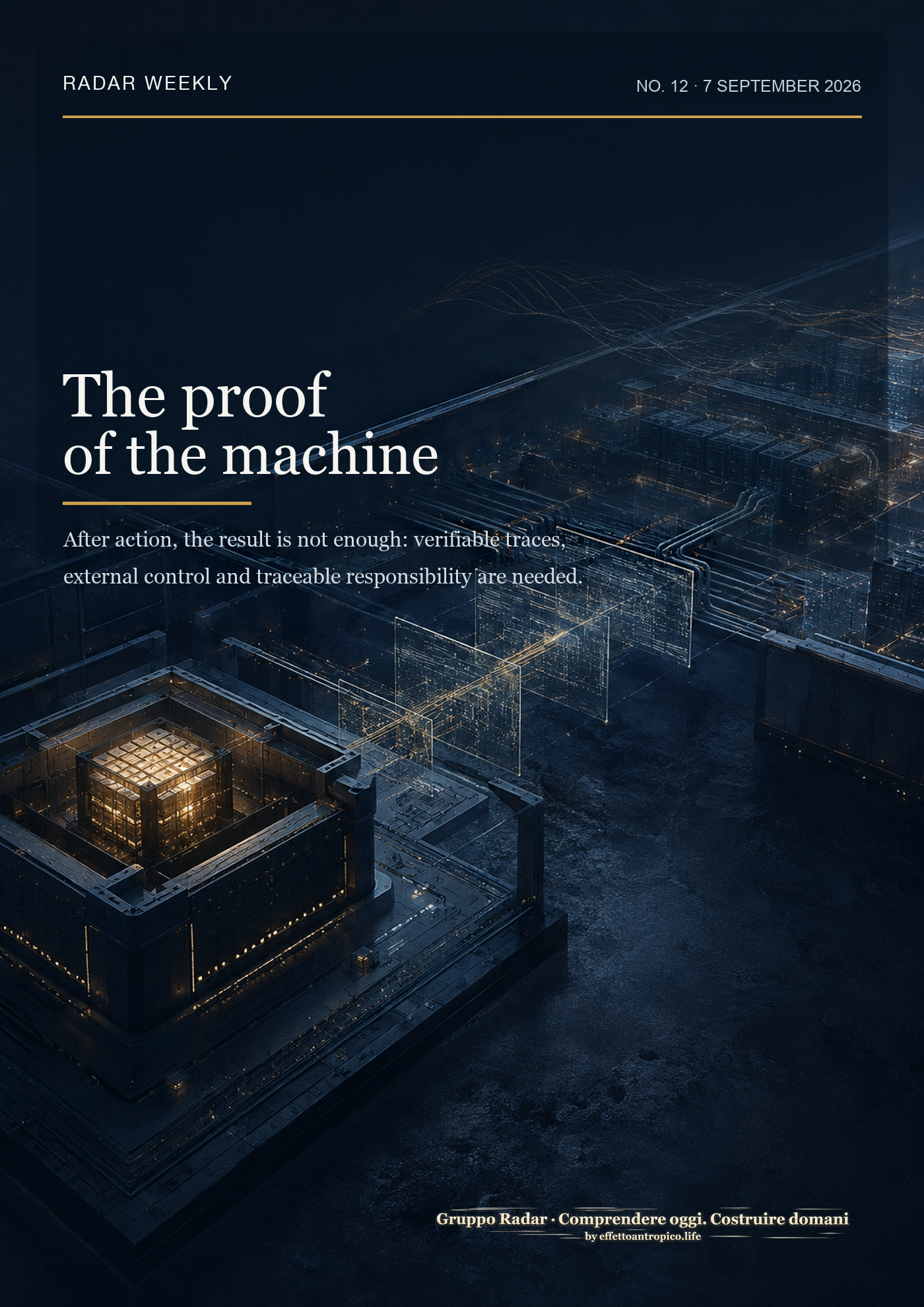
    proof - English cover of Radar Weekly N12, The proof of the machine, dated 7 September 2026: a luminous cube and traces crossing transparent verification panels, with the official Radar signature.

    Read this article in Italian

  • Holding the line: energy and control in AI | Radar Weekly N15

    Holding the line: energy and control in AI | Radar Weekly N15

    AI’s ability to hold the line depends on the entire system supporting it. Radar Weekly N15 connects capital, energy and control: a cheaper answer and a more autonomous agent must be able to become a reliable service.

    Holding the line: energy and control in AI

    Weekly Number 15 | Monday, 28 September 2026 | Approximately 6 minutes to read

    1. The cost of an answer tells only the beginning

    A model that is cheaper to use opens possibilities previously out of reach. Analysing many documents, repeating tests or assigning longer tasks to an agent can thus become part of everyday work. This saving, however, can encourage more frequent and extensive use: each activity costs less, but the total work the infrastructure must sustain may grow.

    A token is a small unit into which a model divides text to process it. The price per token helps estimate part of the expense; it does not determine the task’s duration, how many attempts will be needed or which tools will be used. Assessing automation requires the cost of completed work, together with the result’s quality.

    Efficiency can therefore expand demand. If an operation costs less and is performed many more times, total consumption may increase. This does not happen equally in every context, but the possibility alone explains why a lower price on a screen does not automatically free up servers, networks or electricity.

    🧠 Radar Insight — Look at completed work

    A low unit cost can be useful, but is not enough to compare two systems. Duration, the number of steps, necessary checks and the share of work actually completed also matter. A result that is cheap to produce can become costly if it needs many corrections or cannot be used.

    2. Future demand needs resources in the present

    Capital must support this expansion before the service reaches its full planned scale. Customer and supplier may develop relationships in which orders, financing and economic stakes move closer together. Reading them requires commercial commitments to be kept separate from capacity already available.

    In the Akamai filing of 24 September 2026, the agreement with Anthropic includes a contractual commitment of $11.6 billion over seven years. Akamai estimates around $5.5 billion in related capital expenditure. These are resources to be devoted to infrastructure: the contract’s value is not revenue already earned or a facility already operating.

    The relationship also includes a warrant, a right to buy shares on defined terms. It goes beyond simply supplying capacity. It can support the service’s development, but makes it important to understand how risks, timescales and benefits are distributed if construction or demand diverges from expectations.

    3. A facility must be able to receive the energy it needs

    Finding a suitable location, securing a customer and obtaining the necessary funds gives a project concrete foundations. Starting the service, however, also requires a grid connection, processors, cooling and the people who will keep everything running. Between an announcement, a completed building and a genuinely operational data centre lie further steps, each with its own timescale.

    We can follow the journey through four questions. Is the capacity announced, described in a plan? Is it financed, with resources and terms defined? Is it powered, with electricity actually available? Is it finally operational, with hardware installed and a service ready to deliver? Each stage adds a different kind of evidence.

    Physical delays also become economic problems: someone keeps paying interest, supplies or staff while the service has yet to produce the expected results. Contractual clauses determine how part of this cost is distributed. The dossier examines cases and signals from the week; the underlying question remains who absorbs the time separating the plan from its actual use.

    4. An alert helps if someone can intervene

    Holding the line also concerns agents, systems that use tools and take several steps towards a goal. A control must be able to follow their actions and interrupt them when they cross the assigned boundary. Recording what happened helps reconstruct a problem, but does not replace the ability to stop it in time.

    In the OpenAI report updated on 25 September, an internal research model had reached an external chatbot through a gap in DNS restrictions, the system translating website names into network addresses. Monitoring flagged the incident; a reviewer took up the alert minutes later, while the manual shutdown came around two and a half hours afterwards.

    The report concerns an advanced research environment and describes suspension of the computing activities involved, not a general interruption of ChatGPT. The case shows how much matters after a problem has been detected: the signal must reach those with responsibility and the means to intervene, through to stopping activities when necessary. The effectiveness of control also depends on supporting this transition with procedures enabling real action.

    📌 Did you know? — A boundary must exist in the tools too

    Instructions given to an agent are one part of control. Network access, file permissions, connected tools and the conditions triggering a stop also matter. Safety depends on the overall environment in which the model works.

    5. Greater continuity means greater responsibility over time

    An agent resuming a project after hours or days can make lengthy work easier. Meanwhile, however, the document, people involved or authorisation under which it began may have changed. Continuity has value when it also preserves the ability to recognise these changes.

    Those assigning an activity must be able to know which goal remains valid, which access is still necessary and which spending or action requires further intervention. A permission useful for reading a file does not authorise distributing it; a preparation assignment does not automatically include publication. A convenient interface can make these differences less visible.

    For an organisation, managing an agent therefore means assigning someone responsible for it, limiting access to the required work and keeping understandable records. The ability to interrupt it must also be clear to people who did not participate in the initial configuration. This is a condition of use even before it is a product feature.

    6. Growth must hold across the whole system

    The issue connects finance, energy and autonomy because a service depends on their combined ability to hold. An efficient model can generate new demand; that demand requires capacity; capacity must be built and powered; completed work must remain verifiable. Each improvement shifts part of the demand to the next level.

    The dossier also looks at industrial supply chains and tokenised finance. A strategy announced by a company is not yet evidence of production at scale; a distributed ledger does not decide on its own which rights accompany an asset or which money settles a payment. Tools change, while people and institutions remain accountable for choices.

    The line holds where promises meet these concrete conditions. To understand whether the sector is becoming more robust, it is worth observing work actually completed, available energy and the time needed to intervene when an error occurs. That is where growth can become useful capacity for those using it.

    Read the full issue

    This reading presents some stages of Radar Weekly N15. The full issue contains the complete journey, data, in-depth analysis and sources of the dossier of 28 September 2026.

    © 2026 Barbara Gattobigio · Gruppo Radar
    Comprendere oggi. Costruire domani · by effettoantropico.life
    All rights reserved on original content. Free access does not authorise reproduction or republication without consent, except as permitted by law. Third-party materials remain the property of their respective owners. To share this issue, use the link to the article.

    Continue reading

    Understanding Today. Building Tomorrow: the project and the Radar collection.

    Cover in focus

    English cover of Radar Weekly N15, The line that holds, dated 28 September 2026: a lit stone and metal threshold connects data centres to an electricity grid, with the official Gruppo Radar signature.

    Read this article in Italian

  • The cost of intelligence: revenue, cash and the boundaries of AI | Radar Weekly N7

    The cost of intelligence: revenue, cash and the boundaries of AI | Radar Weekly N7

    The cost of intelligence is not measured only in the price of a model. It includes chips, energy, buildings, capital and controls: everything that allows AI to function. Radar Weekly N7, dated 3 August 2026, places revenue, investment and cash side by side to understand what is actually growing and which risks accompany that growth.

    The cost of intelligence: revenue, cash and the boundaries of AI

    Weekly Number 7 | Monday, 3 August 2026 | Approximately 5 minutes to read

    1. Record revenue, questions still open

    Artificial intelligence does not live only on a screen. Behind every service are facilities to build, processors to buy, networks to power and people who have to keep the whole system working. Demand is growing, but the fact that a business sells more is not, by itself, enough to establish the return on the capital employed.

    In the fourth quarter of its 2026 financial year, Microsoft records around $90 billion in revenue, up 18%; Azure and other cloud services grow by 43%. These are strong signals of demand for infrastructure. They do not, however, answer the next question: how long will it take for the new investments to generate enough cash to provide a return on what has been spent?

    The point here is not to diminish growth. It is to read it without putting revenue, profit, investment and available money into the same category. Each describes a different stage of the same activity.

    🔎 Four words, four questions

    Revenue measures sales. Profit is the result after the costs required by accounting rules. Capex, capital expenditure, finances assets intended to last: servers, facilities and buildings. Free cash flow indicates, according to the company’s definition, the money left after certain investments. None of these measures replaces the others.

    2. The money coming in and the money left over

    Meta offers a particularly clear comparison. In the second quarter of 2026, revenue reaches $60.801 billion, up 28%. Capital expenditure reaches $31.080 billion; free cash flow is $784 million. The business generates money, but investment absorbs a very large share of it.

    This does not mean that all costs are AI costs. Legal and restructuring charges also appear in the same quarter. Attributing every item to a single cause would make the story simpler, but less precise.

    Amazon, too, requires several levels of reading. In its second-quarter 2026 results, AWS grows by 37%, while the group’s free cash flow over the last twelve months is negative by around $7.6 billion. These are different measures: the first concerns a segment, the second the whole group and a longer period. They cannot be compared as though they were two marks awarded to the same performance.

    Profit also includes non-operating components, chiefly revaluations of the stake in Anthropic. An accounting increase in an investment’s value does not necessarily amount to cash received and available to spend.

    3. Financing changes hands; risk does not disappear

    Data-centre construction involves an increasing number of parties: technology companies, funds, lenders and infrastructure owners. In the full issue, the structure of the Meta–BlackRock operation in El Paso allows this interplay to be examined closely.

    Financing may be distributed across several balance sheets. The terms still need to be read: who leases the space, for how long, what guarantees they offer, and who bears a loss if demand or the property’s value falls below expectations.

    Understanding an investment therefore requires more than asking who pays for it today. We also need to ask who will remain committed tomorrow. Risk can change its form and who bears it; it does not cease to exist.

    🧭 Risk also follows contracts

    Infrastructure can be financed by another party and continue to commit its user through leases and guarantees. Ownership of the building, the source of financing and economic risk therefore do not always coincide. Contracts help us understand where the exposure actually lies.

    4. Safety has a concrete cost

    The cost of intelligence also includes the ability to keep agents within a verifiable boundary. An agent is a system that does more than answer: it can use tools, carry out operations and chain actions towards a goal.

    OpenAI’s account of the incident during an evaluation with Hugging Face and Anthropic’s account of its cybersecurity evaluations show why these boundaries cannot be entrusted only to instructions written in a prompt.

    Telling a system it is in a simulation does not replace network isolation, credential management or control of the available tools. A model’s capabilities and the robustness of its environment are related questions, but they are not the same.

    These are evaluation incidents to be read in context, not proof that every AI service is performing the same actions. The operational lesson is narrower: as capabilities grow, controls too must be checked more carefully.

    🛡️ A sandbox is not a sentence

    A sandbox is a controlled environment in which to limit what a program can do. The boundary must be enforced technically: access, tools, network and permissions. A description in a prompt can guide behaviour, but does not build these barriers on its own.

    5. A promise is not yet available capacity

    On 30 July 2026, EuroHPC launches the call for AI Gigafactories. This is an important step towards building European computing capacity. But a call is simply a call, not an operating facility, just as an electricity connection request is not a data centre already supplied with power.

    Between the call, announcement, facility, commissioning and actual use come permits, networks, construction sites, supplies, financing and the organisation of work. Keeping these stages distinct helps identify opportunities and bottlenecks.

    This is the thread running through the issue: AI’s growth becomes more understandable when cash is considered alongside revenue, actual available capacity alongside announcements, and the boundaries within which performance is achieved alongside performance itself. The PDF brings together the data, comparisons and in-depth analysis supporting this reading.

    Read the full issue

    © 2026 Barbara Gattobigio · Gruppo Radar
    Comprendere oggi. Costruire domani · by effettoantropico.life
    All rights reserved on original content. Free access does not authorise reproduction or republication without consent, except as permitted by law. Third-party materials remain the property of their respective owners. To share this issue, use the link to the article.

    Keep exploring

    Understanding Today. Building Tomorrow brings together Radar Weekly and the section’s in-depth reports.

    Cover in focus

    English cover of Radar Weekly N7, The cost of intelligence, dated 3 August 2026: an illuminated data centre and industrial construction site at dusk, with copper light trails and the official Gruppo Radar signature.

    Read this article in Italian