A phone lights up during a conversation, drawing our attention. The glance is ours; the rhythm of notifications, settings and the order of content also arise from choices made elsewhere. The Meta case brings these choices into an even more important question: what responsibilities belong to those who design the digital environment, those who govern it and those who guide children and young people within it?
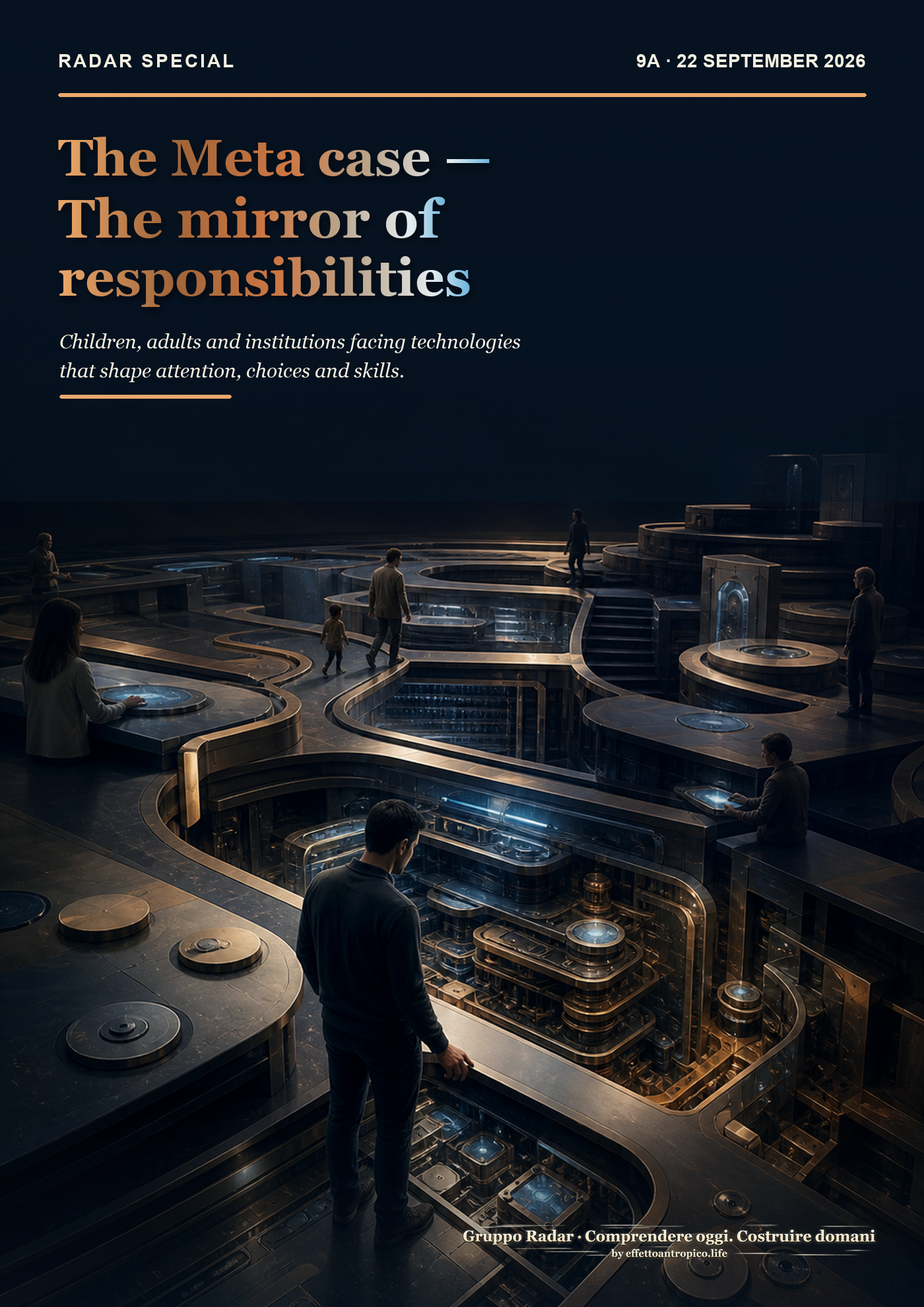
The Meta case: a mirror of responsibilities
Special Issue 9A | 22 September 2026 | Approximately 6 minutes to read
1. A decision that raises further questions
The New Mexico court’s decision of 6 August 2026 addresses the role of Meta platforms in the harms examined in the proceedings. The $375 million in civil penalties from the first phase is joined by $567 million for prevention measures and services: a total of $942 million. The judgment concerns the facts established in that case.
The court recognises Meta’s significant contribution to the problem, while also acknowledging the usefulness of the services and the role of other platforms. The Meta case therefore does not explain every difficulty in digital life. It invites us to look at concrete powers: who knows the risks, who can change the product and who has a duty to intervene. The company’s responsibility remains identifiable even when the system includes other actors.
2. Behind the screen, there are several layers
An hour in front of a device may include a video call with a relative, homework, a cooperative game, reading an ebook, editing a file, dealing with an email or scrolling through content with no visible end. These are different experiences. Time tells us how long they last, but not what relationships they create, what data they collect or what they replace in the day. Understanding the effects requires a closer look at the actual activity.
The infrastructure also has several layers. The operating system governs permissions and notifications; the application determines functions and interface; the recommendation system selects which content to offer and in what order. A family can change some settings, but does not have the tools to re-examine the entire product. Making a control easy to find or hiding it behind many menus changes the real possibility of using it.
📖 Further reading — What the decision funds
In the New Mexico case, the $567 million fund supports community measures, including prevention, needs assessment, connections to services and treatment. It is not an automatic individual payment to minors. Distinguishing the remedy from the penalty helps us understand what the court actually ordered.
3. Knowing how to use an app is only part of competence
Children and adults quickly learn to tap, swipe, search and send. This familiarity can coexist with less visible difficulties: understanding why a recommendation appears, recognising an advertisement, evaluating a source or managing microphone access. Digital competence also includes the ability to explain what is happening and change course when it does not match one’s intentions.
For a school, distributing devices and teaching digital literacy are therefore related but distinct activities. Opportunities are needed to check real information, configure permissions, produce content and discuss how attention and data acquire value. The same work concerns adults: using a platform every day does not automatically make us capable of understanding its choices. Education can begin with this gap, without turning it into personal blame.
4. Effects require precise questions
Research does not provide a single answer that applies to every platform and every person. The CDC observed associations between frequent social media use and some indicators of difficulties among US high school students. That survey captures a situation: on its own, it does not establish whether use causes distress, whether distress influences use or whether other conditions are involved.
This caution allows us to take risks seriously without constructing a general explanation. A small average effect may still leave room for significant consequences for some people; a difficulty observed in one group does not describe all users. Social media and video games also require different questions, because content, relationships, rules and purchases change the experience. We need to know for whom, at what stage of life and in comparison with which alternative a result was measured.
5. Families have a role, alongside real limits
At home, a phone may be needed for work, school, the doctor, the team group and contact with people far away. Rules must fit this actual daily life. Parental controls can prevent a purchase or restrict hours; dialogue can help people recognise pressure, ask for help and gradually build autonomy. These tools do different jobs and can support one another.
Adults have responsibilities to set an example, listen and make choices. The time, skills and resources available, however, vary from family to family. Asking someone to leave the screen has a different meaning when safe spaces, sports, libraries and accessible relationships are available. Alternatives are part of public responsibility: they help make an educational choice practicable, instead of leaving it entirely on the shoulders of those who must put it into practice.
🧠 Radar Insight — Responsibility and power
Responsibilities are not distributed equally. Designers know the product’s data and how it works; educators guide the person; those who govern can require checks and build services. Recognising these differences prevents a situation in which everyone is called upon and, precisely because of that, no one answers for the stage they control.
6. Regaining control without losing the relationship
Credible protection requires each actor to make its work visible. Platforms must make it possible to understand and challenge the choices that organise the experience. Those who distribute applications must make permissions and family tools clear. Schools can teach people to use, create and verify; institutions can ask for evidence and offer remedies. Public measures, too, must be assessed in terms of the data they collect and the possibility of challenging an error.
The Meta case thus becomes a useful mirror beyond the company’s name. It asks us to consider who could have prevented harm, who could have corrected it and which alternatives were available. Regaining control may mean changing a setting, choosing a different activity or asking for a structure to be better designed. The digital relationship retains value when we can understand it well enough to enter it thoughtfully, change it and end it without losing essential rights and possibilities.
Read the full issue
This article presents selected passages from Radar Special 9A. The full dossier contains the complete discussion and further analysis from the original edition (22 September 2026).
© 2026 Barbara Gattobigio · Gruppo Radar
Comprendere oggi. Costruire domani · by effettoantropico.life
All rights reserved on original content. Free access does not authorise reproduction or republication without consent, except as permitted by law. Third-party materials remain the property of their respective owners. To share this issue, use the link to the article.
Continue reading
Understanding Today. Building Tomorrow: the project and the Radar collection.
Cover in focus