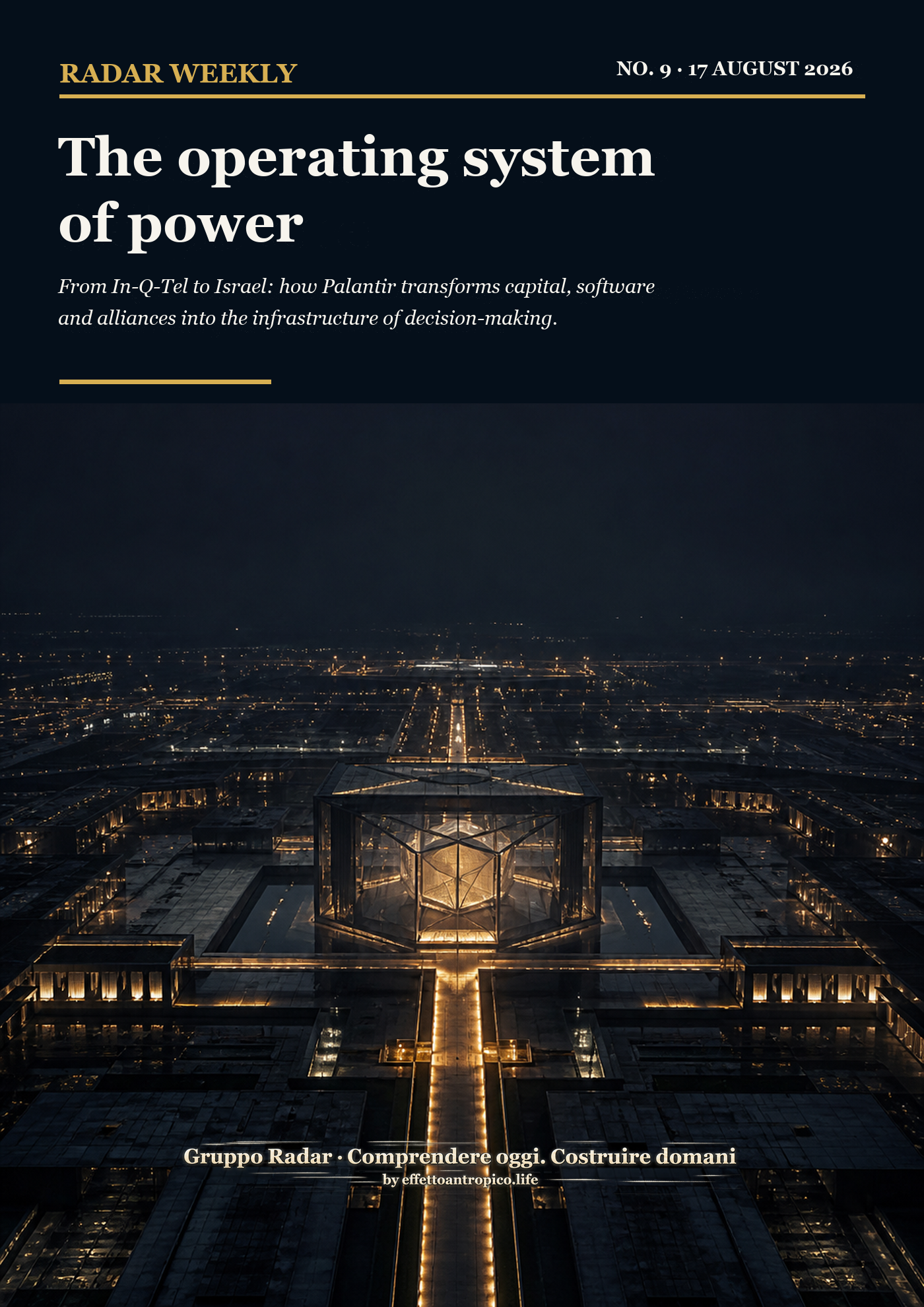
The operating system of power is the thread through which Radar Weekly N9, dated 17 August 2026, reads Palantir: not only a software provider, but an environment connecting data, tools and decisions. The issue reconstructs its origins, contracts and alliances, distinguishing operational power from formal authority and the responsibilities of decision-makers.
The operating system of power
Weekly Number 9 | Monday, 17 August 2026 | Approximately 5 minutes to read
1. Software that organises what can be seen
Digital infrastructure does more than store information. It establishes how to connect it, who can access it, which operations are permitted and which elements reach the table where a decision is made. When it becomes the place where many activities meet, it ceases to be an accessory easily separated from the work.
Palantir was founded in 2003 in the context of US security after 11 September. Its history intersects with capital, public-sector contracts and the development of tools for organising large quantities of data.
The relationship with In-Q-Tel is one piece of this reconstruction, but alone it is insufficient to show that the CIA directs every company decision. Financing or a contract can create important ties; understanding who controls the company and who can decide its operations, however, requires further evidence. These are levels that may intersect but must be distinguished: conflating them does not guarantee clarity.
2. Gotham, Foundry and Apollo: three different functions
Gotham is associated with information analysis in intelligence and defence contexts. Foundry extends data integration into industrial and organisational processes. Apollo, by contrast, concerns software deployment and updates across different environments.
These three functions help explain the transition from a program performing a single task to a platform helping hold many activities together. The corporate filing submitted to the SEC in 2020 allows this architecture and the company’s structure to be read in its official sources.
A platform can speed up the transition from information to action, but connecting data does not make it reliable. The quality of the work also depends on sources, permissions granted and operators’ practical ability to understand what is happening, correct an error or stop the process.
Choosing a platform therefore also affects how an organisation works. When procedures and connections take shape within a proprietary environment, changing provider means transferring part of that work: moving data, rebuilding connections and adapting processes while supporting people in the new environment. The cost of change therefore goes beyond the licence and includes the time needed to regain continuity and autonomy.
🧩 When the cost of leaving grows
Lock-in occurs when changing provider becomes costly because of technical, contractual or organisational constraints. It does not require an absolute prohibition on leaving: it may be enough that data, procedures and expertise are difficult to transfer. Reversibility must be designed at entry, not only when the relationship ends.
3. Ten billion: a ceiling, not money received
On 31 July 2025, the US Army announces a framework agreement with Palantir consolidating 75 contracts, lasting up to ten years and worth a maximum of $10 billion. Its stated aim is to simplify purchases of software and services, reducing time and intermediary costs.
The $10 billion represents the ceiling on possible purchases during the period. The agreement allows purchases according to need. In the announcement, the Army also reiterates its commitment to rigorously assessing requirements and maintaining competition, but does not describe the concrete conditions for choosing alternative solutions.
The subsequent work on a common data baseline for command and control, described by the Army on 22 June 2026, shows a range of suppliers and functions. Anduril leads the work on data architecture, and Palantir participates with Foundry. More actors involved — and what about responsibility?
🔎 Maximum value is not the amount already spent
A framework agreement sets the terms for subsequent purchases. Its ceiling is a limit, not a picture of spending already incurred. Understanding economic activity requires actual orders and obligations undertaken.
4. Operational dependence and command are not the same
A platform can become difficult to replace because it concentrates knowledge, configurations and working habits. This gives it operational weight without transferring the legal authority of the institution using it.
The expression “operating system of power” attempts to describe the role of infrastructure entering the decision-making process: it connects information, makes it available to operators and helps define how it can become action. Its weight also arises from this ability to organise the environment in which people work and choose. To understand it, however, we must distinguish influence exercised through the platform from the authority of the institutions using it: the former does not, by itself, prove that the supplier gives orders or controls its customers.
Looking inside the company, the question of control requires another distinction: between capital held and the ability to influence corporate choices. Documents describe a structure reserving specific voting prerogatives to the founders, subject to defined conditions. Understanding who can steer the company therefore requires holdings to be read alongside their associated rights: a shareholder’s economic weight and decision-making power may follow different balances.
At this point, the question to put to an administration or business is not only whether the software works, but: can its use be scrutinised, its dependencies understood and the solution changed without losing access to the organisation’s own information assets?
5. Israel: separating facts from stated positions
The dossier includes the partnership with Israel’s Ministry of Defence and Palantir’s public position. Precision is particularly important here: agreements, company statements and publicly accessible operational details are not the same thing.
In its response of 22 May 2025 to a United Nations request, Palantir declares its solidarity with Israel and denies developing or supplying the systems called Gospel and Lavender. It also maintains that military decisions belong to governments, not the company.
The company’s statements express its position, but do not replace independent verification of how the software is used. When sufficient public information is missing, questions of responsibility remain open and deserve attention. Taking them seriously means continuing to seek answers while keeping clear the boundary between what sources document, what remains to be clarified and allegations we cannot currently support.
6. What to ask before becoming dependent
The issue’s concluding section broadens the reading to computing infrastructure and agents. The thread remains the same: a technical capability becomes a matter of governance when it becomes an established part of an organisation’s processes.
Before adopting a platform, it is useful to ask who defines permissions, how completed operations can be reconstructed and what remains available if the relationship with the provider ends. A good initial result does not, by itself, answer these questions.
Interoperability (in Italian) means enabling different systems to communicate; portability means being able to transfer data and, where possible, configurations; an audit means examining procedures and evidence to establish what has been done. These are concrete tools for making the relationship between technology and responsibility less opaque.
The PDF preserves the complete reconstruction, data and other analyses of Weekly N9. The question running through the issue is not whether software has power in the abstract, but how that power is bounded, checked and made reversible.
🧭 Three questions for maintaining control
Can I see? Records and explanations of operations must exist. Can I intervene? Permissions and authorisations must be changeable or revocable. Can I leave? Data and continuity of work should not depend on a single path with no alternative.
Read the full issue
© 2026 Barbara Gattobigio · Gruppo Radar
Comprendere oggi. Costruire domani · by effettoantropico.life
All rights reserved on original content. Free access does not authorise reproduction or republication without consent, except as permitted by law. Third-party materials remain the property of their respective owners. To share this issue, use the link to the article.
Keep exploring
Understanding Today. Building Tomorrow brings together Radar Weekly and the section’s in-depth reports.
Who controls AI infrastructure?
When power meets the real world
Cover in focus