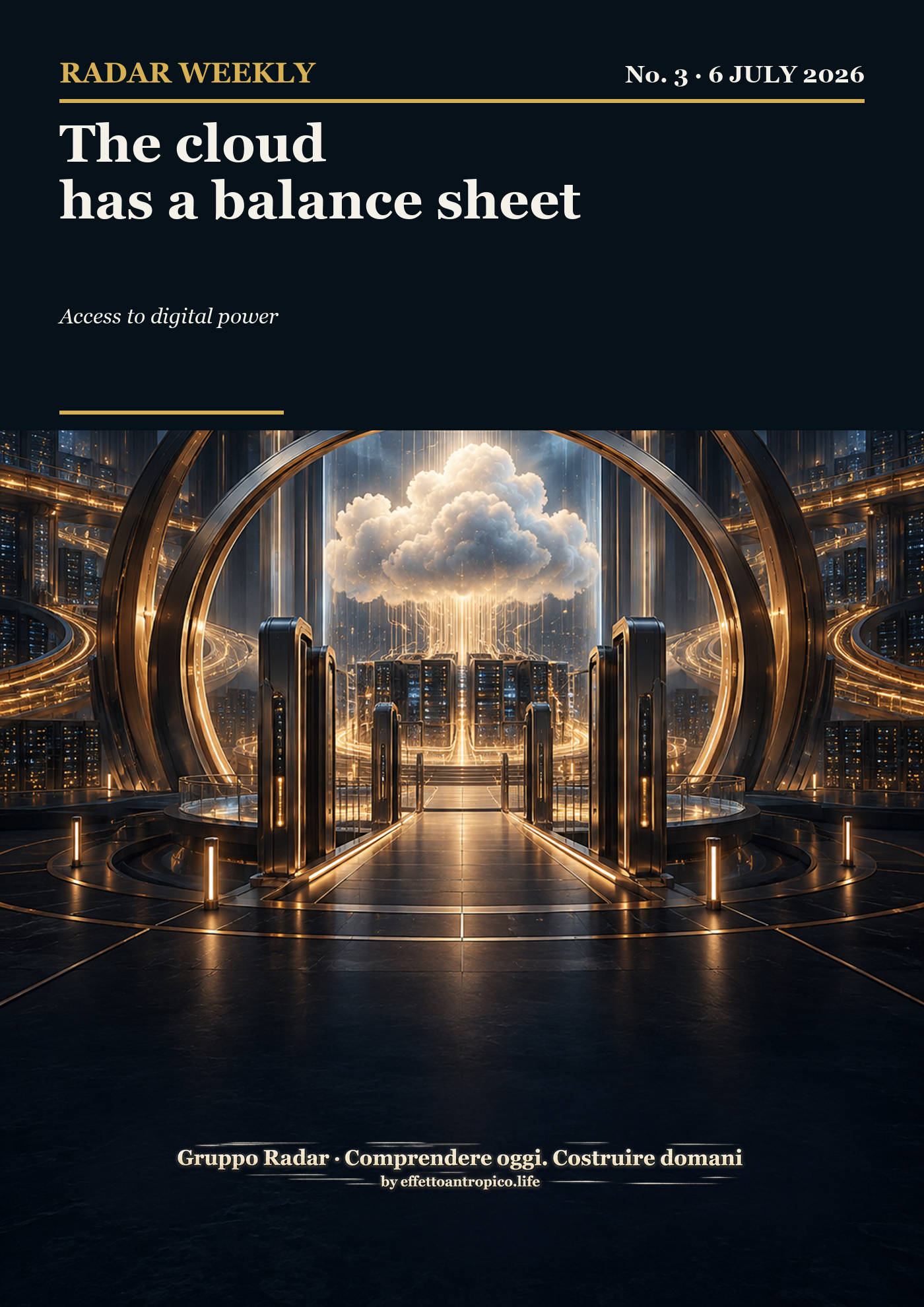
Access to digital power depends on chips, memory, energy and capital, but also on the contracts and rules governing their use. Radar Weekly N3, dated 6 July 2026, connects the balance sheet of artificial intelligence to the availability of computing and the infrastructure of digital finance.
The cloud has a balance sheet: access to digital power
Weekly Number 3 | Monday, 6 July 2026 | Approximately 7 minutes to read
Having revealed its material weight, the cloud also shows its balance sheet. Building a computing centre means investing today, taking on commitments that last over time and waiting for the service to produce value. Meanwhile, that capacity has to be powered, maintained and made available to someone. The question is no longer only what a model can do: it is who can use it, who bears the costs and how the returns are distributed.
The issue continues the journey that began with chips, energy and the geopolitics of AI and went deeper into the conditions of access to infrastructure. Here those threads meet: computing needs physical resources, resources need financing, and their availability depends on economic and political decisions. This reading follows some stages of the dossier, preserving the context of July 2026.
1. The cloud’s balance sheet: spending is not enough
An investment can make a service possible without proving, by itself, that the service will be sustainable. Those selling chips or memory, those building data centres and those buying computing capacity occupy different positions. A supplier’s revenue may arrive while the customer is still working out how much value the new machines will deliver. Looking only at the growth in spending risks confusing these different timescales.
Radar invites us to follow the transition from investment to actual work: the use of facilities, operating costs, revenue and results in business activities. Very large capacity that is barely used remains a cost to bear. Capacity used well can instead improve processes and products. There is no need to choose in advance between enthusiasm and rejection: we need to understand where value actually begins to take shape.
💡 Understanding the issue — The cost does not end with the purchase
Capex means investment in durable assets, such as servers, networks and buildings. A hyperscaler is a large cloud operator that builds and manages this infrastructure on a vast scale. Leasing, using facilities or equipment under a contract, can also create future obligations. After construction, electricity, cooling, maintenance and staff are still needed: reading the balance sheet means considering both the initial spending and what keeps the service running every day.
2. Digital power is built in layers
A model that is ready does not amount to a service available at the required scale. Computing depends on processors, but also on the memory that feeds them data, the networks connecting the machines and the systems cooling them. If one of these stages slows down, the rest of the infrastructure may be unable to work at the expected pace.
HBM, high-bandwidth memory, transfers large amounts of data quickly to processors. DRAM is working memory that holds data while the system is powered; NAND allows it to be retained after power is switched off, as in SSDs. These abbreviations are not interchangeable: they meet different needs that have to come together in a usable machine.
Energy also enters this chain, together with the practical ability to bring it where it is needed. The International Energy Agency’s Energy and AI report, published in 2025, examines the link between AI and the power supply for data centres in greater depth. An announcement therefore does not settle the availability of computing: it depends on components, connections and facilities that take time to build.
3. Available, but to whom?
The issue focuses on access to the most advanced models, called frontier models because they stand at the frontier of available capabilities. The point is not only to compare their performance. How they are distributed matters too: a restricted preview, a service with limits and a capability open to different groups do not offer the same opportunities to experiment.
Material access adds another layer. A model may be formally available and still be difficult to use for those who lack the necessary capacity, cannot afford the price or do not meet the terms of the contract. This is precisely where digital power meets the organisation of the service: quantities, regions, priorities and requirements help determine who can actually work with it.
Safety remains a practical necessity. But acknowledging it does not close the questions about limits: who decides them, how are they justified, and what opportunities exist to scrutinise them? Radar holds these two needs together, without treating every restriction as an abuse or every provider decision as an inevitable response.
4. Autonomy means more than an alternative chip
When access to a strategic component is restricted, dependence becomes clearer. Reducing it requires more than replacing a machine: compatible software, memory, cloud services, developers, networks and industrial expertise are needed. A chip may be the most visible point of competition, but the service comes from the whole.
This is how the issue approaches technological autonomy. Building a supply chain means making the connections between its parts usable and reliable. Rules restricting technology exports, export controls, can slow access to certain tools while strengthening interest in developing alternatives. Neither effect alone proves that one ecosystem has overtaken another technologically: we need to observe what the ecosystem can actually produce and put to use.
5. Digital money needs clear terms too
Digital finance enters the discussion through a related question: what makes a promise usable and trustworthy? Stablecoins seek to maintain a value linked to a reference, often the dollar. Understanding how they work means looking at reserves, who holds them and the terms of redemption, not just the value displayed on a screen.
The dossier follows their transition towards more regulated payment infrastructure. The change concerns responsibilities, checks and operational functioning. A network may enable fast transfers, but trust also depends on being able to know who is accountable for the commitments undertaken. Technical speed and the strength of a promise remain two distinct aspects.
🔎 A point to clarify — A stable balance does not explain redemption
Redemption means redeeming a token under the stipulated terms, obtaining the value or asset it represents. A stablecoin showing a price close to one dollar is not enough to explain how this operation takes place. Who can request it, the reserves available, the timing and any limits all matter. Price stability and the right to redemption are connected, but they are not the same information.
6. Sound verification must start with reliable information
In DeFi, finance that uses programs on blockchains, risk does not concern only the code executing a transaction. There are also connections between networks, nodes and verification systems. A bridge allows different blockchains to exchange messages or transfer assets: its reliability depends on how events on the other side are verified.
If a system receives false information about an external event, it may execute a transaction consistent with that information but wrong in relation to what actually happened. This is why the dossier also examines off-chain components, those outside the blockchain. A correctly recorded transaction does not, by itself, prove that all the information making it possible was correct.
This brings us back to the original thread: infrastructure is more than what is visible in an interface. It includes those supplying data, those checking connections and those intervening when something does not add up. Trust is also built by making these responsibilities clear.
A thread to carry with you
The cloud has a balance sheet because its power has to be built, financed and maintained. It also has terms of access, because resources do not become available in the same way to everyone. AI and digital finance remain different fields, but the issue connects them through what supports them: infrastructure, contracts, rules and opportunities for verification.
The dossier’s scenarios follow these connections over thirty days, six months and two years. They are not predetermined outcomes: they indicate which signals to watch, from investment results to component availability and the concentration of services. The question that remains open is how to turn technological capability into sustainable value without losing access and trust.
The full Radar Weekly N3 brings together the dashboard, business cases, charts, scenarios and vocabulary of 6 July 2026. Here, some stages have been connected; the PDF allows the complete journey to be followed.
Read the full issue
© 2026 Barbara Gattobigio · Gruppo Radar
Comprendere oggi. Costruire domani · by effettoantropico.life
All rights reserved on original content. Free access does not authorise reproduction or republication without consent, except as permitted by law. Third-party materials remain the property of their respective owners. To share this issue, use the link to the article.
To retrace the thread, Weekly N1 — The cloud has weight and Weekly N2 — Who controls AI infrastructure? are available. The introduction to Understanding Today. Building Tomorrow brings together the project and its Weekly and Specials paths.
Cover in focus