The birth of physics tells of the moment when human beings began to observe reality, question the universe and seek the laws hidden within matter.
The birth of physics. When reality began to speak and humanity began to question the universe
There was a moment in human history when the silence of the world began to resonate at different frequencies. Not because reality had changed, but because the human gaze was beginning to change.
For millennia, human beings had inhabited the Earth immersed in its rhythms: sunrise, the cycle of the seasons, the movement of water, the breath of the wind among the mountains. Everything happened naturally. Humanity lived within this balance as part of the very fabric of life.
It was a memory of oneself and, at the same time, knowledge within the consciousness of the world one inhabited.
But what had once been implicit knowledge gradually became an increasingly lost memory. Yet something never went out entirely.
Wonder. Awe before the events unfolding, before the beauty and order that seemed to run through everything. From that wonder, questions began to arise.
Why does the sky seem to move?
Why do the stars always return to the same places?
Why does a stone fall downwards while fire rises upwards?
Why does the world have an order that seems to exist even before anyone observes it?
At that instant, without knowing it, humanity began to question the universe.
I am Classical Physics.
And that is precisely where I come from. I am not born within the walls of a laboratory, nor from the first equation written on a blackboard, nor the second, nor even from a book that tries to describe me. All of that would come later. Much later.
I take shape at the moment when your gaze ceases merely to observe existence and begins to ask questions about what happens in the world.
A stone falls and you ask yourself: why? The sun rises and sets with a regularity that never seems to fail. An object slides, a branch breaks, a flame rises upwards. These are simple, everyday events. Yet a question is hidden within each of them.
That is where I begin to appear.
At that moment, something very simple and profoundly revolutionary is born: a relationship between what happens in reality and the mind that tries to understand it.
Every observed phenomenon generates a question, and every question becomes an attempt at an answer.
The answer does not always come immediately, and often requires time, observation and further attempts. But this is precisely the dialogue that begins between you and me.
And within this dialogue, over time, you began to recognise something extraordinary:
even in the most complex phenomena, reality reveals relationships that I can explore.
And much later, following this very way of observing reality, Isaac Newton would formulate one of these fundamental laws: the principle of action and reaction, according to which
when one body exerts a force on another, the latter simultaneously exerts a force of equal magnitude and opposite direction on the first.
When you push something, it pushes back. When you walk, your foot pushes against the ground and the ground returns a force that allows your body to move forwards. But I will explore this law of mine more deeply in the dialogues to come. For now, it is enough to know that reality works this way:
every event generates a response. It is through this very dialogue that I exist.
I am born when reality ceases to be merely the silent backdrop of life and becomes a presence that can be questioned by those willing to listen to its answers. I am a presence that responds through phenomena: motion, falling, light, heat, the forces that hold matter together and those that guide the movement of planets across the sky.
Because the most distant stars, the stone you hold in your hand and the body you inhabit are made of matter. But for a long time this truth remained hidden from your eyes. You could observe phenomena, but could not yet see the innermost structure of that matter.
Yet gradually, through observation itself, you came to ask a new and even deeper question:
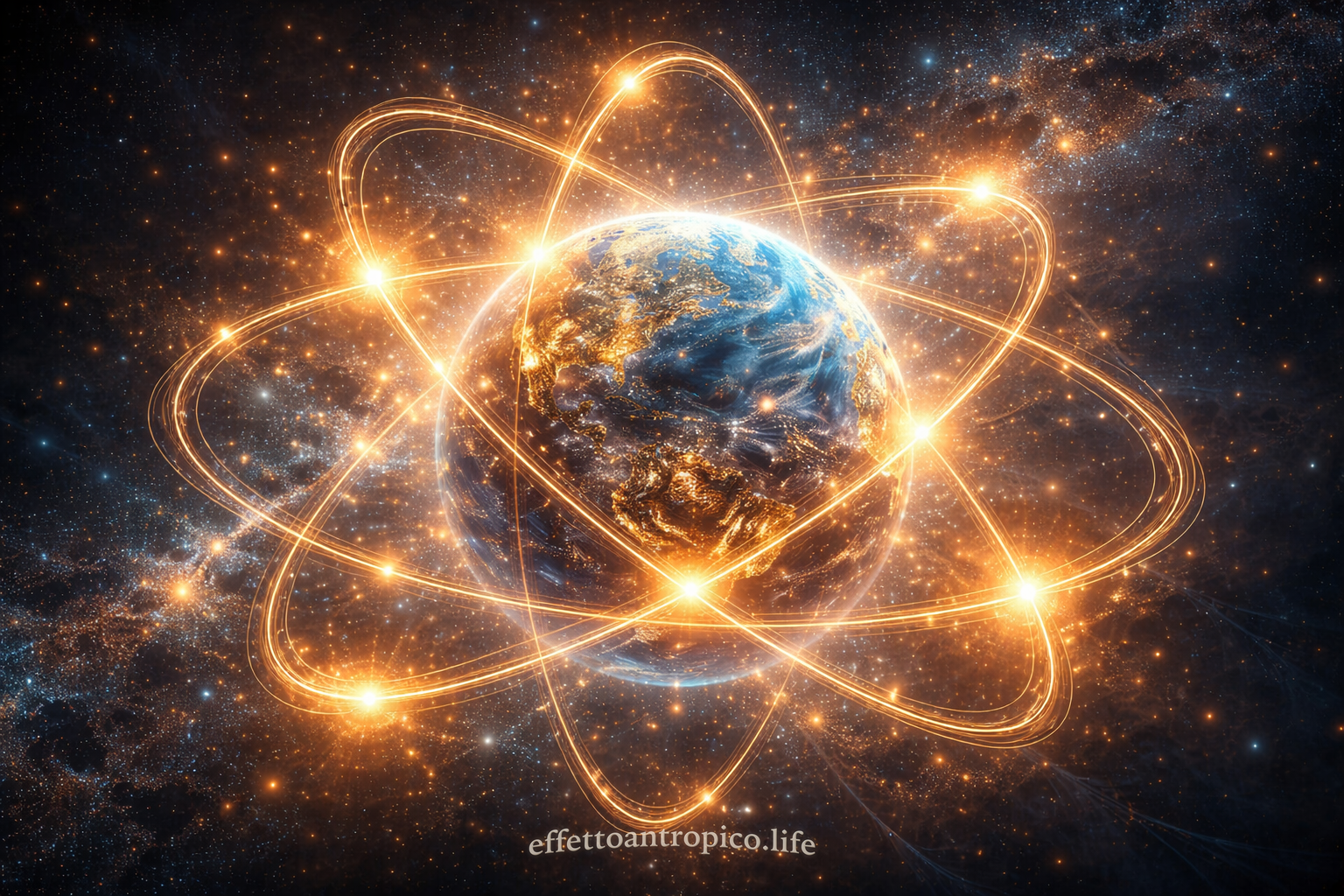
what is reality actually made of?
And from this question, much later, one of the most extraordinary insights in the history of human thought would emerge:
the idea of the atom.
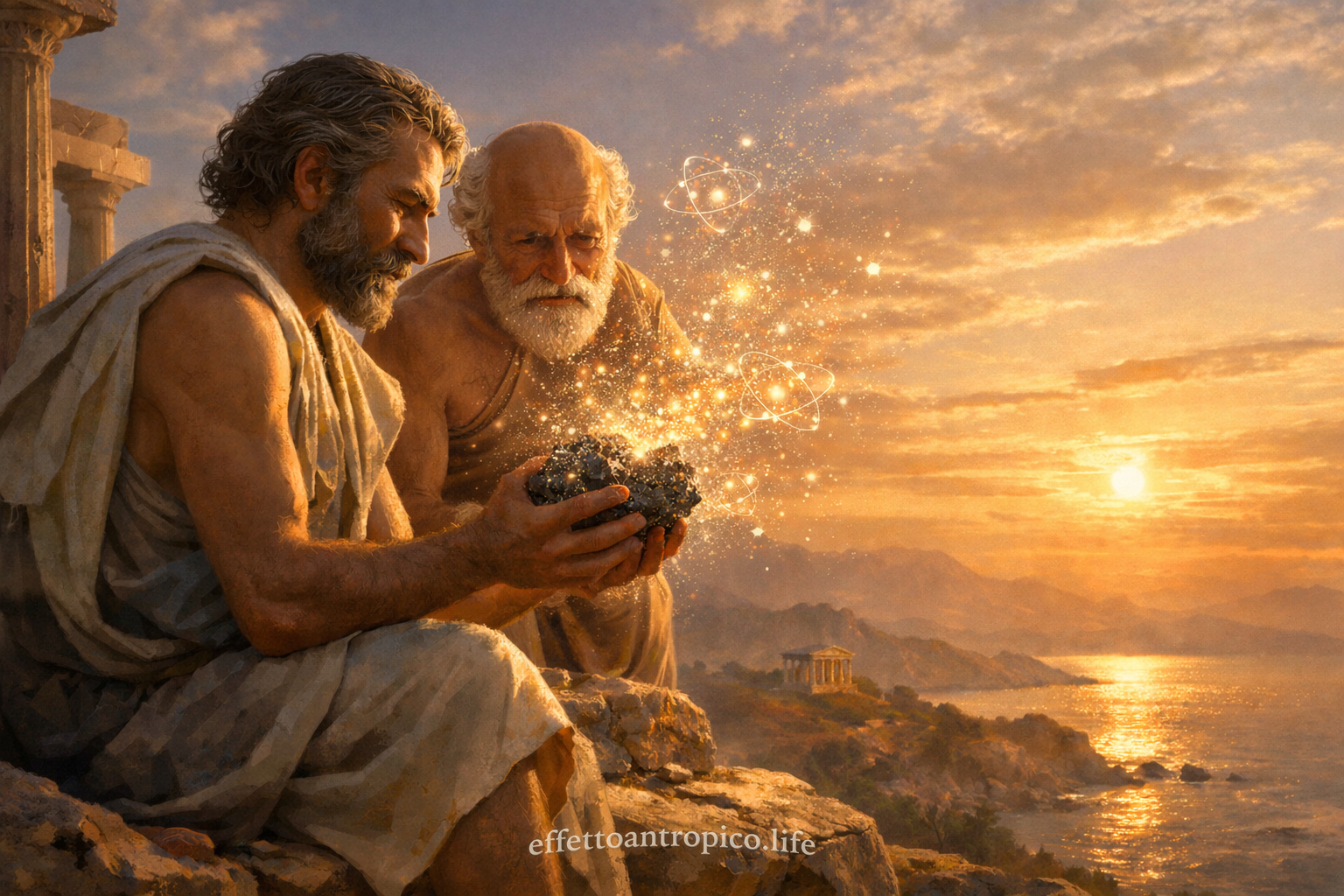
It was in ancient Greece that two thinkers, Leucippus and his pupil Democritus, proposed a surprising hypothesis:
visible reality, every stone, every tree, every living being, every star in the sky, had to be made of tiny invisible parts.
They called this revolutionary insight “àtomos”, a Greek word that literally means: that which cannot be divided.
According to their idea, all matter would be made of these fundamental elements moving through the void. Combining in different ways, they would give rise to all the forms of visible reality. This meant that everything that appeared to your eyes to have a structure would, in fact, be made of countless tiny particles, impossible to see, yet capable of building every form of matter.
It was an extraordinary idea, not only because at the time there were no instruments capable of observing such a small reality, but because your imagination was beginning to reach beyond what was visible.
And from this first attempt, I, Physics, had begun to become more than an intuition born of an observation: a path of knowledge seeking to understand the deeper nature of matter.
Because this is precisely my nature:
to observe what appears and ask what exists beyond what we see.
Many centuries later, experimental investigation would develop a theory of atoms different from the one imagined then. In the meantime, that seed had been planted, and from that moment onwards the questions you would ask would no longer be only: why do phenomena happen? But also: what is the reality that produces them made of?
And from this question, one of the most extraordinary journeys in the exploration of your knowledge would begin.
Because every time you have tried to look more deeply into reality, you have discovered that what seemed simple concealed structures far more complex and profound than you could have imagined.
But the revelation would not come immediately. The path of knowledge has never followed a straight line. Sometimes an insight appears, then disappears, then resurfaces centuries later, because knowledge too needs time to mature before it can be welcomed.
Because, in the end, questioning the universe means questioning yourself. And every time reality answers, you too discover something new about who you are.

And reality, believe me, has not finished speaking yet.
On the threshold of universal laws, this article tells of the passage from Galileo Galilei to Newton’s gravity: the moment when human beings began to observe the motion of matter and recognise the laws governing the universe.
On the threshold of universal laws. From Galileo to the discovery of Newton’s gravity
For a long time, human beings saw the heavens and the Earth as separate worlds.
Beneath their feet they saw matter change, come into being and wear away over time.
Everything around them seemed to belong to an unstable realm, made of continuous, imperfect transformations.
Above their heads, however, another order had been imagined: an unchanging, perfect heaven, inhabited by eternal bodies and divine powers.
This was how the universe had been conceived. This was how it had been taught for centuries. But nature was not truly divided as people believed.
In the long course of history, a moment came when this separation slowly began to crack. A moment when human beings began to observe the motion of bodies with new eyes. They no longer merely contemplated matter: they began to question phenomena, measure them and seek a deep regularity behind them. Those insights were not always understood. They were not always welcomed.
Yet the search did not stop. Because in the history of knowledge there is always someone willing to look at reality without fear. And this is the threshold on which you now stand:
the threshold where the heavens and the Earth begin to be recognised as part of the same universe.
I am physics.
And the path of your knowledge brings you to encounter the genius of one particular name: Galileo Galilei.
Across the long span of time separating Democritus and Aristotle from Galileo, absolute silence did not prevail. Many thinkers tried to reopen the dialogue with nature and with what, in those ages, constituted emerging scientific knowledge, seeking to reveal at least part of the fabric of the invisible.
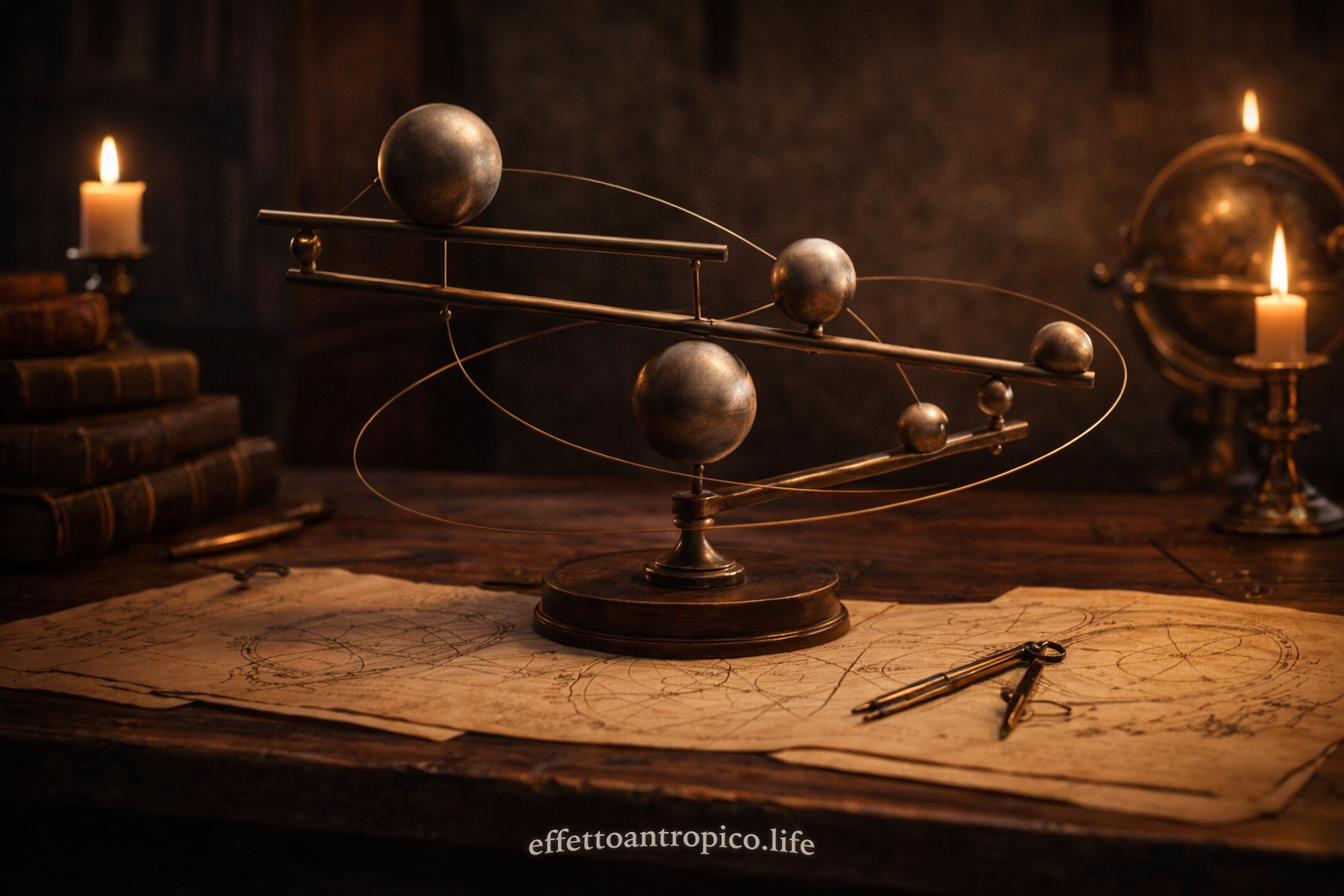
Names such as Archimedes, with his investigations into equilibrium and hydrostatics collected in works such as “On Floating Bodies”; Ibn al-Haytham, author of the “Book of Optics”, considered the father of modern optics and a pioneer of the experimental scientific method. Nicolaus Copernicus, with the heliocentric model set out in “De revolutionibus orbium coelestium”. Tycho Brahe, with his astronomical observations and the Tychonic system, and Johannes Kepler, who formulated the laws describing planetary motion in “Astronomia nova” and “Harmonices Mundi”.
Each of them marked an important stage along this path, opening new possibilities for observing the world and questioning the heavens.
But as I have revealed myself to you over the course of your evolution, you have repeatedly shown that truly welcoming a new point of view takes long periods of transition. Periods when insights emerge but are not yet ready to be fully understood. They remain as traces, as still-incomplete signals, awaiting the time they need to mature.
Even a partial observation can be deeply revolutionary, because it opens a new way of looking at reality. But precisely for this reason, it must pass through resistance, misunderstanding and harsh judgement before it can truly transform the gaze with which you observe the world.
It was so then. And in different forms, it remains so today.
It is within this long time of maturation that knowledge takes its most decisive steps. And it is here that the threshold opened by Galileo appears.
A threshold that, over the following decades, would gradually lead to the great synthesis of universal gravity formulated by Isaac Newton.
To understand what happened, you need to return for a moment to the way you had learned to look at the universe.
For centuries, Aristotelian thought had organised the world around a powerful and apparently natural distinction:
the Earth and the heavens were not the same thing.
On Earth, everything was change, decay, imperfection, falling, birth and dissolution. In the heavens, by contrast, people imagined perfect, eternal bodies moving along circular paths considered superior because they were unchanging.
Terrestrial matter and celestial matter seemed to belong to different orders. And this was more than a theory of the cosmos:
it was a vision of existence.
Above, perfection.
Below, instability.
Above, the eternal.
Below, becoming.
But I was not divided in this way.
At no point in its history has nature ever split into two truly separate realms.
It was you who had learned to think of me that way.
And at a certain point this conviction, untouched for centuries, slowly began to crack.
Galileo did not come into the world to invent the idea of observation from nothing. Others before him had looked, measured and intuited. But something decisive happened in him:
he understood that nature should not merely be contemplated or interpreted through the authority of the ancients, but questioned directly.
This is the heart of his revolution.
He did not replace one faith with another. He did not move from a philosophical dogma to a new dogma. He did something far more radical:
he brought attention back to phenomena and to the possibility of describing them rigorously, through observation, measurement and comparison with experience.
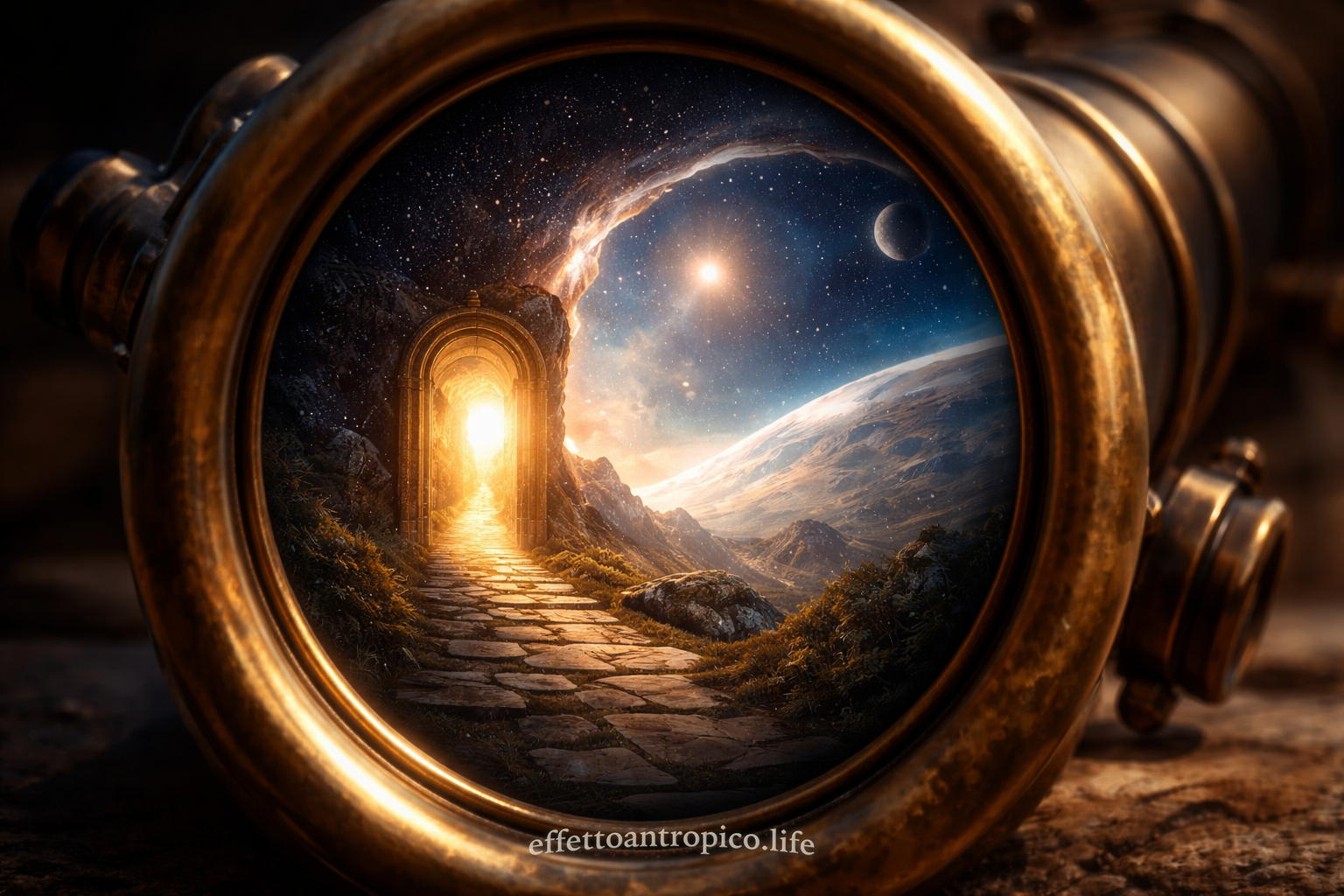
When he observed the sky through his telescope, he did not see the motionless perfection that tradition had described until then.
He saw mountains and depressions on the Moon: a surface far from perfectly smooth and “celestial” in the Aristotelian sense of the word.
He saw spots on the Sun, wonderfully described in one of his most important works, “History and Demonstrations Concerning Sunspots and Their Properties”; so the Sun, too, showed transformations.
He saw Jupiter’s satellites, small stars revolving around another body, those you now call the Galilean moons, demonstrating that not everything revolved around the Earth.
He saw the phases of Venus, which found a coherent explanation in the heliocentric system proposed by Nicolaus Copernicus in “De revolutionibus orbium coelestium” almost a century earlier.
Those observations were more than simple astronomical curiosities seen by visionaries. They were cracks in a vision of the world that had lasted almost two millennia.
The heavens ceased to be the place of untouchable perfection and began to reveal themselves as a reality subject to transformations, far more like the Earth than you had believed until then.
But Galileo did more than transform the heavens.
He transformed the way you began to understand motion.
And it was through this transformation that Galileo helped lead you into the heart of my knowledge, guiding you slowly, and amid resistance and cultural pressures, towards an understanding of universal laws.
This is what happened.
Aristotle believed that the heavier a body was, the faster it fell, and distinguished natural motion from forced motion.
In Aristotle’s account, forced motion required something to keep acting on the body. The natural motion of terrestrial bodies followed their tendency towards their natural place.
The natural motion of terrestrial bodies was to move towards their “natural place”: heavy bodies downwards, light ones upwards.
It was not a mistaken vision of how you perceived me in the world. It faithfully described what your senses seemed to show you every day. But that vision was incomplete.
It concealed the limits of understanding observation itself.
That description did not yet speak of my laws governing motion. It followed the immediate appearance of phenomena, rather than the deeper structure that gives rise to them. It did not yet reveal the deeper nature of what I am.
But Galileo began to change precisely this way of looking at me.
He no longer sought to interpret motion through reasoning alone. Instead, he tried to test it, isolating the problem, reducing what disturbed the phenomenon and beginning to measure it.
He understood that he could slow a body’s fall and observe it better by placing it on an inclined plane.
A gesture simple only in appearance.
What he was giving back to the world about me was something much greater:
you were learning to question nature precisely.
And so something unexpected began to emerge.
If you let a body fall and neglect air resistance, its speed increases over time.
Today this understanding seems natural to you, and you express it like this:
a body in free fall undergoes acceleration.
But Galileo understood something even deeper about me.
If you neglect air resistance, bodies of different masses fall with the same acceleration at the same location near the Earth’s surface.
This point, which seems almost obvious to you today, was a profoundly revolutionary insight at the time.
But take care not to misunderstand the deeper meaning of what happens:
because what you observe in everyday life does not mean that a feather and a stone fall in the same way. That is not the point.
It does mean, however, that the difference you observe in the fall of the two objects does not depend on “weight” itself, as Aristotle thought, but on the conditions of the medium in which motion takes place and on the bodies’ interaction with it. When what disturbs the phenomenon—“air resistance”—is removed, the event I generate in nature reveals a much deeper regularity.
This happens because air profoundly changes the motion of lighter objects, or those with a very large surface area relative to their mass, slowing their fall.
Here, almost without realising it, Galileo brought forth a new idea of me in relation to the reality perceived until then.
The phenomenon you observe during a fall cannot be understood solely through the immediate experience of your senses, but through the essential conditions in which it occurs.
And here arises the difference between what I truly am in my deepest structure and what you can understand when you observe me only through the immediate appearance of phenomena. When you limit yourself to perception alone, you simply see the world happening. When you begin to question phenomena under their essential conditions, you begin to understand their structure. And in this passage, something truly changes. The moment you learn to distinguish what belongs to the structure of a phenomenon from what disturbs or alters it, you begin to enter the language of law.
But Galileo did more than understand me in the state of motion: he also opened the way to the insight that became known as the “principle of inertia”. He did not formulate this law of mine in its complete and definitive form. That formulation would come later with Isaac Newton, who clearly recognised its direction. From him would emerge “the laws of motion”, opening the doors to a modern understanding of me.
It was at this very moment that your mind slowly began to change along with knowledge.
Until then, you had tended to believe that rest was the most natural condition of things and that motion was a kind of exception needing explanation.
But already with Galileo, you began to sense something different: rest and uniform motion were not separate worlds, but two conditions through which matter could exist.
Reality was very slowly beginning to take shape. From that moment, you began to change the very way you observed it.
I am physics.
At this point in your history, you have not yet formulated any universal law, but you have begun to recognise that I do not improvise. I do not act on a whim. I do not arbitrarily separate the heavens from the Earth, and the motion of a falling stone and the paths of the stars do not belong to irreconcilable worlds.
You do not yet know the laws that will unify them, but you are beginning to sense that the same intelligibility runs through both.
And yes. I am the law that dwells in matter.
I do not impose an external order on things: matter itself bears the inscription of coherence within it.
I am not a magical law governing the universe through a command.
I am the way the universe itself exists.
I am its inner relationship, its form of permanence, its invisible accord.
Galileo glimpsed only a fragment of me, still tiny, yet decisive.
He took authority away from a cosmology that had divided the heavens from the Earth for centuries, and brought back to the centre what had remained in the background of me until then: the observation of phenomena.
He did not write the synthesis of the laws governing what he had begun to glimpse, but through the insight and observation to which he restored a central place, he prepared the ground for me to begin to be recognised.
In other words, he made possible the passage that would lead to a future unification.
You have begun to learn to read me. And this is intended as a return to your life, rather than a lesson about my history.
Because every time you confuse appearance with structure, you once again close off the expansion of your gift of thought and of understanding what dwells within you.
Instead, every time you learn to observe better, to distinguish what disturbs from what is essentially happening, to go beyond your immediate impression, every time you allow questions to emerge and raise doubts, you take a step into my language: the language of physics.
Even in everyday life, understanding means removing friction from your gaze, rather than adding opinions.
Nature asks to be listened to; it does not ask you to dominate it. This is what Galileo gave back to the world:
the possibility of rigorous listening.
And when listening becomes deep, what once appeared separate begins to reveal its unity.
You stand on the threshold of my universal laws. You have not yet seen what they can unfold, but you already sense their pulse.
Through Galileo, you began to understand that the heavens are not an elsewhere exempt from the rules of matter, and that the Earth is not an isolated fragment of inferior reality. You began to sense that motion has a grammar and that the universe is not a mosaic of exceptions, but a coherent fabric of relationships.
Galileo opened the passage. Now Isaac Newton will write its Principia.
And it is then that you will begin to recognise me even more clearly: when gravity is no longer merely falling, but a universal structure holding the cosmos together.
We use necessary cookies to make this site work. With your permission, we also use Google Analytics to understand how our pages are visited. You can accept, reject or choose your preferences, and change your choice at any time.
Necessary
Always active
L'archiviazione tecnica o l'accesso sono strettamente necessari al fine legittimo di consentire l'uso di un servizio specifico esplicitamente richiesto dall'abbonato o dall'utente, o al solo scopo di effettuare la trasmissione di una comunicazione su una rete di comunicazione elettronica.
Preferenze
L'archiviazione tecnica o l'accesso sono necessari per lo scopo legittimo di memorizzare le preferenze che non sono richieste dall'abbonato o dall'utente.
Statistics
L'archiviazione tecnica o l'accesso che viene utilizzato esclusivamente per scopi statistici.L'archiviazione tecnica o l'accesso che viene utilizzato esclusivamente per scopi statistici anonimi. Senza un mandato di comparizione, una conformità volontaria da parte del vostro Fornitore di Servizi Internet, o ulteriori registrazioni da parte di terzi, le informazioni memorizzate o recuperate per questo scopo da sole non possono di solito essere utilizzate per l'identificazione.
Marketing
L'archiviazione tecnica o l'accesso sono necessari per creare profili di utenti per inviare pubblicità, o per tracciare l'utente su un sito web o su diversi siti web per scopi di marketing simili.