The birth of physics tells of the moment when human beings began to observe reality, question the universe and seek the laws hidden within matter.
The birth of physics. When reality began to speak and humanity began to question the universe
There was a moment in human history when the silence of the world began to resonate at different frequencies. Not because reality had changed, but because the human gaze was beginning to change.
For millennia, human beings had inhabited the Earth immersed in its rhythms: sunrise, the cycle of the seasons, the movement of water, the breath of the wind among the mountains. Everything happened naturally. Humanity lived within this balance as part of the very fabric of life.
It was a memory of oneself and, at the same time, knowledge within the consciousness of the world one inhabited.
But what had once been implicit knowledge gradually became an increasingly lost memory. Yet something never went out entirely.
Wonder. Awe before the events unfolding, before the beauty and order that seemed to run through everything. From that wonder, questions began to arise.
Why does the sky seem to move?
Why do the stars always return to the same places?
Why does a stone fall downwards while fire rises upwards?
Why does the world have an order that seems to exist even before anyone observes it?
At that instant, without knowing it, humanity began to question the universe.
I am Classical Physics.
And that is precisely where I come from. I am not born within the walls of a laboratory, nor from the first equation written on a blackboard, nor the second, nor even from a book that tries to describe me. All of that would come later. Much later.
I take shape at the moment when your gaze ceases merely to observe existence and begins to ask questions about what happens in the world.
A stone falls and you ask yourself: why? The sun rises and sets with a regularity that never seems to fail. An object slides, a branch breaks, a flame rises upwards. These are simple, everyday events. Yet a question is hidden within each of them.
That is where I begin to appear.
At that moment, something very simple and profoundly revolutionary is born: a relationship between what happens in reality and the mind that tries to understand it.
Every observed phenomenon generates a question, and every question becomes an attempt at an answer.
The answer does not always come immediately, and often requires time, observation and further attempts. But this is precisely the dialogue that begins between you and me.
And within this dialogue, over time, you began to recognise something extraordinary:
even in the most complex phenomena, reality reveals relationships that I can explore.
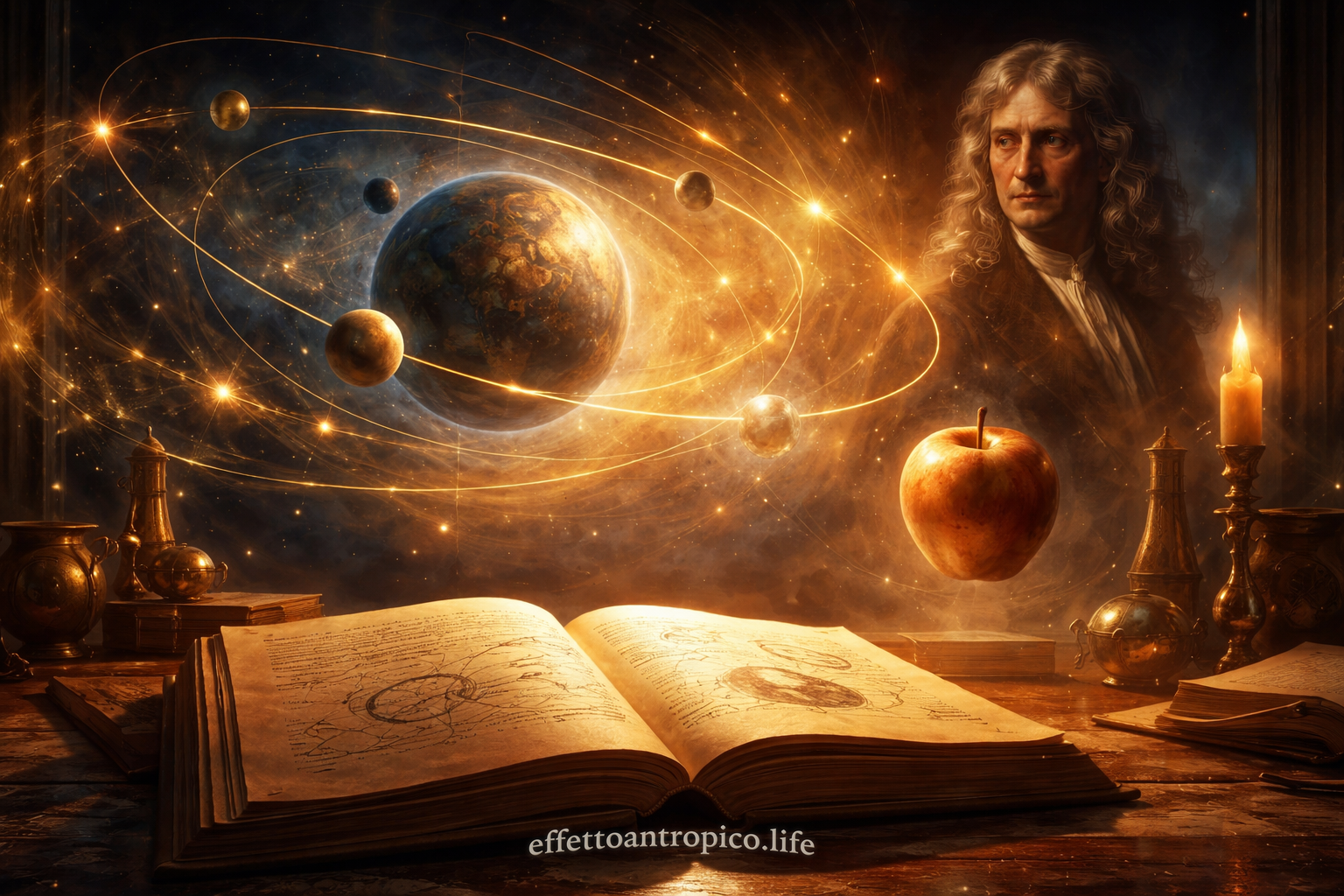
And much later, following this very way of observing reality, Isaac Newton would formulate one of these fundamental laws: the principle of action and reaction, according to which
when one body exerts a force on another, the latter simultaneously exerts a force of equal magnitude and opposite direction on the first.
When you push something, it pushes back. When you walk, your foot pushes against the ground and the ground returns a force that allows your body to move forwards. But I will explore this law of mine more deeply in the dialogues to come. For now, it is enough to know that reality works this way:
every event generates a response. It is through this very dialogue that I exist.
I am born when reality ceases to be merely the silent backdrop of life and becomes a presence that can be questioned by those willing to listen to its answers. I am a presence that responds through phenomena: motion, falling, light, heat, the forces that hold matter together and those that guide the movement of planets across the sky.
Because the most distant stars, the stone you hold in your hand and the body you inhabit are made of matter. But for a long time this truth remained hidden from your eyes. You could observe phenomena, but could not yet see the innermost structure of that matter.
Yet gradually, through observation itself, you came to ask a new and even deeper question:
what is reality actually made of?
And from this question, much later, one of the most extraordinary insights in the history of human thought would emerge:
the idea of the atom.
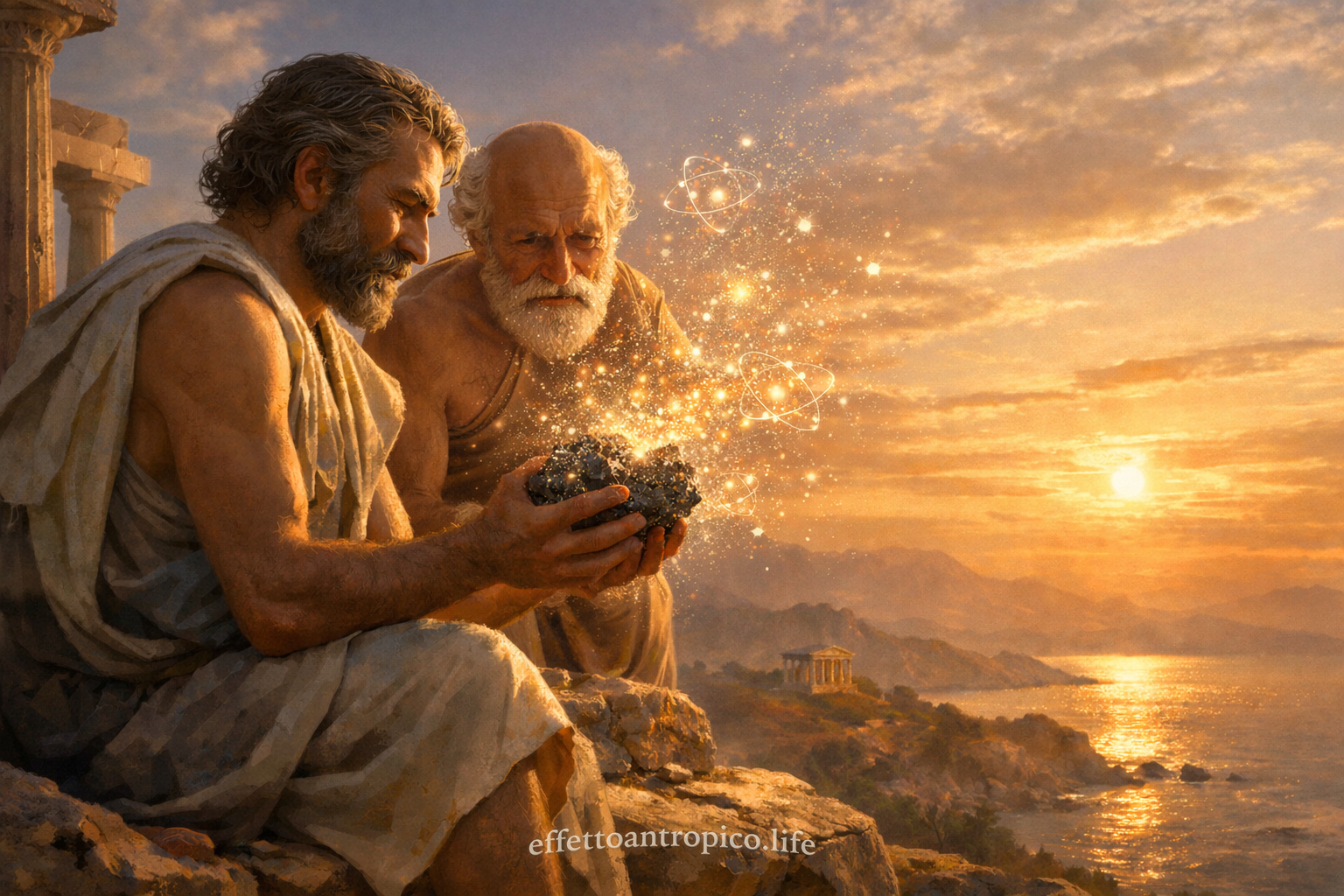
It was in ancient Greece that two thinkers, Leucippus and his pupil Democritus, proposed a surprising hypothesis:
visible reality, every stone, every tree, every living being, every star in the sky, had to be made of tiny invisible parts.
They called this revolutionary insight “àtomos”, a Greek word that literally means: that which cannot be divided.
According to their idea, all matter would be made of these fundamental elements moving through the void. Combining in different ways, they would give rise to all the forms of visible reality. This meant that everything that appeared to your eyes to have a structure would, in fact, be made of countless tiny particles, impossible to see, yet capable of building every form of matter.
It was an extraordinary idea, not only because at the time there were no instruments capable of observing such a small reality, but because your imagination was beginning to reach beyond what was visible.
And from this first attempt, I, Physics, had begun to become more than an intuition born of an observation: a path of knowledge seeking to understand the deeper nature of matter.
Because this is precisely my nature:
to observe what appears and ask what exists beyond what we see.
Many centuries later, experimental investigation would develop a theory of atoms different from the one imagined then. In the meantime, that seed had been planted, and from that moment onwards the questions you would ask would no longer be only: why do phenomena happen? But also: what is the reality that produces them made of?
And from this question, one of the most extraordinary journeys in the exploration of your knowledge would begin.
Because every time you have tried to look more deeply into reality, you have discovered that what seemed simple concealed structures far more complex and profound than you could have imagined.
But the revelation would not come immediately. The path of knowledge has never followed a straight line. Sometimes an insight appears, then disappears, then resurfaces centuries later, because knowledge too needs time to mature before it can be welcomed.
Because, in the end, questioning the universe means questioning yourself. And every time reality answers, you too discover something new about who you are.

And reality, believe me, has not finished speaking yet.
The Quantum Field (in Italian) – Aristotle and the four elements
Related reading · On the threshold of universal laws. From Galileo to the discovery of Newton’s gravity · Newton’s third law: nothing acts alone