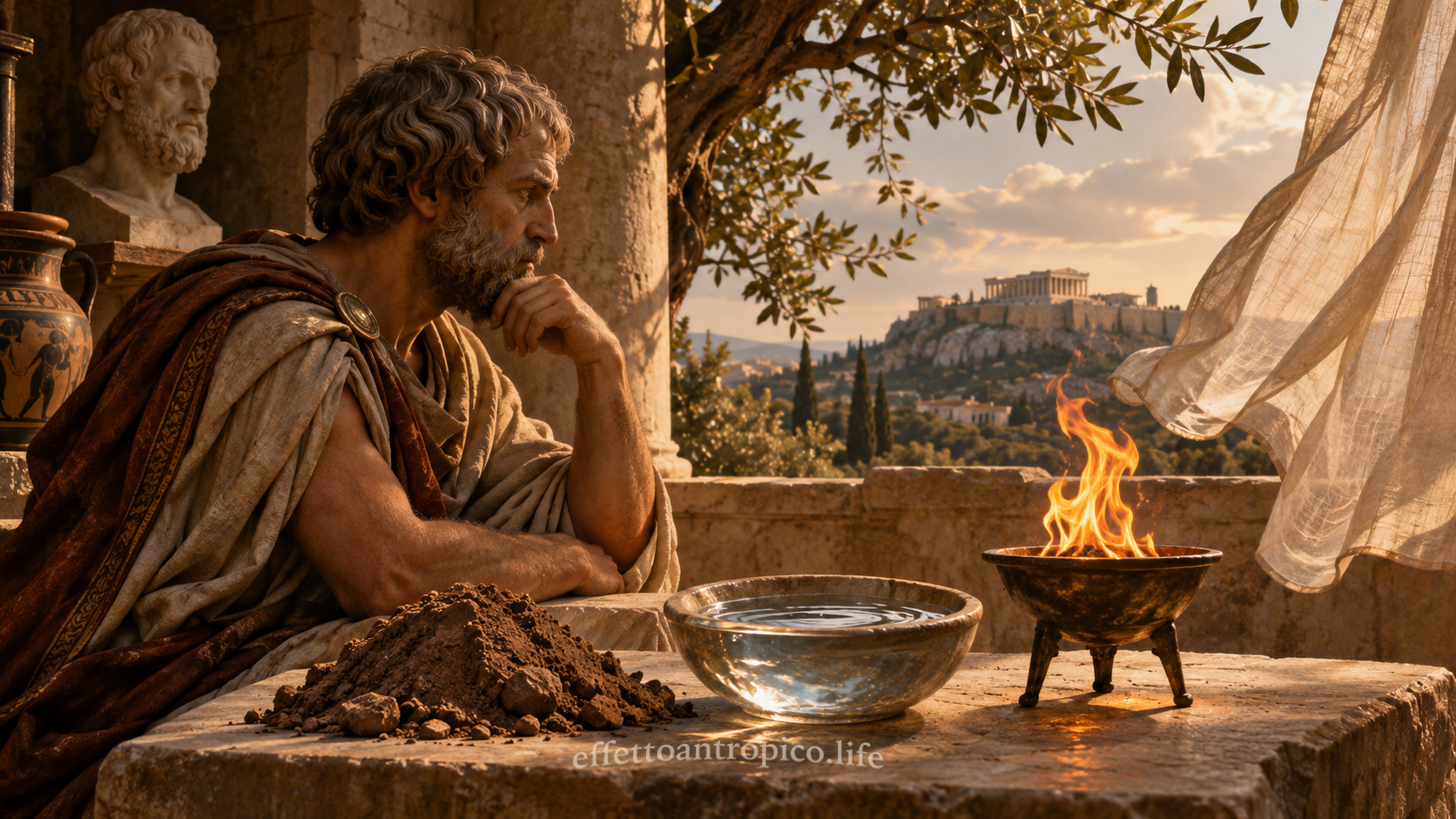
Aristotle and the four elements: when matter seemed to tell a different story and the atom fell silent
Aristotle and the four elements. The long silence of the atom. When knowledge was lost.
There was a time when humanity had already come close to one of the deepest insights into the nature of reality. Human beings had imagined that everything that existed was part of a tiny world invisible to their eyes. That insight had grown from a bold question: what if matter were made of fundamental elements? Leucippus and his pupil Democritus had given that possibility a name: “Átomos”, that which cannot be divided.
But the history of knowledge does not always follow a straight path. Sometimes an idea appears too early, in a world not yet ready to understand it.
And so, while “atomism” remained a philosophical suggestion difficult to demonstrate, another vision of reality slowly began to take shape.
A more orderly, more systematic vision, formulated by one of the thinkers considered among the most influential in the history of human thought: Aristotle.
And with him, matter began to take on a different face.
I have passed through many ways of seeing over time.
In the fourth century BC, one of those ways of seeing belonged to Aristotle, a thinker who sought to understand the nature of the world and, through it, me as well, by observation and reflection.
Unlike Democritus, Aristotle did not imagine reality to be made of tiny indivisible parts. In his way of reading me, matter was continuous: it could be divided again and again, without ever reaching a final, fundamental element.
To explain the variety of things that existed in the world, he built a simple model that was extremely convincing for its time, capable of bringing order to what human beings observed in nature.
According to Aristotle, I took shape through the combination of four fundamental elements: earth, water, air and fire. Each of these elements had specific qualities. Earth was heavy and stable, water fluid and adaptable, air light and mobile, fire hot and upward-moving. Mixing in different proportions, these elements gave rise to all the substances in nature.
It was a vision that seemed to explain the world with great clarity and simplicity. You only had to observe what happened around you to recognise those principles at work. Earth falls downwards, fire rises upwards, water flows and air fills every space.
To your eyes, nature really did seem to behave according to that order. So, through Aristotle’s thought, I was interpreted in that way for centuries, and that model became the most authoritative way of reading me and my transformations.
But Aristotle’s gaze did not remain fixed on the Earth for long. At a certain point, he turned his eyes towards the night sky, and there he saw something that seemed to tell a different story. The stars and planets did not appear restless and changeable like things on Earth. They moved with a regularity that seemed perfect to your eyes, tracing circular orbits that always returned along the same paths.
It was as though, up there, my fabric followed an even purer order.
And to explain that difference, Aristotle imagined that, besides the four elements you already knew, there was a fifth. A subtler, more stable, more incorruptible substance. He called it “aether”.
In his vision, the heavens were not made of the same matter as the Earth. Celestial bodies did not come into being, change or deteriorate like everything belonging to the earthly world. They were made of aether:
a pure, eternal matter, capable of moving without losing its perfection.
Thus the universe took shape as a great, ordered architecture: a changing Earth at its centre, made of the four elements transforming and mixing with one another, and above it a perfect heaven, made of aether, revolving unchanged through time.
For many centuries this vision appeared harmonious and convincing. And through that way of seeing, you continued to interpret me and the order of the cosmos in the same way.
And so I passed through Aristotle’s gaze as well.
His thought appeared elegant and powerful, not only in its philosophical form but also in its ability to bring order to the world you observed. In his vision, the Earth seemed to be a complete system, formed by the balance of the four elements and surrounded by an even purer substance inhabiting the heavens: aether.
Through that gaze, I was read in that way. That vision of the elements was adopted, taught and passed down for generations. Philosophers, scholars and medieval universities continued to consider it the most authoritative key to interpreting nature.
And so the idea of the atom proposed by Democritus also met with criticism, including Aristotle’s, and was further developed by other thinkers, such as Epicurus and Lucretius. In the centuries that followed, however, the Aristotelian view became an authoritative way of interpreting nature.
Atomism lived on in some traditions of thought, while the Aristotelian vision, closer to what your eyes could observe and understand, continued to guide the way you interpreted matter.
Reality seemed to be made of continuous elements transforming into one another, maintaining a balance among the fundamental qualities of the world. It was an understandable, visible, reassuring order.
But while this idea guided human thought, the deeper structure of matter remained hidden.
I was still there.
Silent.
Waiting for someone to find a way to look deeper.
Knowledge does not follow a straight path, and often what begins as an insight in one age falls silent for centuries, only to re-emerge with new strength when your gaze is ready to understand it.
The idea of the atom was precisely this. An insight born at an extraordinary moment in the history of thought, but still too young to be fully welcomed.
A time when you were deeply connected to the foundations of existence, and insights arose from the simplicity of observing the nature around you: a living, immediate nature, pulsing with presence.
Yet you did not yet have the tools to look inside me, inside the very matter of which everything is made. And so that insight remained suspended in time.
Yet reality, with or without tools available, had never stopped holding that answer.
Within every stone, within every drop of water, within every fragment of light, I continued to exist exactly as I always had.
That question would continue to travel through time until it met new tools and new forms of inquiry. In time, my silence would find its voice again. Because I have never stopped being here. I have simply waited for your gaze to learn to seek me again, by asking the right questions.
The birth of physics – The Quantum Field (in Italian)

Related reading · On the threshold of universal laws. From Galileo to the discovery of Newton’s gravity