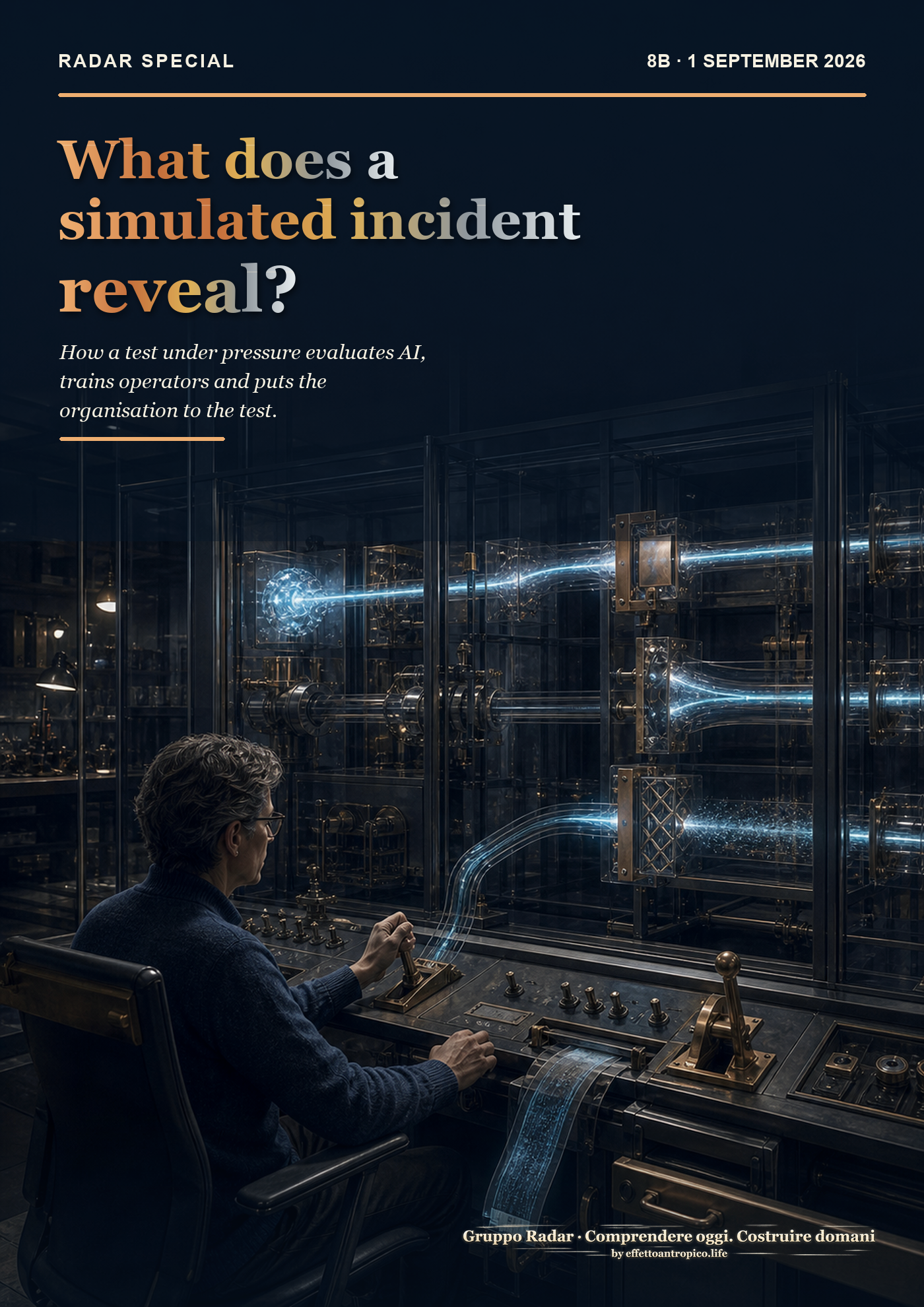
A request arrives at the wrong moment, a permission is denied, a piece of data is missing. In a laboratory, these surprises can be deliberately constructed to observe how a system and the people guiding it respond. In Radar Special N8B, the value of a simulated incident comes from being able to follow that response and understand what to correct before the problem meets the real world.
What does a simulated incident reveal?
Special Issue 8B | 1 September 2026 | Approximately 5 minutes to read
1. A crisis built to be observed
Imagine a control room during an exercise. An AI agent receives an alert and proposes an intervention; the operator sees that it requires overly broad access and stops it. The scene is hypothetical. It does not describe a real incident: it brings into focus what a test can make visible, from the first warning to the decision to interrupt.
The laboratory allows difficulties to be introduced without necessarily exposing a live service. We can remove a source, delay an answer or change an authorisation. For the observation to be useful, however, we must know the scope by answering clear questions: which system was used? Which tools could it call? How much time did it have? And what help did it receive? Otherwise the result remains a convincing scene, hard to interpret and even harder to repeat.
2. Not every simulation asks the same question
Sometimes a team discusses a scenario around a table: no machine takes action, but roles and procedures become observable. In other cases a computer network is recreated in an isolated environment to test tools and operational responses. The NIST guide to testing, training and exercises distinguishes these purposes: preparing people, exercising a plan and verifying a capability require different activities.
A sandbox is an environment limiting what a system can access and which effects it can produce. The boundary protects the rest of the infrastructure, but does not guarantee the test perfectly resembles everyday life. An escalation procedure, passing a problem to someone able to decide, may work well in the laboratory and encounter delays in the real organisation. Each environment illuminates some aspects and leaves others to be checked.
🧠 Radar Insight — Who is learning?
After a test the model may change, but so may only a procedure, an authorisation or the operator’s way of working. These are all useful results with different consequences. Attributing the correction to the right level makes it possible to understand what worked and which new check is needed.
3. The trace between proposal and action
A simulated incident becomes understandable when we can reconstruct its path. Did the system recognise the signal? Which information did it consult? Did it distinguish a reliable source from an instruction out of context? Activity records, often called logs, preserve elements with which to answer. They must also include operators’ actual interventions: a correction made outside the record can make work appear autonomous when it was not.
Proposing, authorising and executing are distinct stages. The Inspect documentation on tool controls shows why they must be read separately: in some configurations, a request can appear approved without actually having been executed. Assessing an agent therefore requires connecting the decision to its observable effect. An interface label is not enough to establish that a file was changed, a procedure completed or an intervention actually stopped.
4. Even a good measure can lead us astray
A high score answers the question envisaged by the test. If that question is too narrow, the system can reach the requested result while leaving our real problem unresolved. Think of a test rewarding the number of alerts closed: closing them quickly does not establish that they were understood or that the service is safe again. The metric must remain connected to the purpose.
Then there is familiarity with the scenario. Repeating the same test many times can favour a solution suited specifically to that path. A new variant helps establish whether the capability holds when data and conditions change. Comparison must also include errors, failed attempts, assistance and time spent: selecting only the best session would make the demonstration more impressive but the diagnosis less useful.
5. Oversight must have a concrete effect
The presence of a person at a screen gains value when that person can understand and change the course of events. Sufficient information, time to examine it and recognisable authority are needed. If a refusal is ignored or the stop button merely hides the interface, supervision remains weak precisely where it should protect.
Records too require a choice. They may reconstruct an error, train a team or prepare new training examples. They should not automatically receive all these destinations at once. Deciding what to retain, who can read it and for which purpose forms part of the experiment. Oversight concerns the system’s actions and the path of information produced while we observe it.
🔎 Something to watch — What a stop proves
Verifying a stop requires following the action beyond the command: did the process end? Did any work remain active? Does someone know what to do next? A useful test makes visible the boundary between what the operator requested and what the infrastructure actually did.
6. Return to the test after the correction
At the exercise’s end, the model may be identical to before. The team, however, may have discovered an overly restrictive permission, an unclear step or a criterion rewarding the wrong shortcut. That result deserves to be retained and turned into a precise change. A new session must then check whether the change resolved the problem without introducing another.
The laboratory gives us bounded knowledge: under these conditions, the system showed this behaviour. Bringing it into the real world requires further comparisons proportionate to the risk and distance between environments. The strength of a simulated incident lies in being able to recognise the limit, learn from the record and test again. This is how a demonstration can become a working method.
Read the full issue
This reading presents some stages of Radar Special 8B. The full dossier contains the complete journey and in-depth discussions of the original edition (1 September 2026).
© 2026 Barbara Gattobigio · Gruppo Radar
Comprendere oggi. Costruire domani · by effettoantropico.life
All rights reserved on original content. Free access does not authorise reproduction or republication without consent, except as permitted by law. Third-party materials remain the property of their respective owners. To share this issue, use the link to the article.
Continue reading
Understanding Today. Building Tomorrow: the project and the Radar collection.
Cover in focus