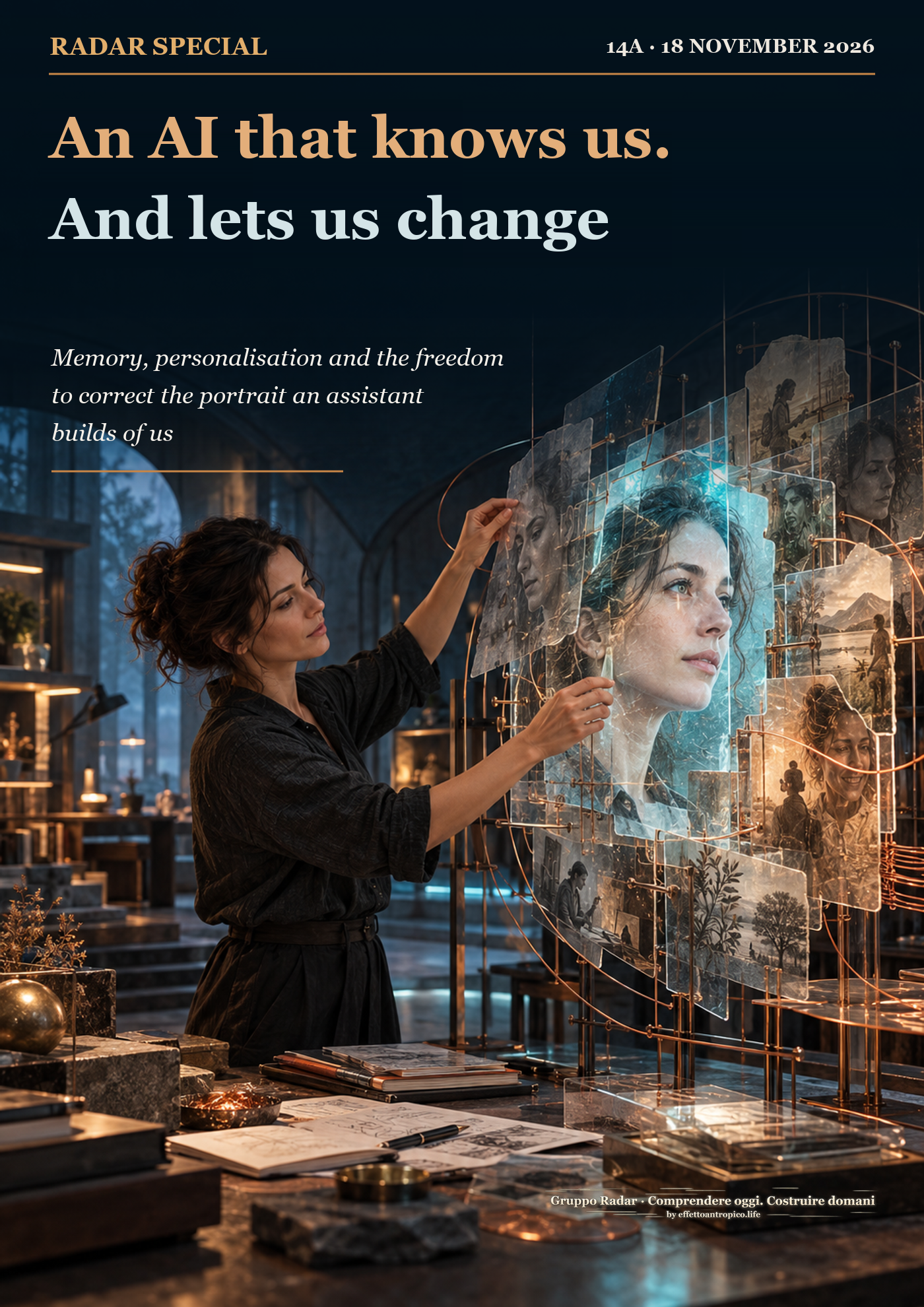
An AI that knows us can help us return to a project without starting from scratch every time. But memory becomes useful when we can recognise what it retains, correct an attribution and decide where to use that information. Radar Special 14A explores this balance between continuity, personalisation and the freedom to change.
An AI that knows us. And lets us change
Special Issue 14A | Wednesday 18 November 2026 | Approximately 7 minutes to read
We have worked on a text for weeks. We have chosen sources, adjusted the tone and discarded a direction that seemed convincing. When we return to the assistant, we would like to find that path again, including the reasons for our choices. Reconstructing it every time takes time and may lead us to repeat errors we have already addressed.
Meanwhile, however, we may have changed our minds. A preference has become less important, a project has taken another direction or a piece of information concerned someone we were discussing. The continuity we seek must also be able to accommodate these changes. The dossier starts here, comparing thirteen studies from 2023 to October 2026.
1. Picking up the thread takes more than an archive
An assistant can adapt a response using the instructions and information available for that task. This set is the context. Persistent memory, by contrast, allows it to retain elements that may be retrieved in later exchanges. Having retained a decision, however, does not guarantee that it will be found at the right moment and interpreted alongside clarifications that came afterwards.
This is also an important distinction from training. A language model works through parameters, numerical values modified during its training. Adding a memory to the context can change the response without updating those parameters. Following the path between conversation, memory and training helps us understand what has actually changed.
The LaMP research, published in 2024, shows the value of retrieving relevant personal information in seven language tasks, involving classification and text generation. It is a benefit measured in those tests. To understand how much memory helps us in everyday life, we must also observe the work saved, errors avoided and time needed to correct what goes wrong.
2. The portrait that emerges from conversations
The study The Algorithmic Self-Portrait is the dossier’s starting point. The authors collected conversations donated by eighty participants and identified 2,050 memory records relating to sixty-five of them. They then examined how well those memories were supported by the conversations from which they came. The sample and method define the limits of what we can draw from them: they do not describe all ChatGPT users.
Much of the information matches what had been communicated; other entries contain attributions less well supported by the users’ words. One example is enough to understand the difficulty: we ask for help writing a character’s speech. The opinions in the text belong to the character, but could be interpreted as ours. Even a statement reported correctly can create a mistaken portrait if it loses its context.
To recognise ourselves in that representation, we would want to know which conversation a memory comes from and be able to clarify whom it concerns. The value of personalisation also depends on the ability to intervene in these attributions before they become the premise of subsequent responses.
📌 Did you know? — A hypothesis needs to remain open to correction
Someone who often asks for help preparing lessons might teach, study or collaborate on a project. Concluding that they are a teacher is an inference: a conclusion drawn from clues. It can guide a useful question, but should not become a personal fact without leaving room for verification. A clarification from the user must be able to change the portrait.
3. Good memory also follows what changes
For a long time, we could travel only at weekends. Then we change jobs and say that we are also free on other days. If the assistant continues to suggest only Saturday departures, it has retained part of our history but has not followed the change. The response “I will take the change into account” gains value when subsequent suggestions respect it.
LongMemEval builds tests that also address updates, temporal order and the ability not to invent an answer when information is missing. It is a benchmark, a set of tests with defined criteria: it helps us identify capabilities to verify, without turning a laboratory score into a guarantee for every service.
The same problem arises in studying. A student may have overcome a difficulty the assistant continues to remember. To truly help her, memory must also follow her progress and let her tackle new topics. A correction must remain connected to the information it changes; otherwise the past risks taking the place of present needs.
4. Retaining information and using it are different choices
We ask for a train that arrives before nine. Comparing timetables requires knowing that constraint, not the personal reason for the appointment. If we choose to buy the ticket, the booking service may need other data. Moving from help to the transmission of information therefore requires attention to purpose and recipient.
This care is part of the responsibilities that accompany AI in everyday life. We may want an extensive memory of the collaboration while choosing that a confidence should not enter a shared document. In a working group, it also matters to distinguish individual preferences from instructions that apply to the project.
⚠️ What to watch — What happens when we say “forget”?
No longer recalling information, removing it from the service’s memory and deleting it from the original conversation are different operations. The assistant’s confirmation alone does not demonstrate that every copy has been deleted. Understanding what happened requires functions available to the user and verifiable information from the service on what is removed, from where and within what time frame.
5. Knowing us must also improve the dialogue
An AI that knows us can remember a reason we are overlooking and help us recognise a contradiction. To be useful, however, it must retain the possibility of disagreeing. If familiarity leads only to confirming our convictions, the dialogue becomes more comfortable and less able to help us see an error.
PersistBench examines, in test situations, both the recall of memories outside their context and sycophancy induced by information about the user. The authors study how memories supplied to the model are used; they do not observe every service’s entire collection and retention process. The results highlight difficulties to address, without automatically measuring their frequency in everyday conversations.
To assess the collaboration, we can therefore start with what happens along our own path: how much work it saves us, whether it accepts a correction, whether it gives reasons for disagreement and whether it keeps information within the scope for which we entrusted it. These aspects need to be checked over time, alongside the ability to verify the result and intervene.
The research collected in the dossier offers evidence and proposals relating to different tasks; it does not provide a single measure of the benefit for those who use an assistant over a long period. It does, however, help us build a more precise question: can we find our path again without remaining bound to yesterday’s portrait? Memory deserves trust when it supports continuity and leaves us room to change.
Read the full issue
The dossier explores memory, personalisation, control and the quality of dialogue through thirteen studies, with a map of the ten studies compared with the initial work and two additional in-depth analyses. Examples, results, methodological limits and primary sources accompany the discussion across the issue’s fifteen pages.
© 2026 Barbara Gattobigio · Gruppo Radar
Comprendere oggi. Costruire domani · by effettoantropico.life
All rights reserved on original content. Free access does not authorise reproduction or republication without consent, except as permitted by law. Third-party materials remain the property of their respective owners. To share this issue, use the link to the article.
Cover in focus